|
NATIONAL SALES MEETING AGENDA Table of Contents |
|
|
Frontiers of Progress Expanding Frontiers Resources for Expansion Planning the Expansion Resources for Development Crowding the Frontiers Planning the Breakthrough Applying the Resources |
The End Results Resources Behind the Scene Behind the Scene Activity Knowing the Ground Rules Applying Your Knowledge It Resources in the Field Where's the Pay-Off? Here It Comes Challenging Frontiers Our New Challenge Frontier Off -Shore
|
|
Table of Contents (cont) |
|
|
Off-Shore Sales Barter with Other Tribes New Mother Lodes Acres of Diamonds Scalp Counting The Great White Father Broad Frontiers
|
Far Frontiers and Outposts Near Frontiers Back at the Ranch Frontier Service Prospecting There's Gold in Them Hills II A PORTRAIT OF THE COMPUTER DEPARTMENT III ACTIVITIES
|
|
Official Picture, 1961 National Sales Meeting
|
|
|
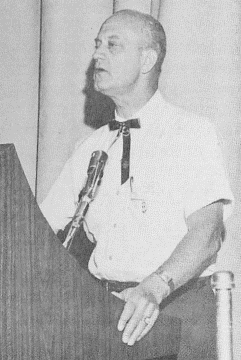
RONALD REAGAN
Hello: I'm Ronald Reagan speaking for General Electric. At General Electric, you know, "PROGRESS IS OUR MOST IMPORTANT PRODUCT". But, all progress must have a starting point. All great human enterprises begin at a frontier. The pioneering of hostile lands. ..the mushrooming of the Atomic Age with its mixed blessing of destruction and construction. ..the rolling back of space frontiers beyond the planets to the stars. ..and the beginning of the information-handling revolution. ALL these had -a common starting point --a frontier of PROGRESS. Webster has defined a frontier as: "An advanced or not fully explored region." That is an almost perfect description of where the computer industry is today--in an advanced or not fully explored region. The broad expanse of this region is almost limitless.
General Electric Company, with its tremendous resources is continuing to invest in the exploration of this region through accelerated improvements of its present products and their related facilities, and through added research and development. General Electric recognizes the computer business is an exciting frontier. The traditional pioneering efforts of the Company in this field have already resulted in dramatic new technologies. Many of you are undoubtedly aware of the Company's major contributions--such as solid state computers and magnetic ink character recognition techniques. But---where and when did the exploration of this information handling frontier begin? Who initiated it? Was it the business machines manufacturers? Was it the Federal Government? Was it in 1954 when the first large scale. ..electronic computer system for business data processing was installed by General Electric. ..at Appliance Park in Louisville, Kentucky? The answer to these questions is, of course, NO. It was GENERAL ELECTRIC COMPANY. But the year was 1920! That was the year that General Electric engineers developed the first practical electric computer in the entire industry --a D-C calculating board. This computer reproduced in miniature hundreds of miles of transmission lines in vast power networks. Forty-one years ago. And, over the years General Electric has continued to acquire more computer systems know-how through wider scope of applications than any other organization. Forty-one years. That was a long time ago- beyond the memory of many in this audience. 1920---It was the year that Babe Ruth joined the Yankees--as a pitcher and hit 54 home runs... The year the 19th amendment permitted women to vote for the first time --and the 18th amendment closed man's last haven: the corner saloon! Man 0' War was a three year old--winning $166,140 for his owners that year!. ..and, the hopes and prayers of a war-weary world were pinned to the League of Nations first meeting at Geneva, Switzerland. It was the year when some of General Electric's top salesmen wore dresses. ...and bared their charms to a cold frontier! It was the year that General Electric first penetrated the computer frontier and inaugurated the information handling revolution. As Victor Hugo so aptly puts it in his "Les Miserables": "Would you realize what revolution is, call it progress: and would you realize what progress is, call it tomorrow. " As the 20' s rolled by, General Electric engineers continued exploring the frontiers, while its salesman was already carrying the ball. Then came the 1930's---and another step forward into the frontiers of computer progress. General Electric announced the A-C Network Analyzer--resembling a telephone switchboard in appearance, the machine was built before the mathematics were available, and from this computer came the mathematics that ultimately explained to the systems engineer how his transmission system really worked. These were the Gershwin years and General Electric was pioneering many other new ventures. Now---our salesman---was also beginning to be known. And... the frontiers were becoming more challenging. Prior to World War II--about 1938--GE engineers and scientists developed a differential analyzer for use in the study of Radar, rotating machinery, and airplane stresses. They were the only practical computers available to the United States at the start of World War II. During the war, the computer-control systems
1 |
|
| developed by General Electric for the B-29
were so accurate that fire control far exceeded that of any previously
developed plane in this country or abroad.
Following the war---while reviewing the past of those hard-sell years General Electric pioneered many computer frontiers. They were using differential analyzers at White Sands, New Mexico to obtain trajectory data for firing V -2 rockets. There was OARAC, a specialized development for the U. S. Air Force. Then came a "Robot Psychologist", known as a Psychological Matrix Rotator, developed for the Department of Defense. It is still used to literally "see" that the right man gets the right Army job. And, during the Korean War, many additional specialized computers were developed by the Company for controlling flight and gunfire of speeding jet planes during combat. It was not until late 1955, however, that General Electric decided to concentrate its computer activity into one component. At that time, some 200 engineers through-out the Company were pioneering in both development and applications of computers. At about the same time, the Bank of America and Stanford Research Institute were winding up a five-year development effort designed to give the Bank an Electronic Recording method of accounting. They called it ERMA. They had successfully developed a crude prototype machine that proved the feasibility of processing bank checks with magnetic ink character recognition techniques. But much still remained to be done. The Bank of America needed a top manufacturer to refine the complex and cantankerous prototype into a workable, practical electronic system. The Bank of America was also knocking at the frontiers of progress. What they did here is a remarkable story. Let's listen.
This is the story of ERMA and Seth Clark Beise. He heads up the Bank of America. This bank has been around for a long time and seems apt to be around for a long time to come. For Seth Clark Beise is a good businessman and here in 1949, the bank is doing well, --it gets more business each year. Seth Clark Beise frets a little. He knows he still lives by the good sound business principles that built Bank of America up to the largest bank in the country. Of course, he doesn't like the uncontrollable factors that face every banker these days --such as rising labor costs, climbing material costs, soaring equipment costs---but he figures that he can live with them as well as his competitors can. This morning, he had listened to a presentation by a Business Machine manufacturer. Seth Beise listened carefully, but after 30 minutes, was sure Business Machines Manufacturer could not satisfy his needs. I am the Spirit of Computers. There is a better way to up-date your business methods. There are great advances coming, in electronics -Mr. Beise -in electronics -which you can use in your business. Come with me into the future---l0 years. from now---in 1959---listen to your Vice President and executive officer for operations. Come with me into the future --and listen to Frank M. Dana. Soon after the close of World War II, it became evident to us at Bank of America that a better tool must be developed to help us process the steadily increasing volume of paper work flowing in and out of our branches every day. The need was most acute in the area of commercial bookkeeping -the Checking Account. To solve our paper work problem, we looked for a system which would operate at a higher speed than anything known at that time ---be completely accurate eliminate routine and repetitive chores handle all sizes and quality of paper and be economical to install and operate. Electronics offered the most promise in reaching our objective. But this field was relatively new and we felt that neither we, nor the banking business as a whole, could wait for business machine companies to develop this equipment in their normal course. The paper work problem was too pressing. Accordingly---in 1950, Clark Beise, now our president, contacted Stanford Research Institute and told them what we wanted. Their engineers went to work, and in late 1955, completed the prototype ERMA- ---an automated system which could completely process commercial accounts. Satisfied that ERMA was practical and economical, we selected General Electric to adapt electronic developments of the preceding six years and to manufacture the system for us and, through acquisition of our rights, for other banks as well. ! 1 j ! j .
Thank you, Mr. Dana. General Electric got the order and at that moment set into motion a project that took over three years of research, development, engineering and production necessary to turn the prototype into a manufactured working installation. It meant not only the gathering of the the right equipment but also building of a new plant and the expansion of its computer business. The man in charge is Mr. Clair Lasher, General Manager of the General Electric Computer Department. Yes, gentleme!1, we got the order, the largest commercial computer order ever placed--30 million dollars. The chain of events that put General Electric on the track of this order began in the late 1955' s--with a short notice in the Stanford Research Institute quarterly review.
2
|
|
|
An alert General Electric opportunist, well aware of the computer studies underway in General , Electric had circled the notice of ERMA and bucked it to Syracuse. The newly formed Industrial Computer Section was electronified into action.
So a representative was sent to the Bank of America, ---but there were 29 experienced competitors who also recognized the value of the opportunities involved. Let me emphasize here that it was no superman who called on the Bank of America. Rather, it was a confident, dedicated aggressive General Electric salesman---highly motivated to make the Company's new computer business a success---one who recognized that the reward would be worth' the thirty million dollar risk---one who recognized how imp'Jrtant the impetus of this order would be in gaining a foothold in this new market. The Bank of America had already invested more than two million dollars in a prototype. They knew, or thought they knew, what they wanted. While 29 competitors tried to persuade Mr. Beise to change his mind and work with available business machines" because they knew and so did we ---that a complete re-design of the s. R. I. ERMAprototype was required," ---we agreed to -adapt their design wherever we could---without restricting our own ingenuity. The contract did not -mention the S. R. I. ERMA. It specifically called for automating the Bank's Checking account bookkeeping system.
Awarding of the contract was announced on April 25, 1956.
From a four-man team with nothing but office space, ---we had committed the company to a new b'lsiness. Engineering work began immediately in Palo Alto, California, close to the customer and S. R. I. in rented facilities. We built a team of engineers. But we needed space to operate---space to manufacture. It was the beginning of a new General Electric Department. Within six months from the Department's establishment in Phoenix, Arizona, manufacturing was begun in a 50,000 square-foot rented facility known as the Peoria Avenue Plant. One year later, ground was broken for the permanent home of General Electric's new Computer Department. With the Peoria Avenue Plant already bursting at the seams, time was at a premium. Construction proceeded rapidly. It had to. Explosive growth of the Department's business required bringing together the functions which were widely-scattered over a 25-mile radius. The accelerating tempo of the computer business couldn't wait. Before the building was completely finished, administrative personnel began moving in---just six months from the beginning of construction.
The Computer Department is proud of its new building---and justly so. Since its dedication by Arizona Governor Paul Fannin and Department General Manager Clair Lasher, the building has become the home of many computer firsts. We have developed magnetic character reading---the machine readable language that is also eye-readable. In September 1959, we announced the first completely-automated banking system using magnetic character reading --the Bank of America's ERMA system. This is ERMA, Gentlemen, the machine that put General Electric into a.young, vigorous and growing business, which today is valued at I. 5 billion and will reach 2. 8 billion by 1964. Now that the real ERMA is working, she supports herself, and has paid back most of the allowance advanced to her while she was growing up. Largely due to the contributions of this young lady, we are capturing an increasing share of the computer market. Direct spin-offs from ERMA include. ..the GE 210 Computer System, sold to 14 leading banks--an order for automation of another banking function transit, ---and new applications of Magnetic Ink Character Reading. For example, MICR will be used by the General Electric Credit Corporation. Spunoff from MICR, we are in these new product lines encoders, sorters, and re-entry printers. With our medium sized 225 Computer System and our Industrial Computer line---General Electric is now a major factor in the Computer industry---Most important, we have made a major customer happy. Here's what Mr. Beise, President of the Bank of America had to say during a recent press conference. "ERMA is a new concept in banking. Its effects will be far reaching, touching such things as bank architecture and new banking services undreamed of today. Because of electronics, we have an eighteen months' lead time over all other banks in this amazing era. ..thanks to General Electric." Seth Clark Beise is a changed man. His business will be a changed business. He is combining sound business principles with modern business technology through creative, customer oriented selling, coupled with a willingness to accept a business challenge and the attendant risks.
Both General Electric Company and the Bank of America are in the Age of the Computer.
Thank you, Mr. Lasher. The ERMA story represents another milestone in General Electric's march through the frontiers of progress. This 3
documentary of General Electric's 41 years of computer experience has been both exciting and informative to me. It's quite a history. Many more chapters will unfold in the years ahead. Plans are being mandetory to carry General Electric to a leadership position in the information-handling revolution. And now, let's turn the program over to the salesman who life parallels that of the General Electric Company's milestones of progress in the computer industry, Bob Sheeley.
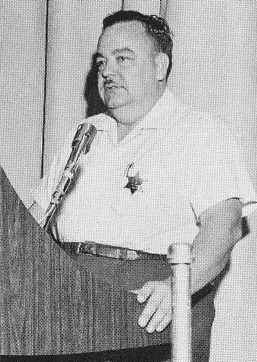
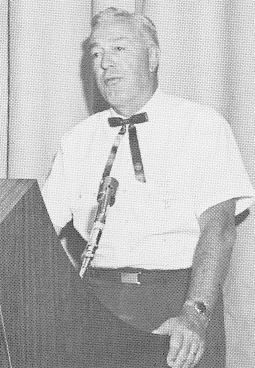
L. R. SHEELEY
Thank you, Ronnie, you have established the theme of our meeting, Frontiers of Progress. We are truly on the verge of a revolution. ...the information handling revolution. The frontier. ..this expanding frontier... is unfolding before us. It is this frontier that we will be talking about for the next four days. Exploring with you the boundaries of the frontier and the many methods and plans available to us to push back these boundaries. The past years can be described as years of change. No one knows that better than you. The future, however, is not static. Change is inevitable in a dynamic industry such as ours. Changes to meet the expanding frontiers. Changes to meet the challenge of competition and changes to meet our volume objectives. As a matter of fact, you should be proud that your organization is capable and willing to make changes. It proves that our department and its management is dynamic. ..flexible. Flexibility is essential in this fast moving business. ..the keynote of success. The ability to move fast and turn around in a hurry. This is flexibility. You will see and hear much in these next few days. ..much that will contribute to your ability to represent the General Electric Company and the Computer Department. You will see examples of our flexibility. ..our ability to turn on a dime. We are sure some of these examples will surprise you. Some may even amaze you. But all are for your benefit. All will contribute in one way or another to the achievement of our and your objectives. We have mentioned the flexibility inherent in a small business. ..the Computer Department. We have not mentioned stability. ..the stability of the General Electric Company. This is a definite advantage that none of our competitors enjoy. The flexibility of a small company with the stability and resources of a very large company. You are going to hear much more on this subject from Paul Chamberlain, our Department's sales consultant.
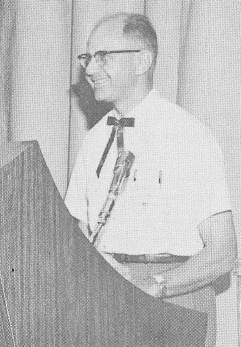
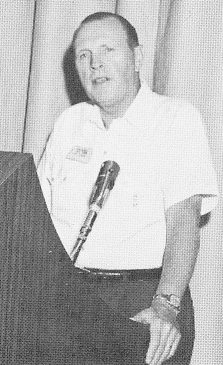
P. L. CHAMBERLAIN
This introduction reminds me of a three day symposium on communications that I attended about three years ago. Bill Merrihue of marketing services opened the meeting by telling us of a friend of his who had a very large, very virile, tom cat. He said that this tom cat spent every night tom catting around the neighborhood and causing quite a disturbance. The friend decided that this could not continue, so he took the tom cat to have him altered. Some two or three weeks later Bill met his friend and said, 'I assume that your cat now spends his evenings at home quietly by the fireside?' 'In which his friend replied, 'Like hell he does, he's out with the other cats every night serving as a consultant~ At which point Merrihue introduced his consultants. So now you know just what a consultant is. Seriously though, I have functional responsibility for advice and counsel in the areas of product and market development, sales and distribution channels, sales incentive compensation plans, guidance to sales managers in the technical aspects of their positions. When I came here in January, Bob Sheeley placed no. I priority on the study of our government sales setup, both at headquarters and in the field. After checking into what we had in place I made eight recommendations which were as follows: 4
1. Transfer responsibility for the general sales activities with all government agencies to the field sales organization. 2. Transfer present Washington D. C. personnel to the field sales organization.
3. Transfer Huntsville representative to the field sales organization and consider Atlanta as the base of operations. 4. Set up separate quotas for government business for each region and each district manager and salesman who has assigned government customers. 5. Set up manpower to cover government customers in all regions. This responsibility may be at least' in part assigned to present personnel, on either a part or full time basis.
I I
6. Realign the headquarters sales unit as follows:
1 senior sales engineer air force 1 senior sales engineer army and NASA 1 senior sales engineer navy and AEC 1 sales engineer special computers and systems and Rand D. 7. Establish an application engineering group in the headquarters sales unit. The original group to consist of: 1 senior application engineer, two application engineers.
8. Appoint an acting sales manager.
These recommendations were approved and some of them have already been implemented. The others are in the process of implementation. Another activity on which I have spent a great deal of time in the last three months has been the planning for this sales meeting. I have already done considerable collecting of information on current incentive compensation plans, both inside and outside the company. This in turn has lead to plans for a rather complete market study and survey about which you well hear more from the next speaker. I have recently concluded visits to a number of sales offices in the central and eastern region. I had a very frank exchange of information and ideas at all locations and I think that you will find some things taking place as a result of this trip. Other field trips are planned for the near future. In talking to many of you in Phoenix over the last several months and also on this field trip, it was quite apparent many of you are new to General Electric or to the Computer Department, or both. I feel that many of you do not fully realize the strength of the General Electric Company, and I hope that during this four day meeting you can align your thinking in terms of General Electric versus other computer manufacturers rather than the Computer Dept. versus other computer manufacturers. -
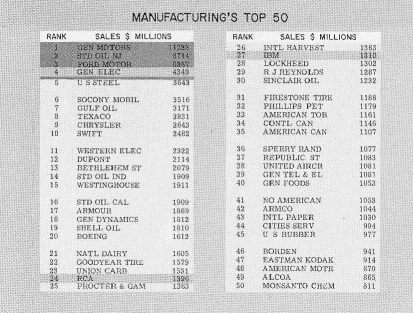
This slide is one indication of what I am talking about. This is a tabulation of the fifty largest manufacturers in the United States. It shows General Electric in the number four position surpassed in size only by General Motors, Standard Oil of New New Jersey, and Ford. In going through this list I fiI)d the next computer manufacturer, RCA, is in twenty-fourth position, while ffiM is in twenty-sewnth place. Sperry-Rand is thirty six. There are no other computer manufacturers in the first fifty and I have not gone further in the descending list to locate the others. So that we all may have an up-to-date picture of General Electric's size and resources, I am going to talk from some slides that were used by Mr. Cordiner at the April 26th share holders meeting in Syracuse. Since the end of World War '1\110 your company has moved from a centralized company to a decentralized modern organization of 113 different business units, each with its own seasoned management team and meanwhile we have developed a sound structure, patterned to fit our five major market areas, consumers, industry, electric utilities, government, and international market in the decade since 1950 we have grown from 129 manufacturing facilities in ninety-eight cities in the United States and Canada to a hundred and sixty eight manufacturing facilities in a hundred and thirty four cities plus an expanding network of manufacturing and sales facilities around the world. Sales doubled in the same ten years growing from two billion dollars in 1950 to over four billion dollars annually in recent years. The physical plant has been almost completely rebuilt mmnwhile at an investment of approximately one billion, four hundred million dollars since 1950. Today our company has the capacity in place to produce at the rate of six billions dollars worth of products efficiently and profitably. But greater than our change from centralization. ..greater than our modernization. ..greater than our growth in capacity. ..is our basic change from a manufacturer of tradition electrical equipment "to one of the most diversified product manufacturing businesses in the world. It is as though we had built a completely new General Electric side by side with the old one. The new one working in the nevI fields of space, atomic energy, of jet engines, gas turbines, electronic equipment, chemical and metallurgical products, missiles and of course, computers. Your company has advanced through this period of radical 5
change not only finareially strong but well able to finance profitable new mentures and with foundations for constant growth in the most exciting new areas of economic development. Today your company is not simply growing within already established industries. It stands at the advanced outposts of the most complicated technologies of our time. There are very few companies in the world that could even attempt to solve some of the fantastic technical problems posed by space exploration or development of nuclear energy, for example. But General Electric can solve such technical challenges and develop new businesses from them I have mentioned the company's exciting new business developments. They are expensive ventures, in some of the mQ) t advanced technologies of our time. But these- are the coming sources of economic growth, new employment and greater profits. They include such advanced technical businesses as atomic energy, fuel cells and other power sources, gas turbines and jet engines for commercial use, computers and information handling systems; automation of industrial, commercial, and government operations; modern electronic components such as transistors, diodes and micro circuits; exploring the business potentials of thermoplastic recording; desalting of sea water, and space vehicles for scientific military and commercial purposes. In addition to the domestic market the international markets are increasingly attractive because they are in many cases growing even faster than the United States markets. In 1960, the company's foreign sales including exports, Canadian General Electric, and foreign affiliates amounted to six hundred million dollars. By the middle of the 1960's, this will be a billion dollar business and that is only the beginning in a world that is electrifying as fast as it can. Today we have plants in twenty-one countries, truly 'the sun never sets on General Electric~ We have a number of basic strengths which will enable the company to rise above the present sales rate. There is, first of all, the strength of our superb body of employees, perhaps the most creative team in history. We have a quarter of a million skilled and productive employees, including 37 thousand college graduates of whom 26 thousand are scientists ~nd engineers. These employees are organized into 113 business departments and the research oriented functional services. Each under the experienced leadership of seasoned managers. Some 01 the departments are a quarter of a half the size of the entire General Electric Company twenty years ago. We have at our disposal 108 million square feet of completely modern manufacturing and laboratory facilities, most of it built or equipped since World War Two. In 1961, 160 million dollars more will be invested to modernize and expand these facilities. Your company has an established market position in every segment of the economy here and abroad including consumer, industrial, commercial and government markets. Thus, it has the channels to establish new ventures quickly and soundly.
General Electric has ample financial resources to develop profitable new markets and product lines and handle any other financial needs that may emerge. The company has, as a consequence of this diversity, a unique capability to produce completely engineered systems, nct merely individual components and products, for industry, electric utilities, national defense, commercial and residential installations and for municipal services. Such engineered systems enable us to sell many of the company's products at one time to the advantage of the customer as well as General Electric. As I mentioned earlier, these slides and much of the accompanying script were lifted directly from Ralph Cordiner's talk at the share holder's meeting. I have taken your time to go over this because properly applied, these customer resources and contacts can be a great source of strength to you in the sale of computers. You have already seen the influence that can be exerted at the proper time by our financial people in the field of banking. In the next few days you will hear from the man who heads up the defense field operation, who will talk to you about the help that they can give in contacts with the government. You will hear from one of our better known Regional Vice Presidents who will discuss their function. And you will hear from the man who directs our advanced management school at Crotonville, from Harold Strickland, our Divisional Vice President and a member of the office of the president. I believe that these people and the other speakers will ;give you a whole new dimension of the company and how it compares with our competition. In closing, I would like to tell you one of the few computer stories that I have run into. It has to do with an old line army colonel of the 306 and bayonet school. It seems that his staff had been trying to get him to consider a computer for several years, but had not gotten very far. Finally, during a recent computer meeting in Washington the staff persuaded the colonel to attend and they eventually got him over to a GE 225 that was on display. And after a good deal of discussion they finally persuaded the colonel to ask the computer a question. The question he asked was 'where is my father?' The answer came back.. .'Your father is in Alaska.' The colonel snorted and said that he knew these machines weren't any good. 'My father is dead.' Wayne Wright who was in charge of the display was quite perplexed, but finally suggested that the question be rephrased to 'where is the colonel's mother's husband.' This time the computer came back with. ..' the colonel's mother's husband is dead, but tell the so and so that his father is still in Alaska. ' 6
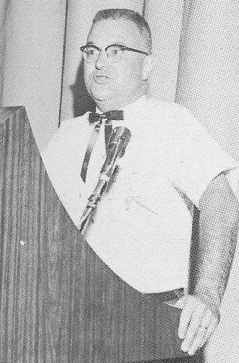
O. K. LINDLEY
As many of you know, since leaving the Eastern Region I have been assigned the job of manager...Sales Analysis and Planning which is a sales subsection function reporting to the manager of sales. So much for titling, and what it is worth. ..what does it really mean. Very simply, it means planning, organizing, integrating and measuring... good old Crotonville poim. " even though I express this as simply it is basic to every detail of this function. As we all all know, the sales organization is a major contributing activity in the achievement of the department's objectives for volume, market position. " that is percent of available... and profitability. The sales objective is to sell the maximum quantity of the product or service through the most efficient sales and distribution channels within the planned selling expense. And since sales volume does not always vary in direct proportion to selling expense, the sales sub-function must determine the relationship of selling expense for various levels of sales volume to be considered by the manager of marketing in establishing volume and permitted selling costs objectives.
Now, let's first talk about sales planning. One part of sales planning involves the formulation of sales objectives, specific plans and policies by product, market and customer required to carry out the over all marketing plans of this department.
Another part involves plans and programs designed to stimulate the selling organization and to keep enthusiasm high. To do this function, it is necessary to formulate sales volumes objectives in appropriate detail, that is, by product, market, trading area, customer, channel of distribution and individual salesmen, if so desired. It also includes the formulating of market participation objectives, percent of availability in appropriate detail, and determining the proper sales approach by product, by market and by customer We must also determine the optimum sales effort manpower, that is manpower and expense, required to meet these various sales objectives we must recommend or changes in sales channels within and outside the department. We must formulate plans and timing for seasonal compaign~, special sales activities, special local promotions, .
timely well planned sales meetings, both at headquarters and in the field and introduction of new product lines and models and product specialists meetings, as well as possible incentive compensation plans. Another important function involves the development of merchandising plans with the help of advertising and sales promotion, as well as integrating the plans of the marketing sub-functions with the sales plans and programs for the department. I believe I have defined and described the sales planning function, now let us talk for a moment in the sales analysis area. Here in this function we analyze the available business and sales results by markets, industries and customers, including location. In order to do this we must evaluate product acceptance and position on the growth curve, and at the same time, constantly be appraising new uses and applications, analyzing competitive practices, determining customer buying habits and trends, appraising selling practices and trends, surveying customers on results of sales campaigns and promotional programs. The data resulting from this sales analysis work is necessary for the development of the sales and marketing plans, including the assignment of manpower, location of field sales personnel as well as recommendations for product planning, advertising and sales promotion, sales and distribution channels, market development activities and sales methods. This sales analysis work, you will see, re quires the necessary assistance from marketing research and integration with product planning studies. So much for what this job function will con tribute in your overall, everyday work assignment. Now, let's take a closer look at what has actually been accomplished, and is underway to your benefit. For the first time in Our department history, and as of January 1st this year, each of the respective three regions had their commercial orders received budget as well as their commercial and administrative expense operating budgets, and since that time, for measurement purposes, the regional budgets have been broken down for each of the districts, both as it pertains to orders received and their C and A operating budgets. As of May 1st the Regional OIR Budget has been increased by seven million dollars. ..1. 5 million to Western. ..1. 5 million to Central. ..and four million to Eastern. This increase represents the government and military portion of our business for 1961. I had to laugh the other day when reviewing the monthly sales report of one of the unit managers who had been traveling the districts recently.' He made the statement to tlie effect that the distrIct people were unhappy with their budget of orders received and unhappy with their operating expense budget. This is a healthy situation and indicates we have done a good job. The report went on to say, however, that they expected to exceed both. By far the majority of the time and effort has been devoted to field 7
personnel work consisting of organization, budgets, placement. When it comes to the placement of people, a few of us back here at headquarters feel as though we have been playing with God, but at the current date there is every indication that the respective regional managers and district managers are now beginning to take over from a recruiting, hiring and placement of people within the various district areas. Since we are talking personnel we should understand that personnel budgeting is fundamentally based on marketing strategy. Therefore, this budgeting wj.ll be done as a part of this function, reviewed with the regional managers, and implemented by all contributing groups. I am sure you will be interested to know that we have started and assigned eight men, representing about a two man year effort, to make a very detailed study as it pertains to both sales analysis and sales planning in our planned prime market area which are. ..banking, electric utility (but not gas utility or telephone) aircraft and missile and federal government (USAF, USN, and non-military) elec trical-electronics, petroleum, chemical, steel and automotive insurance service, research and consulting organizations and computer service bureaus. The main areas of investigation in each of these markets will be: definitions of industry studies, participants in industry factual description of pre.sent information handling needs, present computer applications, anticipated future customer needs, in-dustry as a market for computers, identify important potential customers for computer department. This study of prime markets areas is, as you can see, quite detailed and since the study will be developed to the finest point geographically speaking, we expect the final results to become the basis for better marketing strategy. Better marketing strategy which will accomplish. ..consideration of incentive compensation better placement of personnel, opening of strategic new offices, positive approach for direction of your pre-sales planning and efforts enabling you to properly assign sales responsibility by type of customer by geographic location. Aid in better selection of type of customer you will concentrate on with what product offering. Another example of thoughts and efforts in your overall behalf, you should have received at your regional and district locations by this time, a complete complement of framed pictures for you respective offices. Another small item of annoyance I hope will have been licked shortly, and that is your time clock card reporting. Of course, intermixed in all of this is the individual requests from you respective people in the field, particularly the Regional Managers and the District Managers, wherein you come to either Bob Sheeley or myself for information requiring effort on our part to better enable you to perform your sales functions in the field. You should all reasize that we people back here in headquarters are at all times thinking, working and performing with your uppermost interests in mind, enabling you to do more direct selling, which is your prime responsibility. At the same time, you must realize that whether it be timeclock routines or framed photographs, and because of the fact that many other functions and people are involved it all takes time. If I can, in this small alloted time, impress you to the point that you will leave here and return to respective locations with the factual impression that we are planning and producing for you behalf, then my turn here on this podium has been accomplished.
Yes, we admit that there are any number of things pertaining to personnel, market analysis, advertising, sales promotion, product planning, as well as many other areas which need to be looked into and bettered from your standpoint. We wish to assure you that given enough time and enough pills for blood pressure, metrecal for overweight condition, milk of magnesia for ulcers, these jobs will be done. RESOURCES FOR DEVELOPMENT
L. W. GOOSTREE
How a New Product Is Born
The General Electric Company is in the business of manufacturing and selling some 200,000 different products every working day of the year. The products range from toasters to turbines; lamp bulbs to jet engines; man-made diamonds to plastic table tops. With this gamut of products you may wonder how the company can ever come up with new products. The answer is simple in addition to manufacturing and selling products. The General Electric Company is also in the business of invention. 8
-~
r
r I
General Electric has long been a leader in this industry of invention. According to government patent records it is the most inventive company in the United States and probably in the world. It has more than 30,000 patents to its credit. That is an average of about one patent per day for every single day of the 83 years General Electric has been in business. Today it is almost impossible to glance around you and not see a product in which the General E).ectric Company has had some influence and yet it continually comes out with new significant and sometimes startling products. Let's consider why this is so. .1
Consider, for example, that General Electric spends more money in a year on research and development than it earns in profits. Consider also that of its some 1/4 million employees, more than 37,000 hold college degrees, and that more than 26,000 of those degrees are in engineering and the physical sciences. And then consider that more than 1,000 of those degrees are doctorates. It all adds up to this: in every area of technology and science related to the company's activities. ..whether in nuclear physics or chemistry electronics or metallurgy. ..General Electric is able to call upon a huge reservoir of technical skills and -experience that is unsurpassed in industry. Where are these skills? Many of them are in engineering groups among the more than 113 product departments across the country. Many more can be found in the forty major laboratories throughout the company that are devoted to research and development in many different technologies. In addition, -thousands of specialists throughout the company are showing that savings can be effected, costs lowered, and the conduct of business improved through the application of research methods to engineering manufactur ing , marketing, financial activities, and the company's relations with its employees and its public. All of these activities contribute to new products and new areas of activities for the General Electric Company. The research laboratory at Schenectady is devoted to pure research where scientists are encouraged to explore any area of interest. From this laboratory have come such significant developments as methods for using'Tungsten for light bulbs; the X-Ray tube; Alnico Magnets; man-made diamonds and thermoplastic tape. The General Engineering laboratory at Schenectady is credited with much pf the company's early work in computers, talking movies, electro-cardiograph equipment and thousands of specialized instruments ranging from A as in amplistats to Z as in zymometers. Man-made diamonds is an excellent example of how a product is born. Announced as a research development in February 1955, the making of diamonds was the result of more than four years of intensive research. Examining various materials subjected to combined high temperature and pressure during this research, special techniques and equipment were developed to maintain for the first time temperatures above 5,000 degrees fahrenheit at pressures in excess of 1,500,000 pounds per square inch. Following announcement of diamonds, more research went into the product and little was heard of the results. However, 33 months after the original announcement, the metallurgical products department announced it was in pilot production. During this time General Electric had invested $2.5 million in research and facilities. Today the metallurgical products department is in full production of diamonds for industrial markets. Recently I read where the man-made diamonds were being introduced to the consumer market as needles for Hi-Fi sets. Man-made diamonds is just one example of how research and development has paid off for General Electric. Between the original development and the pilot production, however, much effort was expended in product planning, marketing research, and applied engineering before the laboratory development became a practical and marketable product. A good example of a basic research development which has not yet reached the marketable phase is thermoplastic recording many of you are familiar with it. There are hopes that this development will someday be used in the products you are selling. .. computers. Thermoplastic recording was announced to the press in January of 1960. TPR, as. it is called, is described as a technique combining 'the processing speed and much of the versatility of magnetic recording and the storage capacity of photography while offering some advantages over both of these systems. ~ Initially, the research laboratory, the chemical development operation and the electronics laboratory are working on the special tapes used in the process. The General Engineering Laboratory is investigating applicatIons which could contribute heavily to world technology. And, our own Computer Department Advanced Development Laboratory, as you will hear, is studying applications for computers. The Industrial Electronics Division has been assigned responsibility for developing recording and play-back equipment for commercial application of the new technique. To date, thermoplastic recording is only an infant, and its commercial applications will come about in the future only after considerable development work. The effort will include more basic research, many hours of applied research, much frustration by product planners, arguments among practical engineers, and slowly but surely, products incorporating the development will reach the marketing phase, where you will become involved. We realize, of course, that General Electric does not have a monopoly on research and development. Competition is also becoming more able and 9
more aggressive, and we cannot expect succes$ to come automatically. The paths into the future will be marked by accelerating technological obsolescence, as heightened competition between companies and countries places a premium on the ability to develop new products and processes. However, using previous experience as a guide, the company expects that at least one-third of the products General Electric will be making in the 1970's are now either totally unknown or are simply. ideas in the minds of the men working in the company's forty major laboratories many of these ideas will apply to future products of the computer department. For example, in 1963, 72 per cent of the orders received for business and scientific systems will be' for products not now available. One year later, in 1964, the percentage will have risen to eighty-four per cent. Meanwhile, we will not be forgetting our current product line. We are accelerating innovation and emphasizing better customer values. The computer industry presents a challenging opportunity for General Electric to intensify its traditional innovative efforts, enhance its productive performance and step up even further its competitive vigor. Over the next four days, you are going to hear about the various steps the Q)mputer Department is taldng to assure creative innovation, productive performance and competitive vigor. We are proud of the team we have developed, and are continuing to develop a team that is experienced not only in the evolution of new products and new businesses, but also in taking a pioneering approach to every function of the computer business. We intend to intensify our efforts against major competitors. ..in every phase of the department's activities General Electric is not new to the struggle against major competitors. We have never had the market to ourselves but have always fought hard against some mighty tough odds to become leaders in such areas as the vacuum cleaner market; the major appliance market; and the communication market, to mantion a few. We are going to put up the same fight in the computer market.
Whether we can accelerate or even maintain our present rates of growth will rest largely in getting your wholehearted support and cooperation. Success will depend upon how the market-place evaluates our products and your services. The entire department is with you every step of the way. The products we now have are proven. We have made competition sit up and take notice and in some cases, have made them realize that the top is a slippery place. With the many new plans and products you will hear about during this meeting, we have every confidence that you will help General Electric rise to its responsibilities and opportunities in the computer industry.
CROWDING THE FRONTIERS
Dr. C. F. Spitzer The charter of the Computer Laboratory states that is is this Laboratory's function to supply to the Department new technology and to recommend areas for advanced development. As seen in Figure 1, the Computer Laboratory reports to the Manager of Engineering and its personnel currently represent about 16. 5 percent of the Department's engineering staff. The names of the laboratory's support technical units and their managers are shown on this organization chart. Eighteen personnel represent the technical and administrative support functions. In addition, five employees reporting to other department sections are assigned to the laboratory as local representatives of General Accounting, Materials, and the Patent Operation. The technical staff consists of about fifty. The present distribution of professional training is shown in Figure 2, together with our tentative long-range goal. Operating experience will teach us, whether these goals will require later modification. The currently planned expansion of the Computer Laboratory is shown in Figure 3, At the end of 1961 the total staff should be about 100, and continued growth at about thirty per year would bring us near 300 by about 1970. Figure 4 shows a forecast of budget and overhead rate. With staff increase must, of course, come an increase in physical facilities. Currently we are housed in a 20,000 square feet rented building in mountain view, California (Figure 5). A second rented facility less than 100 feet away, was occupied on May 1, bringing our total space to about 20,000 square feet. Approximately one year from now, our permanent facility in the Sunnyvale International Science Center should be ready for occupancy. Its 36,000 square feet on 5.6 acres of land are designed to accommodate at least 150 personnel, and will therefore be adequate until mid 1963. Space is provided for a computer, and for its service personnel (Figure 6), Total cost for the fully equipped facility will be about $1.5 million. 10
I , It is essential, to frame laboratory projects against the background of product plans, applications experience, product engineering readiness, and manufacturing capability, in order to maintain realistic coupling with the non-laboratory world. On the other hand, it is the laboratory's further obligation to broaden the scope and vision of our market-place oriented organizations. These functions could present impossible tasks to our relatively smaillaboratory, and are made possible only through very close coordination of our own work, with that of othex: company laboratories. This coordination is particularly intimate with the computer system and oriented components of the research laboratory, the General Engineering Laboratory and the Syracuse Electronics Laboratory. Information is freely exchanged, and fairly frequent visits ensure friendly relations based On mutual respect, giving us the confidence that comes from knowing that the research and development strength of the entire co mpany stands behind us. Figure 7 shows, in terms of vis itors to the laboratory, the intimacy of our liaison with Phoenix personnel and with the rest of the company. The trend toward more frequent contacts in unmistal.able, and hopefully it is a sign that, before very long, we will have taken our place among the outstanding company laboratories. We feel pleased and honored that this attention has become as regular pattern, and we sincerely hope and expect that it will continue. The division of our effort is such that about 70 percent of the work is aimed at the satisfaction of -recognizable short... or long-range product engineering needs. The remaining thirty percent are of an exploratory, or research nature. In both categories, we draw heavily on the ingenuity, Imagination and advice of personnel in Product Engineering, Manufacturing, and Marketing, and of others, outside the .Computer Department. We do not by any means believe that only ideas developed by laboratory personnel are worthy of further consideration. It is a widely-recognized observation, that the output of laboratories requires, in general, a considerable Product Engineering effort before becoming a manufacturable product. Indeed, the words: 'another worthless idea, if we had not taken it over' are product engineering by-words known to almost anyone who ever worked in a laboratory. I have, after these many years, arrived at the conclusion that this comment is in reality a significant compliment, on one hand, laboratory projects not ultimately taken over by Product Engineering would, in fact, be worthless to the company. On the Other hand, a laboratory should not carry its developments so far that they require no further Product Engineering. The Computer Labora tory is no exception to this rule, and we attempt to keep the Product Engineering subsections carefully informed of our progress. Every three months we formally present the laboratory's developments to Phoenix personnel, and we receive a return visit of the Product Engineering subsection managers during the interval. Many other contacts outside these formal presentations supplement the information exchange. It is, of course, the function of the Computer Laboratory to serve first, foremost, and above all, the needs of the Computer Department and of the process computer section. However, as frequently pointed out by our Division General Manager, essentially all the Division's work relates to the processing of information. It is to be expected, therefore, that the results of the laboratory's efforts should be made promptly available to the other departments of the division. For example, we have scheduled a conference of the division's Managers of Engineering for next month, to share our latest understanding with them and to learn, in turn, about their own advanced developments and development needs. Conversely, we have much to learn from the computer users in the company: for example, a seminar held last month at our laboratory, of. the company foremost computer experts, has helped us greatly in forming new concepts for future systems. Copies of our monthly status reports go to key mangers, within the division and in the centralized company laboratories. Since the computer field encompasses aspects of all physical sciences, and their related technologies, it follows that the laboratory's work covers a wide range of scientific activities, in its four technical units. The advanced circuits unit actually concerns itself equally thoroughly with materials development, device fabrication, and circuits research typical projects relate to the study of electroluminescent phosphors and photoconductors for display devices and logic elements; thin magnetic films as very fast memory devices; cryogenic materials for potentially very small and inexpensive computer elements; tunnel diodes in novel circuit configurations; and research and development on transistor logic circuits operating significantly faster than any currently marketed computer. The problem of evaluating the systems aspects of new components is assigned to the special projects unit. Their work is concerned with the logic potential, of such new elements as tunnel diodes, cryotrons, lumistors, etc. Components technologies of the future will take the form of integrated electronics, and relatively large circuits will be fabricated in a single sequence of processes. The problem of yield will then be of foremost importance. A small effort is, therefore, devoted to the problem of improved yeild through logic design. Optical information precessing techniques will be of the greatest importance in future computers, and one such system is currently under evaluation. It may have a significant impact on future computer design schemes. The earliest pay-off from any of the computer laboratory's work may be expected from the computer organization unit. This group has already contributed significantly to the department's present product lines, by proposing superior organization concepts. It is highly probable that a far more competitive machine can be designed by approaching 11
r""""
more efficient utilization of all the equipment composing a computer system, than can be done by designing for higher speeds of operation of its components. Two of our projects are therefore devoted to studies related to improved organization. Another effort of a far more theoretical nature concerns the theory of machines. We hope that this work will culminate in a comprehensive understanding of the behaviour of all sequential machines regardless of their codes, programs, or specific organizations.
The peripheral equipment unit's work thus far this year, relates primarily to the general problems in optical character recognition.
Concurrent with participation in the American Standards Assocatiods work on a successor to the ~ 13 B Font, this unit has designed and built equipment to read and recognize characters of the new ASA numeral letter font, both by magnetic and by optical means. Other work is concerned with basic problems in optical pattern recognition, and with the use of thermoplastic tape and slides, as high-density storage media. Even though we have, as an advanced development laboratory, been in existence for only about one year, we have accomplished some noteworthy results, , summarized in the following list:
Transferred Projects Sorter Feeder
Transferred and integrated into Product Engineering.
Computer-Organization Proposed machine organization incorporated in the design of the planned product line.
Electroluminescence
Fabrication know-how communicated to manufacturing engineering, and used in checkout of printed circuit ,boards. Multichannel Reader In process of transfer to Product Engineering. With both magnetic and optical reading heads.
Maturing Projects Cryotrons:
Significant improvement in fabrication technique, circuit design, and logic design.
~
Electro-optical information search machine under construction.
Font Design
Participation in American Standards Association work in defining 'a font tolerant of print defects. Significant Progress List Structures
Better understanding of improved use of computer memories.
Yield Improvement
A small number of redundant elements may dramatically improve the potential yield of high-density mass-fabricated electronic microsystems. Thin Magnetic Films
Equipment almost completed, for deposition and evaluation of memory films.
This listing is not intended to be complete. On the other hand, some of the projects transferred to product engineering are not to be considered anywhere near ready for manufacturing, let alone sale, and considerable Product Engineering effort will be needed to develop them into products. As projects are transferred, time and personnel become available for new work. Future projects being evaluated for their promise include a new method of character identification, novel high speed memories, and studies of asynchronous logic, to name but a few. Most probably, we will give our particular attention to the problem of non-erasable mass memories, with the initial aim of more than 20,000 bits per dollar of shop cost. Other potential future areas relate to studies in the mathematical identification of industrial systems, man-machine relations, process control computer reliability, and redundancy studies. In summary, let me state emphatically that, as a departmental laboratory, our aim is not the advancement of knowledge for its own sake; but rather, to select our projects carefully and in such manner, that we will at all times serve the foreseeable department needs by receiving our direction from the Product Engineering subsections, while trying to meet unforeseeable needs by making our best possible guesses as to where the 'frontiers of progress' may be in future years. In this manner we shall attempt to carry out our responsibility to you today, tomorrow, and in the increasingly successful years to come.
12
r I. 1
"""
)
't
!
,; t t , ;: i ;: ," i !
PLANNING THE BREAKTHROUGH
R. F. BARNES
Gentlemen.. You and I are part of an exciting team. ...Marketing Research and Product Planning. ..A team that is bringing you one complete new computer system each year for three years. ..A team that is producing unique peripherals. ..document handlers, card readers. ..optical character recognition. ..All to make it easier for you to beat Clair Lasher's orders budget. To show better how you and we fit together to make your fut~re selling more effective, I've arbitrarily broken this presentation into two parts. ...Marketing Research and Product Planning. I say arbitrarily, because both these functions must be and are closely tied together. Both are aimed at answering two questions. What will we make? Who will we sell to? Let's answer the second question first: 'Who will we sell to: Wao's selling to them now? And how big is the market? To .bring you aboard our Marketing Research efforts, here's Chet Rice.
7 t I It ;: I
PLANNING THE BREAKTHROUGH
C. T. RICE
McGraw Hill in this year's Annual Economic Report of the Electronics Industry started out by saying, 'Electronics markets will be untouched by any business downturn this year.' 'Not to be outdone by McGraw Hill, Marketing Research is pleased to say that the same applies to the computer market. In fact, we are predicting a pronounced jump this year in computer shipments.
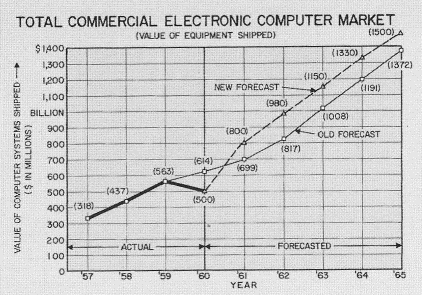
The first slide shows our last year's forecast and our present forecast of the total electronic computer market growth. This shows a 15-20% per year growth rate, which is a rapid growth rate even when compared to other markets in the fast growing electronics industry.
One interesting feature is the dip in the chart which we detected in 1960. This is primarily due to IBM's transition from tube machines to transistorized machines, 2 years after G. E. Originally, IBM planned on shipping out a sizable quantity of 7070's during 1960. Remember, now, that this machine was announced in late '58 and they started taking orders all during '59 for shipment starting in early '60. Unfortunately for IBM, they ran into some serious technical problems with their first production machines and they had trouble getting the first installations working. At the same time, IBM was phasing out of production of their various tube machines such as the 650, 305, 704, 705, 709, etc. Thus, their factory output was seriously down in 1960. Interestingly enough, because IBM has such a stranglehold on many of its customers, the total market actually dipped and those customers waiting for 7070's were not picked up by the rest of the industry.
13
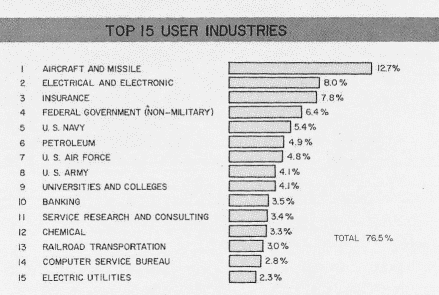
Note also how our forecast goes up in 1961. This is due to expected large shipment of 7070' s, 7080' s, 7090' sand 1400 series. ..all transistorized computers well into production. Now that you have a good picture of the growth rate of the overall computer market. The next slide shows how it splits up into the top 15 user industries. This analysis was done on a little different basis than actual computer hardware shipments as shown on the previous chart in that this one shows cumulative orders received for computer hardware since the computer industry began in the early '50' s thru the end of 1960. Because, by the end of 1960, some orders had been received for computer systems to be shipped in 1961 and 1962. It gives us a little peek into the future, but, primarily, gives us a snapshot picture as of the end of 1960 and does not show the dynamics of each of the individual market. It is true that some markets are developing faster than others, but a similar analysis done two years ago by Jay Greene showed remarkable similarity. Note the rankings of the electric and electronic markets and the banking market.. .Both popular with the Computer Department. ..But also, note that if we had grouped the non-military Federal Government, the U. S. Navy, Air Force and Army into one big Federal Gov't market, it would total over 20 % which makes it the largest customer industry classification .for computer systems. ..and incidentally the pioneer of early computer purchases.
,
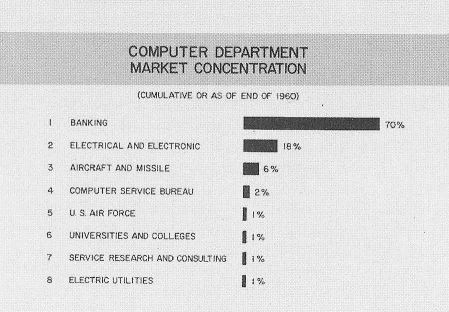
Let's now look at what the Computer Department has done in the market-place. This slide shows how the Computer Department's cumulative orders received have split among user industries. Those 304 computers sold to NCR were not shown since they were subsequently sold to a variety of markets and, therefore, do not show the emphasis of our own sales organization's efforts. I don't believe that it's a surprise to anyone that we have strongly concentrated in the bank market. Electrical-electronic is next because many of our internal General Electric orders fall in that category. Incidentally, don't get the idea that opportunity is anywheres near exhausted in the bank market because a recent marketing research study showed that we have concentrated heavily in the top 180 banks and for these we emphasized the GE 210 for demand deposit accounting. There is lots of opportunity for expanding into medium-sized banks with our 225 and there are many other possible applications that demand deposit accounting. For example, many of our customers are talking of automating a bank's payroll. Now let's turn more specifically to Marketing Research and how we do our work. Let me assure 'you at the outset, that the proverbial crystal ball as a Marketing Research tool became obsolete with the introduction of the computer. Off the record, you might get me to admit that we drag the darn thing out occasionally and dust it off, sometimes, when management asks us a question which the computer can't answer. But our program in Marketing Research is to automate our task of gathering facts and statistics on the ever-changing business environment, so that we can assimilate on a systematic and continuing basis a huge amount of information with a minimum number of personnel. By utilizing a computer, we can constantly store information and then manipulate this up-to-date information when needed. With the possibility of stepping on Rem Rand's toes, we call this' Real-Time' Marketing Research. Through automation, we hope to be able to assist management in making sounder business decisions and formulate better strategies by replacing hunches or preconceived opinions with facts. The slide shows the way information flows in Marketing Research. M:Jst of our input comes from newspapers or magazines plus letters and reports, some of which come from you salesmen in the field. We figure we scan over 10, 000 pages per m:>nth. Out of the initial screening comes a series of clippings which contain information pertinent to the computer market. These clippings vary in size and importance, for example, from the price of the new Philco Model 2400 satellite computer to a whole article from Fortune Magazine on Sperry Rand Corp. These clippings then take one or more of three paths. One is directly into one of our 14 file cabinets. Another path is the Marketing Research Newsletter which is shown on the next slide. I am sure that most everyone here is familiar with' this publication. What we do is publish the first few paragraphs of each of the week's top news stories in the computer and automation fields. We add to this, a keyword headline, which we later index using punched cards. This index we publish and distribute semi-annually. For those of you who don't already get the newsletter, all you have to do is give me your name and address and I'll add your name to the list. I'm happy to add that it's still free! For those of you who already do get the newsletter, I would like to remind you that we accept contributions, particularly clippings from your respective local papers. I especially want to thank Gene Agerton from Philadelphia who is a recent contributor as well as Jim Kessler from the Dallas office. Incidently, we get contributions from other sources too. ...G. W. Alexander up in the Minneapolis ASD office is a faithful contributor and we even got one the other day from J. B. Lanbert in Rio de Janeiro telling about machines bull opening its first office in Brazil. 14 PLANNING THE BREAKTHROUGH
R. F. BARNES
An example of the third and automated path is shown on the next slide. This shows how information flows into our installation report. Information from anyone of three sources is formated and keypunched, providing a punched card which represents a new computer installation. The three sources are (1) magazine clippings or (2) a 'yellow card', and more about that in a moment, or (3) a salesman proposition report, which itself is being automated by Marketing Administration. This one card by itself doesn't mean very much but when this is placed into a deck of cards, each of which contains similar information on many other installations, we have a powerful Marketing Research tool. We have recently put this data through a sorter and had printed up an installation report a copy of which was sent to the manager of each field sales office. This is a l;1andy document and we want you to become familiar with it and use it. For instance, the other day, Ralph Zani wrote me from Boston, stating that he was recently assigned the state of Rhode Island as his sales territory and wanted to know all the computer installations in that state. Although, we don't have everyone listed, we probably do have 75% which is a good sample. In his case, it was easy for him to look up, because we have the data sorted out by state and city. Similarly, Bill Beagle asked for a list of all the computers in the New York City area for N. Y. office. Besides these general requests, we sometimes get detailed requests like a recent one from Jim Kessler. He asked for street addresses for two computer users in Waco, Texas whom we had listed in the installation report. When our information proved correct, Kessler reported that even the local Waco Chamber of Commerce didn't know those manufactures existed~ To keep this report up-to-date and more useful to you, we have provided 'yellow cards' on which to send in new installation information. Tom Horton in Los Angeles has already sent in three 'yellow cards', and I want to thank him a lot for his cooperation. These 'yellow cards' were used to verify some questionable data we had from another source and it was then fed right into the system. As you can see Marketing Research is a two-way street. By feeding our systematic collection system factual bits and pieces of information, we will be able to feed back summarized information which will help to make your sales task easier.
------------------ Thanks, Chet. Now that you fellows are current with Marketing Research, let's look together at the second part of my talk. ..Product Planning. Four important phases for you to be acquainted with are: What we do. .. How we do it. .. Who does it, and a look at future results. To describe what we do, let's look at what good Product Planning isn't.
Customer needs. Here your regular sales contacts are important to point out where a future product change will be valuable. As a Product Planning team member, you can improve our inputs by bringing these to the attention of Product Planning, as well as arranging depth discussions with selected customers, and consultants, as required. Product spects. Here's where customer needs, sales tactics, engineering capabilities, and manufacturing requirements are hammered out by the product planner into function specifications. Product appraisal. Performance, features, attractiveness and cost are compared from the sales and customer viewpoint, Competitive analysis are made on current and forecasted offerings. Timing. For the team, product planning records the scheduling of the major key dates, bringing to the attention of microscopic people how they fit into the microscopic picture. From these schedules, announcement, order taking, and shipment dates of your new products are made available to you. Product line control. Your sales needs for an endless variety of ratings as a standard line are matched against the costs to produce and the probable results. Pricing. Value to your customer competitive levels now and forecasted, costs, sales volume, profit goals, selling tactics are all considered in
15
arriving at those prices which stand the best chance of helping you meet your goals. So much for the work elements of product Planning. Since it's a creative, evolutionary, and a team process, a brief moment on how it all fits into your field selling efforts. Starting at the left, ideas for products. ... hardware and software.. .may come from any place. Three major sources are: One Engineering, including the lab, ideas on how to do a present job better.. .faster, cheaper, more flexible, more saleable.
Two. ...Joint analyses of competitive offerings.. .techniques, features acceptance.
Three.. Sales and customer requirem~nts over and beyond current products. Here you fit in importantly. Promising ideas are then synthesized by the product planner into functional specifications to which engineering, applications, and manufacturing address themselves. The time cycle from specification to a deliverable product includes the type of invention, design, manufacturing required.. .plus, the priority of this new product in relation to others going through the same process. In the computer system .business, headquarters sales tactics determine when, during the engineering manufacturing cycle, the product will be announced and orders taken. On a -planned basis, orders are filled and customers use the product to satisfy their needs. As manufacturers -introduce more and more new products, hopefully to obsolete all but their own products, the product planning management of this team process becomes as competitive as the product itself. The pressures to shorten the process time cycle become as insistent as the pressures for increased product performance. As a member of this new product team, you can markedly improve the output. ..in time and product. . ..of this process by insuring that your inputs and feedbacks get to product planning for evaluation with ~,ngineering, manufacturing, applications, and other sales people. Headquarters backup to keep you in the Product Planning and research flow of information includes Chet Rice, Dick Fay and Ray Washburn, trainees Bob Lyons, Don Graf ( 225), Pete Scola (new computers), and Al Case (optical character recognition and the new document handler) Case Krygsman and Howard Carter (3100, 3101, data communications) Ross Reynolds, Don Falk (Site,) Rod Mead (1000 CPM Reader, ) Archie Watson (TPR), and May Doyle (proof encoder). Part four of my brief talk involves a quick look at our new product objectives. In supporting your present and future sales efforts, new product goals are aimed at increasing volume, broadening line, and creating new growth businesses. In business data processing; we currently have the 304, 210, and 225 computer systems aimed at pieces of the IBM overall line. As a result of close analysis of selected customers, competitive comparisons and in conjunction with Arnold Spielberg's group, and those with Art Critchlow, we have in active planning and implementation a broader market basket. As Lacy Goostree stated, this will mean in the business processing area alone, seventy two per cent of your 1963 orders will be for products not now available. In 1964, eighty four per cent of your orders will be for new products. These new lines (and it will be more than one line) have not yet progressed to the announcement stage. I can say that we are aiming at a line smaller than the 225. ..and one larger. The timing of their availability depends heavily on your current success with the 210 and 225. ..Getting the orders and resultant income so we can afford the major expenditures in new hardware and new software. On peripherals, our objectives are twa to design, manufacture and sell our own products to (1) better match peripheral performance to system needs, and (2) obtain greater profits and controlled source of supply by in plant manufacture. The General Electric document handler, full field proof encoder, 1000 card per minute reader, and OCR are examples of one or both of these objectives. Peripherals, as you are well aware, are the important interface between the customer and the information system. Working closely with Ken Manning's group, our plans are to make these electromechanical marvels more and more of General Electric design and manufacture. With the peripheral content increasing to well over fifty per cent of the total system cost, and the tailoring of systems to selected applications by unique peripherals, our new business systems will hinge on General Electric peripherals. In the next three days you will hear much of our new team approach to the product plans. ..that we are currently talking about. You have an important part to play in this team process of planning products to beat orders budgets. The perfect product has been defined, from conflicting viewpoints as: From Sales. ..A low price, immediately available from stock, with obvious unique sales features every customer wants and no competitor has. From Finance. .High net income and low investment, \ preferably none. From Engineering. ..A patentable contribution to the art. From Manufacturing. ..1000 a week output, never change the rate, one model only, requiring fancy machinery to produce uneven, but acceptable quality. The challenge of Product Planning is to weld these diverse views into one timely department plan which will satisfy you and your customer. ..and will build confidence that General Electric's plans for future products will enhance your personal stature in your customer's eye. 16
APPLYING THE RESOURCES.
R. R. JOHNSON
A few weeks ago, the Computer Department received a letter from a high school student in Pittsburgh. 'Dear sirs,' it began, 'I am a data processing student and I would appreciate any free material and samples you might have on this subject.. .' Now, while this letter is amusing enough on the surface, let's pause and consider it for a moment. For, in this relatively innocent request, we can put a finger on two vital issues in this com-plex business of selling data processing. First, from our engineering point of view, it stands to reason that we can not furnish free samples, that even the simplest of our products represents dollars in development plus dollars in hardware. On the other hand, your customer, like our youngster from Pittsburgh, often would appear to be looking for the most for the least with everything but green stanps thrown in at bargain prices.
Moreover, I believe we have a new brand of customer. For, is it not true that many of your customers today feel their organizations have hovered on the brink of a recession. ..have had time to hear talk from dissatisfied computer users. ..and have become cautious when automation is offered as a pill or panecea for their business ills? How then may we bridge this lack of free samples when our end product is probably the most expensive time and money saving device the ingenuity of man ever invented? Both the equipment we have to sell and your sales techniques depend upon a common factor. This factor is information. So, I am here today to give you a review and preview of Computer Department products from the engineering point of view and to discuss briefly the philosophy of the Engineering Section at work. A philosophy which we believe is producing and will produce an increasingly attractive family of data processing equipments capable of broad applications, long life, and efficient service. There is a Chinese proverb to the effect that it is wise to make haste slowly and I am certain that you learned at your grandfather's knee that haste makes waste. Yet for all the wisdom which may exist in old saws, the Computer Department Engineering Section scarcely has had time to cease running since Bank of America almost six years ago selected the General Electric Company to automate a major portion of its banking procedure. How fast that running has been may be simply illustrated by a few figures from Ergineering personnel rosters past and present. For example, in January of 1957, there were 101 individuals assigned to Computer Engineering. By January of 1959, this had grown to 240. Current figures for the Engineering Section set the figure at 452. Although Com;.:>uter J;)epartment Engineering and Erma had to 'grow up' together, we were very fortunate in achieving two major and enviable objectives. These were a big, solid-state computer and a satisfied customer. So much at the moment for ERMA. From her, we went on to the GE 210 system which will be discussed presently. Meanwhile, back in Engineering, another computer system was under development. This was the NCR-304 electronic data processing system and the subsequent 304-B. With the NCR 304, the Computer Department Engineering Section entered actively into a design automation program, and it should be noted historically that a considerable portion of the 304 was designed with the aid of another computer Today, we are using a 304-B to run design automation programs on current and future computer models. We are confident of the value of using a com~:>uter to aid in the design of a better computer. We have learned that proper design automation techniques will: 1. reduce computer design cycle tim,e; 2. reduce engineering design manpower; 3. provide better documentation for the designed computer; 4. assure greater reliability built into the computer; 5. determine optimal computer design; and 6. most of all, perhaps, remove much of the' coolie labor' from ~he backs, or more precisely, the minds of the design engineers. This year has seen us double the size of our design automation team which means that as the year passes, more and more of the routine and drudgery of computer design will be handled by computers. As our sales representatives, it is extremely important to you that we use computers to design better computers. Design automation is one of the strongest tools in the industry today with the key competitive advantage that it is possible to explore any number of design possibilities before freezing the design. It is also our intention in the future to extend the benefits of simulation to customer requests where they enter the area of performance ability in new equipments. But this must depend upon you educating our customers to the idea of our working out their problems in an elegant pseudo language such as COBOL, ALGOL, TABSOL or fringetobe processed by our general compiler program, GECOM. 17
Before leaving the subject of design automation techniques, one thing more remains to be said. Design automation and simulation depend upon computer programs. As I am certain Dr. Sassenfeld would be the first to agree, computer programming is not inexpensive. Still, weighed against the tremendous expense of a new product line, design automation is money well spent and perhaps the best 'life insurance' we have as we move to the future. Now let's consider our current frontier~, the products we have and how we in Engineering can help you in this day of the 'harder sell'. First the General Electric Company intends to assume a major role in the computer industry. In the Computer Dept., it is spending large sums of n1oney on engineering and applications efforts to assure our ability to provide you with more than adequate equipment for your customer's needs. It is our fullest intention both in hardware and software to increase our position in the field as dynamic contributors, and to continue to furnish you with highstandard, high-fashion, high-reliability computers. So, what are we in Computer Engineering doing about this big obligation.
Byron Burch will tell you how GE 210 grew out of Erma and will delineate its present capabilities. -Originally working with checking accounts, it has broadened its activities to process mortgage loans, -and eventually will be applied to all bank accounting functions. As you noticed on your copy of the General Electric 1960 annual report, the GE 210 is a show horse as well as a work horse. It's a truly spectacular set of prestige equipments. The bank without GE 210 is not a handsome as the institution that has "one. And while this certainly is not the chief bit of business we sell when we sell a computer, it's not an item to be over-looked. To illustrate what I mean, I was reading the other evening a account of the history of the British military uniform. Now it's a long jump from a nineteenth century soldier suit to a twentieth century electronic data processor, but I couldn't help noting that when the British Army of Queen Victoria's day was faced with a dull, unpatriotic period of peace on earth and the recruiting fell off, it increased what was called the seductive value of the uniform to attract young men into service. So let's not ignore the possibility tliat we may build a more seductive computer, and I am suggesting most strongly that neither engineering nor you can over-look the appearance factor and the value of a strong General Electric product image. Grant the GE 210 is the banking computer, it also is something considerably more. And, taking advantage of the know-how gained through it and ERMA we are now preparing to move strongly into the 7070. ...1401 span of the general purpose computer market. It will be the pleasure of Mr. O'Rourke and Mr. Levinthal to present to you the major virtues and capabilities of the GE 225 and I am" certain that I can add little to their remarks. But I would like to call your attention to its extreme flexibility as a computer. For here, at last, we have a truly modular machine, a computer developed in the building block philosophy which adjusts simply and quickly to any size task. The GE 225 can cover a range of applications from conventional punched card approaches to a highly sophisticated management information system, demonstrating equally high performance in general data processing or engineering and scientific calculations. Moreover, its ability to incorporate a variety of peripheral devices by means of its special common connecting device, the 'controller selector function' mark it as a big step toward tomorrow's computers which must emphasize compatibility among all computer department product lines and equipments. Before we leave the 225, a word of caution. We like the 225 and we're glad you like it, too. But please, gentlemen, think twice before you offer a customer a new option you've just thought of. The 225 does just about everything now short of bird banding and counting goldfish, and I suspect if one of you ran into an individual who needed a computer with a bird bander and automatic fish counter built in, you would sell him a 225 with the bander and counter as optional peripherals. Actually, in the field of special applications for computers, we're better set up to serve your individual needs than we were. At the beginning of 1961, we established a new Engineering Subsection, Special Computer Systems under Mr. William Bridge and this is the function in engineering which has been assigned the very important job of customizing our computer devices and systems to serve particular and unusual assignments. The formation of another new subsection in engineering also has occurred since last we met. This is Peripheral Equipment Engineering under Mr. Ken Manning. And on Wednesday, Mr. Manning, himself, will talk to you about the big new look in General Electric Computers. the addition of a strong and substantial line of major peripheral equipments. Naturally, this change will not take place over night. Obviously, there is a long and difficult road ahead. But in less than a year, we have made tremendous strides. From a handful of individuals, we have built a full-fledged, exceptionally competent Engineering Subsection. Moreover, the subsection, as Mr. Manning will tell you, has gone to work. Some of its products are in the development stage and others are close to the point of release to manufacturing. Among these are: sorters, a proof encoder, card readers, a large random access memory, a flexible disk memory, a low speed printer, and an optical character reader. Other products are in the planning stage both in the peripheral engineering function, and as Dr. Spitzer has revealed, at the computer laboratory. 18
r I
Therefore, one of the important facts of this sales meeting, gentlemen, is that the Computer Department in general and computer engineering in particular have moved into the peripheral field with the means and intentions of building some of the finest computer peripheral equipment that have yet headed to market. Still in the area of engineering's reorganization, I am most happy to announce to you today the creation of a third new engineering subsection. This is small automation systems and devices engineering. The small automation systems and devices engineering subsection will emphasize and implement our interest in low cost, self-standing, automatic devices for industry. These will be data processing units and systems aimed at those individuals and industries who don't like the ultra sophistication of highly priced, highly involved on-line data processors. The GE 3100 and GE 3101 are data collecting systems designed to serve the management and business functions of any industrial enterprise. These devices handle such areas of activity as shop production, inventory control, shipping and receiving, stock and warehousing, cost accounting, and any other important functions which the individual industry feels may require monitoring. Perhaps, I should point out here that we are not interested in assuming the ful:ictions of industrial computers, but we are most interested, indeed, in exploring and developing those supplemental services -of a strictly business nature. The 3100 and 3101 systems are spring boards into an enormous area of computer applications. They will permit us to do business wherever our kind of business is done. Regardless of the merits of these several .products, as far as Engineering is concerned, they are not good enough. The best machine in the world is not good enough nor shall it ever be unless it achieves the quality of those perpetual motion devices man dreamed of in the seventeenth century. And oddly enough, as we enter the age of the computer, it is precisely a perpetual motion machine that we require most. ..That is to say, data processing systems capable of one-hundred percent up time. So, within the Engineering section, a constant program of product improvement goes on. Reliability is the rule of the day with sophistication and diversification of product application running neck in neck for second place. Other factors also enter into our constant search for means of upgrading our equipment. Standardization of equipment philosophies and components bearing across product lines will make the job of product service easier. Conformity of appearance design to present machines with a pleasing and uniform General Electric aspect, improved human engineering so that operator controls and displays are in the best possible locations, simplification of installation requirements, increased modulability, each of these is of major and immediate concern to Engineering as we seek to provide you with the best computers available in the trade. And here, I would like to remark upon the growth of Engineering's Industrial Design unite which has more than trebled in the last year. For, from these individuals has come and will come our most apparent product improvements. Last year, for example, Mr. Henry Bluhm .received the 1960 Wescon Award for outstanding computer appearance design. Much more work of the same caliber is in progress. I have mentioned the outstanding good looks of our 210. You are well aware of the neat, handsome and efficient aspects of the 225. On Wednesday, Ken Manning will give you a preview of the exceptional appearance of our new line of peripheral equipments. Looking now to future frontiers, what are some of the things we must achieve in Engineering. One is compatibility among our products. As I have mentioned when speaking of'the 225, we already are involved with this concept. In the future, it must concern us in every aspect of our design. Assuming the obligation of our own peripherals, it would be dangerous to limit their design to this particular system or that. If we are to achieve the growth which we must to survive in the battle of computers which lies ahead, it is important that compatability among our equipments and devices become a prime goal of the immediate future. Of equal importance is this business of a product image, and it is of major concern of all of us that we develop a General Electric computer image. Our Industrial ~sign people are immediately involved as they should be. But this creation of a firm product image must go much deeper than the 'finishing touches'. You can not improve the appearance of a cow by painting it purple. It is absolutely essential to all of us who are concerned with building and marketing computers that we think in the terms of a General Electric computer so that the final product will be indelibly and unmistakably stamped with the GE brand. Sales and service are as much a part of this brand, this all essential product image, as is its appearance design. Finally, gentlemen, the state of the art in electronic data processing is always fluid and dynamic. There are no indications anywhere that we can settle down to this type of device or that, that we can say this is our market and that is not. Therefore it is the intention of the Engineering Section of the Computer Department to continue to explore, initiate, innovate and develop engineering programs in support of new and expanding product fields. An indication of this intent has been given to you in the promise we hold for the 3100 and 3101. There are several other projects on the drawing boards. Big, exciting computers, small, extremely fast and efficient systems, but gentlemen, the time for their unveiling has not arrived. When it does, it is our belief that we will make a major step forward in the computer business. As devastating as it may appear to established sales routines, it is the business of your Engineering Section to obsolete our existing products technologically as fast as we are able. For, this is the only way in which we can achieve those important contributions to computer technology which 19
will put us in the forefront of a field where General Electric belongs. Thank you, gentlemen, for your attention.
THE END RESULTS
T.J. O'ROURKE
I am here today to tell you a frontier story about a gun that made history. You have undoubtedly heard the story of how the colt 44 opened up the west and made it safe for the early settlers. Well, this is the _story of a Rifle that opened another frontier. This rifle is kn~s the GE 100 computer system. In the early days, this frontier belonged to a certain tribe of Indians. These Indians were firmly established and roamed their hunting grounds at leisure. They were not bothered by an occasional settler, just as long as the settler did not encroach on their superior hunting and fishing areas. Life was difficult for the white man on the frontier in those days. However, one pioneer family was not deterred from stringing-out on their own and establishing themselves. This family was George and Bofa Bank. From this union came the GE 100, delivered right on schedule, in June of 1958. This was just the beginning. With George and Bofa as a rallying point, the settlement began to grow and prosper. The Indian bad men became concerned about this invasion of their exclusive hunting grounds. They went on the warpath. This led to the establishment of the banking outpost as a haven for those bankers who were unwilling to knuckle:under to the Indian bad men. To defend this outpost against the raging IBM tribe, a highly-select group of men was formed. Their names are legend now: Hogg, McGoldrick, Bellamak, Hayes, Lindley and Prince, on the right! They were the original Arizona Rangers! ! MUSIC
Those early days were tough and fraught with danger. (I ought to know; I lost most of my hair. ) But we did not yield. Then, as now, there were some who doubted if we could make a go if it. On every side, there was much wailing and wringing of hands about tape problems, about late delivery, about pricing, and so on, ad infinitum. But we overcame every problem and today all of us point with pride to what we have accomplished. Yes sir, those were the days! But those damn Indian bad men never let up. From 'it will never work' tactics, they suddenly switched to 'our 70701401' millimeter howitzer will do it better: To meet this challenge, the GE 210 was developed: a newer, lighter, rapid-fire weapon that literally ripped holes in the opposition. As of today, the banking outpost is firmly established. The original Arizona Rangers have gone out on the offensive and are carrying the flight to the enemy's camp-grounds. The original Rangers have been relieved here in the fort by a new group of young, vigorous replacements. The original few inhabitants of the outpost... (we call them 'customers') ...have grown in number and they do many things other than banking now. With both the GE 100's GE 210's in service, our firepower is increasing daily. But we haven't stopped the Indian bad men. ...As you all know, we have developed another weapon for the arsenal: the GE 225 like the 210, it is light and rapidfire. The two of them together give you the weapon you need: a double-barrelled shot-gun, loaded with both 210 and 225 shot. You can shoot with either barrel, depending on the situation. (in some instances we've fired both at once~) But more about this weapon later. While we have won some important battles against the Indian bad men, we have not yet won the war. We still have to defend the outposts we have established. In fact, as we penetrate deeper into various markets, we ourselves become more vulnerable to attack. To help you in the field sales outposts, we here at the fort are organized to provide special assistance in each of the market areas we are planning to go after.. ..These market areas are: banking and finance. ..Ranger Lieutenant Hal Wells; utility data processing. ..Ranger Lieutenant Jim Richmann; engineering and scientific---Ranger Lieutenant Gene Scott; manufacturing and production control. ..Ranger Lieutenant Len Kilfoyle; insurance. ..Ranger Lieutenant Art Dodd; information storage and retrieval. .. Ranger Lieutennant Jim McPherson; consultants. .. Ranger Lieutenant Len Kilfoyle; hardware and software. ..Ranger Lieutenant Jim Pompa and, most of all, First Sergeant Lois Littlefield, ram-rodding the outfit. You know, she's recently been designated the official "Den Mother" of the headquarters unit, Arizona Rangers! Several of the present-day Arizona Rangers are specifically charged with helping you to defend and expand the banking frontier. Here is Ranger Hal Wells to tell you about it.
20
|
|
|
THE END RESULTS H.
N. WELLS The job in the banking group is to help you defend and
expand the banking frontier. You may be asking yourself "What the
hell is the banking frontier?" To answer this question, let's take a
look at one of the pioneer stage lines on the banking frontier . .
. . The original slogan of the stage line was: "California or
Bust" This outpost in California was established back in June of ought-fifty
eight. It was an up hill trail all the way, full of mental ruts and
pitfalls, like random file-posting and poor character-recognition. The
General Electric 100 was our only rifle in those days, and it is still
shooting through two-and-a half million pieces
of paper every night! Since 1958, General Electric MICR systems have
processed over one-and -a-half billion items, without a single undetected
posting error caused by the equipment. Since then, with the help of the
General Electric 210 and the General Electric 225, we have established quite
a _fe_w
banking way stations. One of the newest way stations is in San Francisco,
where the Indian bad men lost half of their claim on the American Trust
Company to General Electric. Why? Because two General Electric 225's are
better than three IBM 1401'
s? . . . . . and, more than likely, ar e better than three IBM 1410's??
How do I know? Because we just got an order for two General Electric 225's
which replaced some IBM equipment already on order. The banking trail now
goes all the way from transit to trust. and _th_a=:t'=:s-the new
slogan of the stage line . . . . From
Transit to Trust You'll
all hear and see
it more and more in the months ahead. Here is a map
of what your prospects can expect to find along the banking trail. Transit
is our market area of greatest potential. This is the area
where a bank can really increase its earning power, and all large banks
have the transit problem. You have the solution to this problem
in General Electric computers, peripheral devices and experience. The
first commercial bank to automate its transit operation on magnetic ink
equipment is doing so with
a General Electric 210 computer. This is Security First National Bank,
over in Los Angeles. Three other banks are moving into this transit outpost,
and there's room for many more. These 21
four
banks will handle a combined volume of over one million checks daily in
transit. Anybody
can do transit on a sorter, but, he
loses control of individual items; somethl-'n-g bankers feel
is very important. On General Electric equipment, we do proof transit. .
. note the word proof. . . by maintaining on-line control of documents.
The audit trail is never lost. Further, when your big prospect says . . .
. (Why, I don't need a full field proof encoder with only three pockets .
. . I'm told I can kill over fifty per ce-n-t-o-f my work in a ha-lfdozen
large sending pOints: What I really need is an NCR eight-pocket
proof machine . . . . ) The answer to this one is that the GE
full-field proof-encoder can -p-r-o-ve, encode (in all fields), endorse,
list, and distribute (in up to three pockets) ... further, it speeds
up your manual operation, "'" requires less decisions from your
operators, and ... keeps credits and debits together in deposit proof. The full-field proof-encoder concept allows you to use a
computer system to do analysis at automated speeds. In fact, on
General Electric systems, you can do proof transit and deposit
analysis at ,2400 times per min-u-te-. General Electric blazed the trail in check accounting.
Demand deposit is now a well-established community on the banking
frontier. Over twenty banking homesteaders are represented at this outpost.
The experience gained in the aut-om-at-ion of
these banks, representing more than a third of the
banks in the top 100 which have placed orders for
computers, has given us a broad base of experience. We have used
this experience to create a system package -fo-r-s-maller banks. Now, the
next 400 largest banks can get on the air with BANKPAC, which includes
everything needed to automate check accounting. Just remember when
you've got the "Which one to
choose blues, " you get a lot more product for a little
more dough with the General Electric 210-E. Installment Loan. We have eight
customers with an installment loan application: The first one
"on-the-air, " and the biggest, is General Electric Credit
Corporation. At GECC, our initial computer system will be handling the
complete records for over 500 thousand accounts at each center.
Eventually, GECC will have loan-accounting centers all over the country.
The installment loan application is feasible because we _h_a_ve_ a two
pocket document handler for data entry, and we have a printer which allows
us to create magnetic ink documents. Real Estate Mortgage Loan is
another outpost along the route. This outpost IS very
close to installment loan and thus is a logical outgrowth. Bank Credit Card Charge Accounts are
waiting only for imprinting and encoding devices. Our Mountain- View
Laboratory has been working on pointof-sale encoding devices for some
time. When we get
these, even newer frontiers will be opened. Savings. With daily interest
sweeping the banking industry from coast to coast, it is
imperative |
|
|
that
banks obtain some computer solution to the interest calculation problem.
MICR-encoded items, with special account numbers or transaction codes, may
enter a computer system through a normal transit or demand deposit
entry-run and be handled as any other piece of demand deposit paper.
Savings pass books are passe !
! The
newest frontiers are "No Pass Book Savings and Daily Interest."
Both are naturals for General Electric computers. Payroll.
Payroll is an
old standby for anyone who has a computer system. With our re-entry
printer, your bank can print pay checks and deposit slips. Further, our
banks can now offer a service to local industry to do its payroll and
labor distribution reports . . particularly banks which need added
volume to justify the computer. Stock
Transfer. Again,
with re-entry printing, we can offer a unique solution to the problems a
banker faces in printing stock certificates, issuing fractional warrants,
and keeping the transfer records of those companies served by the bank. Trust.
This old "Bugaboo" of banking with its volumin-o-u-s-r-ecords is
particularly adaptable to a tape oriented system, such as the GE 210.
Eventually, we expect nearly all of our banking customers to put the
trust application into their computer system. There it is: Transit to
Trust. We have made proposals or sold equipment in all of these areas. How
much equipment have we sold? Here's Ranger Bob Dilweg, to tell you about
our banking sales achievements . . . . . . THE END
RESULTS R.
A. DILWEG Fifty-three
of the top one hundred banks have ninety-eight computers installed or on
order. General Electric has sold fifty per cent of this hardware. We
shipped the last GE 100 system tothe Bank of A merica on April 28th, just
two weeks ago, and right on schedule. Here's a recent listing ofourGE 210
sales in the banking and financial market. We have banking customers in
fourteen states from California to Connecticut. All but two of our GE 210
customers are
in the top one hundred banks. The others are 22
#298
and #347 nationally. Both bought four tape systems. You can see that the
210-E and BANKPAC appeals to banks well down the list of the top five
hundred. We already have our first BANKPAC sale .. to National State Bank
of Elizabeth, New Jersey. Several other 210E proposals are active right
now. Specifications for the generalized BANKP AC programs have
been finalized. Each of you will be supplied with
a copy and a questionaire for use as a sales aid. As you know, we have
also sold a few 225's to banks. Shown here are orders for six systems. We
have a number of proposals outstanding which will be bringing in _m_o_r_e_orders
_s_o_o_n_. The 225 is an extremely competitive banking machine. It has the
high internal speed to perform multiplexed proof transit. And ...
some of our competition can not say that. In addition to computer systems,
we have already received orders for quite a few full-field proof-encoders.
The one- . pocket version will be the first off the production line. We
have orders for ninety-eight single-pocket encoders. As Hal mentioned
earlier, this device is one of the basic ingredients for performing
integrated proof transit and check accounting. Fifty-one
GE three-pocket proof encoders are on order. The added pockets allow debit
and credit breakouts or segregation of special items. A&SP has
published a new full-field proof encoder prochure to give you added facts
which we could not publish, Ranger Paul Shapiro has prepared a
comprehensive field mailing. It includes keyboard description, discussion
of special features, and operating procedures. The machine, including all
options, is very versatile. It can be used as a utility encoder, and can
also do production work on intermixed encoding. It can even be used as an
adding machine. It leads the industry in concept and versatility.
Incidentally, the Indian bad men do have their twelve-o-one
proof-inscribers out in the field, but no 1203' s . . . their so-called
full-field incriber. The 1203 is not really full-field as they claim,
because it lacks on-us and transit fields except as options. It does not
possess any capability to print in the auxilliary on-us field at all.
Furthermore, two passes are required to print full-field. The
First National Bank of Arizona has six IBM 1201 proof machines. Two of the
six are always down. One
IBM customer service engineer spends ten to twelve hours a day, every day,
trying to keep these machines up. And he can't do it. In fact, if you'd like to
see three different manufacturer's encoding equipment simultaneously being
repaired, visit the First National Bank of Arizona almost any time. Three of
our GE 12-pocket document handlers are now in production. The first
delivery is in August. One tow-pocket handler and twenty-seven 12-pocket
handlers are now on order or installed. The two-pocket document handler
was delivered last October to GECC. The first General Electric twelvepocket
document handler off the production line is in test this week. You'll see
it on your plant tour. During
this sales meeting, you will be briefed on our sales promotion plans for
C. P. M. After you have returned to your offices, you will receive
training in the application of critical path method to your customer
scheduling problems. |
|
|
In the
area of Optimizing &
Simulation techniques,
you will be supported by know-how, literature and programs. No other
competition can match your customer support program. To keep
you abreast of new developments, we will organize manufacturing systems
seminars. Speakers will include representatives from our own and other G.
E. operating departments, the Internal Automation Operation, and the
Company Service functions. Initially, these seminars will be organnized
at regional level and will be supplemented by periodic mailings of
application literature. At the district level, arrangements will be made
for inplant training and orientation visits to selected G. E. product
departments. We will
monitor the actvities of the G. E. corn puter users group and keep you
posted on projects undertaken by its membership and specialized committees.
You will receive copies of the group's periodic publication, cie-tations,
and any special reports as they become available. We will
monitor the actvities of the GE 225 User's Group. In this way, you can
demonstrate to your potential customers the advantages of membership in
such a knowledgable and progressive User Group. A true fountain of
knowledge! Briefly,
I will mention another key area of support activity . .. Data Acquisition
Systems. The necessity for obtaining current, accurate, feed-back data is
obvious. Some of the methods of satisfying this need are self-limiting and
cumbersome. Consider
one of the traditional methods the little black book. Our new
product line, 3100 and 3101, will be announced to the external market very
shortly. Personnel
of the Advanced Systems Group have participated in the development of the
product line. As a by-product of their efforts, a sales support package
has been developed. This package will be available to you in the near
future. Other
speakers will give you more details on
development and marketing of the 3100 product line. I mention it only to
emphasize the well-rounded support which you can offer to your potential
manufacturing customer. In
summary..then, where do we stand? First, we have the unique back-up and
support of G. E. manufacturing systems know-how. Second, we are translating
this know-how into powerful sales tools. Examples are TABSOL, Critical
Path Methods, and Generalized Simulation Programs. Third, we are marketing
data acquisition systems, 3100 and 3101, to
support the customer's integrated systems concepts. Fourth, we are
developing methods for the dissemination of our applications know-how
seminars publications and user groups. All of these methods will be
available to and designed for customer sup- 23
port.
Fifth, we are shooting for a significant share of the manufacturing
industry served market. Our job
is to put you in the position where your prospect says to you . .. you're
the supplier that I've been looking for because you can give me the
applications know-how and support as well as the computer that I need to
manage my business. SKIT
This can
be your prospect's consultant talking. Our job is to make sure that we
support your consultant relationships in the best way possible. We want to
create the most favorable environment for your sales situation management.
When you
court your customer, you can't ignore his consultant. You tell us the
names of those consultants who need to be clued-in on our policies and
products. Then we'll move into action! Our
current program for consultant education includes periodic seminars,
personal contact with senior representatives of consulting firms, and liaison
with consultants who visit headquarters in the interests of a specific
client. Our
participation in a computer educational seminar for the California Society
of Certified Public Accountants is an example of the specialized support
we can provide. Next week,
we and six other computer manufacturers will submit solutions to a case
study for payroll and labor distribution. The seminar will be held in the
IBM training center at Los Angeles. What better place to twist the lion's
tail than in his own den We
recognize, however, that all of the headquarter's programs put together
are only a small part of the total answer to more effective consultant
relationships. In the
main, you are the one by whom the consultant judges the General Electric
Computer Department. It behooves you, then, to know your consultant! As
an additional aid to you, we will prepare a
profile sheet on each of the major consulting firms, including C. P. A.
's, who are exerting influence on the computer market place. In turn, your
feedback can improve the effectiveness of these profiles. Consultants
are primarily 'intelligence agencies'. Their stock in trade is
information. Their value to a customer lies in their ability to contribute
input to his decision-making process. If we keep them well informed, they
will not be embarrassed by their lack of information about our products
and our policies. After all,
you wouldn't recommend a girl you hardly knew . . . . .. five years ago,
the only girl the consultants knew was I. B. M. How well do they know us
today? Well enough to recommend us? |
|
|
That's our
job . .. to make sure they know us well enough to recommend us . .. with
confidence. So, let's
have a go at it and try to arrive together; it's better that way! SKIT
are
available sooner and extra time for customer contact is provided. In fact,
one branch manager down at the First National Bank of Arizona has
estimated that he now has twelve additional hours every week for customer
contact, since the GE 210 system was installed. THE END
RESULTS To
summarize, our banking prospects want Savings Audit
Control Reliability Operating
Equipment Easy-to-use- Equipment Integrity Experience
Accurate
and Timely Reports Question
. . . Can we supply these needs? Answer
. . . . You bet we can . . .. Our GE 210 is designed specifically for
banks. Our experience is available to our customers for both the 210
system and the
225 system. Have
banks agreed that we have the solution to their pressing automation
problems? Merchandise National Bank thinks so . . . . Let's watch their
movie. H.
N. WELLS We have
talked a lot about what we are offering to customers and how we can appeal
to the banking market. But what do bankers really want from automation?
First and foremost, they want savings; savings in personnel, savings in
floor space, the ability to handle volume increases over a number of
years, and the ability to absorb daily fluctuations. All
of these result in dollar savings to a banker. Bank
of America has experienced a one-third costsaving since automation. A
banker is interested in audit control. One of his primary questions is
'Does it Prove? Absolutely, and to the penny?' He's interested in
reliability and demonstrated working products, not just a gleam in the eye
of an engineer. He wants to see operating hardward. The General Electric
100/210 systems are experiencing ninetynine per cent uptime and have
proven to be extremely reliable. They are designed to do an efficient bank
job reliably. The 225 system in its initial operation has also shown
itself to be an excellent performer. A
banker wants ease of useage. We can offer him BANKPAC. Including specific
programs for demand deposit accounting and other generalized software
(such as automatic programming packages. ) Plus our
high-powered customer applications assistance. And our reliable product
service maintenance. He wants integrity. He wants to know that we have
proposed enough equipment to do his job and that we guarantee its
performance. A banker seeks an experienced manufacturer. Bank automation
is our specialty. We know banking and we know it extremely well. Let's
build on our specialty! Bankers want accuracy. With aGE 210 computer
system, he will get virtually no errors. He'll have no need to reprint
statements. The erroneous posting of Smith to Smythe is completely
eliminated. And bankers want timely reports. With a GE 210, management
reports 24
(A
movie, "The Second Revolution in
Banking, " was shown at this time. ) That's
what Merchandise National Bank has to say about bank automation. Copies of
this film are being printed and will soon be available for your use as a
sales tool. The top
one hundred bankers have been our target so far. In many cases we have
justified a computer system to one of these top hundred banks on the basis
of one or two large-volume applications. Now, we have pretty well reached
our potential market of new hardware sales in single user applications. Of
course, we could sell second-shift time to some of these original hardware
customers, or even more equipment . .. and will. But our objective now is
to sell more hardware. What we must do is develop
|
|
|
none
of the individuals could afford the tariff. Another way that we can expand
the banking market to include all of the top five hundred, is to provide a
means of total integration of all the bank's services. The problem is how
to get more orders. The opportunity is
here for us to get those orders. If we were able to say to our next
four-hundred prospects . . "Look, Mr. Banker, you can't afford not to
automate. Look at what you can offer your customer with our system that
your competition can't come close to doing. " Pete Repenning of our
Chicago office has come up with an approach which is not only an advantage
to the bank, but to the bank's depositors and customers as well. Here's Pete
Repenning, commulter from the land of the elevated trains to tell you
about it. THE END
RESULTS P.
A. REPENNING Sales offices in unit banking states, such as Illinois, are
faced with a rapidly-dwindling number of
large banks who have not ordered computers. It is, therefore, vital to
find ways of making computers useful and justifiable to smaller banks . At least
two of the directions this effort can take are . . . One . . Do more jobs
for the banks, and Two . .
Perform a
function which has advantages for the bank's customers, so that the
justification includes not not only economies of operation but also
customer service. Beverly
State Bank in Chicago, a unit bank with thirty-six million dollars in
assets and about twenty-five thousand depositors is an example of a bank
too small to justify a computer solely on the basis of cost savings. In
working with them, we have developed an approach to their system which
will cost about the same as their present manual system, but which offers
distinct advantages to management and to bank customers in the form of
improved information. An interesting side-light of the proposed system
is that it could not be performed by anything less than on line, buffered,
MICR-entry equipment. Beverly Bank suggested that one master tape file
contain all accounts of all customers. That is, data on savings, demand
deposit, and various types of loans would be carried under one account
number for each customer. 25
Since
the master file would contain all the information, not only on demand
deposit accounts, but on savings and loans as well, it was proposed that
all transactions would be entered on MICR-encoded documents and
differentiated by transaction code. As a result, entry
and re-entry tapes would contain a complete record of savings deposits and
withdrawals, consumer loan payments, and demand deposit debits and
credits. At the same time, since Beverly Bank has only two transit end
points, these segregations could be made and a transit tape could be
written for later sorting and
listing. Sort, merge, and posting are conventional except that different
types of transactions would be posted to different portions of a
depositor's master file
record. At this point, however, the system becomes significantly different
since the master file being passed contains a complete record of a
customer's total bank business, it is possible, without collation of
other files, to pick this information off
for print-out. The relatively small number of accounts makes it possible
to combine the status report and journal in one report without resulting
in too much paper to work with. This status report and journal will be
like none other in existence:: In one spot, by account number, the bank
officer has checking activity, balance, date of last transaction, and
perhaps, service charge information. In addition, he has the customer's
savings balance and a record of the
types and amounts of loans taken out by the customer. Some payment
history would probably be included. Now, when an officer has a report of
an NSF check, he will have a complete picture of the customer's
"value to the bank. " He will not be in the embarrassing position
of bouncing a $10. 00 check when the customer has a $10,000 balance in a
savings account, since this information will all appear in the same
location. But the advantages of such a system do not all accrue to the
bank officers . . . . . . This is a
rough idea of the type of statement that could be provided. In
addition to complete detailed listings of transactions to checking and
savings accounts . . . . Beverly Bank already eliminated the savings pass
book . . . . . summary boxes would be included showing balances for demand
deposit accounts, savings, and all
loans. Summary information on checking accounts, suitable for filling with
cancelled checks would be . shown. Savings balances, beginning and ending,
would be shown. Earned interest, calculated monthly and credited
quarterly, would be shown with its credit date.
Total year to date interest credited would constantly remind the
customer of the benefits of saving. At the end of the year, the
year-to-date interest credited box would show total earned interest for
tax purposes. At present, Beverly Bank would like a breakdown of loans
into three classifications . . . time, monthly payment, and mortgage.
Again, total interest paid would be readily available for transfer to tax
forms. In an effort to underbid General Electric and obtain the order from
Beverly Bank, the Indian Bad Men quoted a 1210 reader sorter to card
converter. They
proposed that entry cards be sorted on an 083 |
|
|
One
. . Give better customer service, Two . .
Avoid cluttering up the bank with cards. Three . . Offer general business
data processing capabilities to customers. and
the off-line entry concept would make it extremely difficult to perform
the proposed consolidated entry of all types of transactions, because
segregation of the different types of entry documents could not be made
by the computer. Also, transit segregations would be extremely difficult
to make without the required programmed table look-up. Acceptance of such
a scheme virtually eliminates other machines in the GE 210E or 225 price
range! ! This approach to
a computerized bank automation system benefits everyone involved .
. . . . . The bank benefits by: ·
. . .
Improved information ·
. . .
Improved accuracy ·
.. .
Reduced costs, in many cases, ·
.. . A tool by which every customer is reminded monthly
of all the services the bank offers, · . . .
and a service which the bank can merchandise to prospective customers . .
. . The
customer benefits by: ·
. . . Consolidated information on all banking matters .
. . current monthly ·
. . . Consolidated interest information for the support of
tax claims . . . . And
General Electric benefits by: ·
. . . Making it possible to justify a complete GE computer
system to smaller banks. This
will expand our market to include the top five hundred banks not just the
top 100. The greatest benefit of all, therefore, is more sales. THE END
RESULTS H.
N. WELLS This is
really a new idea, a fresh approach to expanding our market to the entire
top five hundred banks. Banks can't afford to stay behind competitively.
With this approach banks can justify computers on the basis of competitive
advantage, and also on the depositor benefits. We want General Electric
computer systems in the top five hundred banks, and this is one of the
routes we can take. The
headquarters banking group is on the frontier to help you. There are
several ways that this help can take place. On a day-to-day basis, the
banking posse is always ready to help you with your field problems. Deputy
Ed Motz is just about to receive a phone call from Dick Nosky in the
Cleveland district office. Hello
. . . . Hi,
Dick .... You
need a few sales aids for a presentation tomorrow. OK,
what do you need? All right, that's a 32K Central Processor for a 225
system, 4 dual 1000 KC Tape Handlers, Re-entry Printer. That
it? Oh, you want card-in-card-out on it
too. OK, swell, we'll ship System #50to you this afternoon. I'll tell
Manufacturing and the moving van lines and you'll have it by tomorrow
morning. Course now, if you need it tonight, we'll airmail it. What's
that- Scale
models will be fine? This is Dick Nosky, isn't it? Oh,
I see, the board room already has a sorter installed, and there is no room
for a complete system. OK, anything else? You
have a Phoenix visit planned. Wait a minute now. Let me tell you about our
summer-long special on plant visits. As soon as the hot weather starts,
we're going to air-lift the entire plant up to Lake Louise. It's a lot
cooler up there for dear old King Customer, you know. Your
visitors will be here next Monday? Oh, that's too soon for the Canadian
deal, because we're having just a little trouble with the Canadian
customs. Your
customer is the 2056 Last National Bank. There
will be the Vice President, Cashier, and three others. They
like to play golf, swim, visit night clubs, and if necessary they'll even
come out to the plant. OK, fine. Now, do you want them to see the Proof-
Encoder, the Sorter, 52 1/2 KC Tape System, , dtwo 225 systems
multiplexed. All
right, we'll hold back then on the Card Reader, Optical Scanner, Cryogonic
Circuits, Super-Secret new computer, and Thermoplastic Film Memory for
their next visit. All right now, Dick, all we're going to need from you on
this yet is a list of their names. As we have outlined in our Field
Mailing No. 93. We'll see to it that they have a good time and a good
tour. So long now. Hey,
a short one. Need compact computer for Falcon Division of Ford Motor Co.
Price 26
must be under $50. Please advise. Casebolt. Ye Gadsmore special contract terms from Boston. Mr. Shapiro, I want to see the 10,000 card a minute Reader you've been telling me about.Mr. Dwe've got a little problem. Mr. Shapiro, what about your optical scanner production line? Well, Mr. Silva, I'd like to tell you. . . . .. How long will it take to have my computer ready to compute? Well, Mr. White, it seems... . . . ., . . . . Where the hell is that Document Handler that sorts 5, 000 documents a minute.? I'm glad you mentioned.. .. . . . .. . ., How about that van. . . . I thought we were going to see it today? Well, 1............. What is the earliest delivery date on my computer? Hey, Ed, I think we're going to need a little help on this plant tour. OK, fellows, just let me take care of these telegrams. We don't have the time to dramatize all the areas of support to field sales, but we did think that this skit would show some of the day-to-day operations. . . . In a more serious vein, we're here to help you. Day-to-day support is only a part of this. Other areas include development of new market application studies such as the one shown in progress on the screen. . . . . . . .. sales aids, trade shows, such as NABAC and so-fourth. And, of course, we're always available for trips to the field. Some specific sales tools you'll find in your district sales offices are. Bank analysis-questionaire Sample portfolio of the First National Bank of Arizona daily reports A pictorial review of the Computer Department BANKPAC specifications The proof encoder write up, and the New proof encoder brochure. Some of the things we're working on right now are. . . . One Application studies in each of the areas transit to trust.Two Information on Cooperative and share banking.Three Information on the Beverly Bank approach.All of these things are projects in the mill right now. Others are in the planning stage. We are here to help you in any way we can. Let's develop that banking market to get the lion's share of those five hundred top banks. We're here to help you. . call on us. . . anytime; Now here's Captain Tom 0' Rourke. Thank you, Ranger Wells. As you can see, there is a lot of potential left in the banking market. . . . A market in which we've already established ourselves. Let's not forget the machine that made us the leader in this business. It has many features, that in the flurry of new machine announcements, we all may tend to overlook. .. features that we can use to round up some of those Maverick Bankers we haven't been able to corral yet. . . . . not the least of these features is the re-entry printer.. We've asked one of our hardest-riding, straightest-shooting gun-slingers to help you use this special range find sight on your GE 210 barrel.Here he is. . . . . . . Honorary Ranger "Betem-to-win" Byron Burch; ! ; Chop... Chop... Chop... Chop.. .Chop Bryon Burch What is that ? Voice Indian bad men chopping rectangular holes in cardboard dividend checks.
THE END RESULTS B. F. BURCH Well, see if you can get them quiet while I tell these people about the way dividend checks and similar action documents should be prepared. For a long time, there has been a very weak link in the data processing cycle. As computers and their ancillary equipment have become more powerful and sophisticated, this weakness has become even more obvious and painful. The missing link to which I refer is, of course, the process of translating the output of a data processor into a form such that a human being may comprehend it, take action, and then inform the data processor that the action has been taken. Translating the output of a data processor into a form which may be comprehended by 27 a human being (oops) is no great problem today, using high-speed line printers which perform this task at speeds up to 1200 lines a minute. Entering information into a data processor at high speeds is now no great trick either, using high-speed card reading and document handling equipment. In the case of punched cards, the preparation of these cards is a slow process with an additional operation required to make them comprehensible to human beings. The document handling equipment does use a medium which both the human being and the machine understand, but presently available equipment capable of reading media prepared as output of a computer is slow and the reject rate, where known, is high. I am referring, of course, to presently available optical scanning equipment. You have already heard of the work being done by the department to make optical scanning a useful tool, the GE 59B Font equipment. The presently available document handling equipment which is capable of high speed operation, the E- 13B Font MICR-reading equipment has required high quality pre-printing with variable data added by manual operations. No means for preparing E-13 B Font action documents containing variable data as output of a data processing system has been available, heretofore. Recognizing this need, the Computer Department undertook sometime ago to develop a high-speed line printer which would be capable of printing both standard gothic type and E-13B Font characters on the same document as an output device for data processing system. This, then, would provide the means for closing the loop to which I referred. . .. Data processor output, to human being for action, and back to the data proc essor to indicate action completed, either as directed or with exceptions. There are many examples which come to mind immediately which illustrate the need for equipment with this loop closing. . . Let's call it "re-entry' ability. How often do we see the words on a bill of one sort or another: "Return this portion with your remittance". The document on which we see these words, was prepared by some data processing system, manual or otherwise, and the document is to be returned with the payment called for, to inform the system that payment has been made. Here are a few of the more common examples. . . . Public utility-service bills: Electricity. . . water. . . gas. . . telephone Credit card bills: Oil. . . shopers credit. . . 'diner's club' Insurance premium notices Department stor e bills Mortgage payment notices Installment loan payment notices or coupon books. Another application of this type of processing technique is the preparation of checks and drafts. Here are some examples of this: Dividend checks Drafts for paym,ent of life insurance pr emiums "Bank-O-Matic" insurance claim payments Payroll checks Accounts payable checks Some of these applications are naturals for 59 B optical scanning, but the group of applications involving check-writing will be affected by the fact that the banking system has standardized on E 13 B Font. You will notice that insurance companies are mentioned in both categories. If common re-entry equipment is to be used by insurance companies for both the premium notice and check-writing jobs, it must be remembered that the common language requirements of the banking system, through which those checks pass, have been specified as the E-13 B Font MICR language. It is likely, therefore, that most insurance companies adopting a re-entry approach will use E-13B Font for both jobs. Similarly, in any application in which billing and a significant amount of check writing are both present, the requirement of E-13B Font MICR language for the checks will probably dictate that E-13 B Font be used for the whole job. In a bank, several applications of re-entrytype processing are present. Among these are issuance of dividend checks for customers of the corporate trust department, mortgage loan billing, shoppers credit plans such as the Bankamericard plan, and billing of installment loan and check credit accounts. The need to write pre-encoded dividend checks requires E-13B Font for this application, and this, in turn, would suggest that E-13B Font be used for all the applications to minimize the equipment required. Referring again to the insurance companies, there is a very interesting application problem which can be solved by the use of E-13 B Font reentry printing. This relates to the issuance of drafts against the accounts of policy holders for payment of premiums. This process is known by such names as Bank-O-Matic, Check-O-Matic, PruMatic, and others, depending upon the company involved. With this plan, an agreement is made between the company and the policy holder whereby the company is permitted to issue a draft on the account of the policy holder. This draft is usually in the amount of one-twelveth of the annual premium. The company issues no notices and reed not process payments in the normal way, thereby saving clerical cost. In exchange, the policy holder gets the equivalent of the annual premium without actually having to pay the annual premium as a lump sum. Since these checks are drawn on banks all over the country and on many thousands of different individual accounts, it is impractical for the insurance company to maintain a supply of preencoded drafts for each policy holder. As a consequence of this, these drafts presently bear no E-13B Font printing. This is the problem. The volume of these drafts is significant. . . Significant to the point that the banks are starting to complain to the insurance companies. Since the bank in which the account of each customer is located is a party to the agreement, the banks may refuse to participate in such plans. The banks are in a position, therefore, to make their complaint heard, and the insur 28 ance companies are, in fact, actively seeking a solution to the problem. There is a readily-available solution to this problem. . . A General Electric re-entry printer using E-13B MICR Font. The transit number of the bank on which the draft is to be drawn would be contained in the master file record of each policy holder together with his account number. When the draft is printed on the re-entry printer, the name of the bank, the name of the policy holder, the date and the amount would be printed in conventional gothic font, and the transit number, policy holder's account number and the amount of the draft would be printed in E-13B Font at the bottom of the draft, making it fully qualified. Only thirty-two characters of file space would be required as a miximum. The insurance company would provide space on the acceptance form, used to secure bank agreement, in which the bank would specify each character position to the left of the amount field, thereby making provision for inclusion of the transaction code. In the issuance of dividend checks by a large organization, or by a bank corporate trust department acting as its agent, the problem of variable E-13B Font data again arises. If the dividend checks are to be drawn on a number of banks around the country, in order to use local funds, the transit number will be different for each bank, and the account number of the corporation paying the dividend will be different at each bank. .. A code in each stockholder master file record can be used to cause the check for each stockholder to be drawn on the appropriate bank. If preencoded checks are used, the check data must be sorted by bank code and the checks for each bank printed separately. With the re-entry printer, this sorting is unnecessary. Even if the checks are drawn on one bank, the amount and serial number are variable, and if the checks are being prepared by a bank's corporate trust department, the bank has a vested interest in getting the amount printed before issuance. If the paying corporation is issuing the checks the bank will probably be willing to talk about service charge consideration for issuance of fully qualified checks. The issuing corporation will find, also, that reconcilement will be simplified if the serial number is printed on an other-wise blank check, rather than being preprinted. Since any spoilage caused by set-up and operator error will not leave gaps in the serial number sequence. Oh, by the way, bankers to whom I have talked indicate that the auditor will be enchanted by the idea that dividend checks prepared in advance may be read back and compared on line, check by check, on account number and amount just prior to mailing. I think that these two examples are enough from the ivory tower. You fellows are on the firing line in daily contact with the customer and his needs and are able to do a far better job than I of finding the applications that certainly exist for the E-13 B Font Re-entry printer. There have been those who have asserted that a high-speed printer could not be built to print E-13B magnetic font acceptably. I will admit that there are some pretty good arguments which can be advanced in support of the contention. However, there is one argument on the side of those who said It could be aone. . . . . . It has been done! These documents were printed by a GE 210 re-entry printer. They were printed with magnetic ink ribbon at 319 lines per-minute. .. When read online and compared character for character using a GE 210, the acceptance rate was in excess of ninetynine-point-five per-cent for several passes of several thousand documents. Remember that these documents have not been handled, so don't quote that number, but it does serve to illustrate the point that re-entry printing of E-13B Font MICR documents is at the very least, possible. The best news of all. .. You will see the G E 210 re-entry printer in operation when you tour Deer Valley later this week. This is the printer to be used with the GE 210 system at the General Electric Credit Corporation to do installment loan accounting for over five-hundred-thousand accounts in the GECC, New York Region. Thanks, and here is Ranger Captain O'Rourke. THE END RESULTS
T. J. O'ROURKE With the information Byron has just given you, plus the tools Hal Wells and his boys are providing, we ought to be able to greatly expand our grip on the market, using the present 210 system. In fact, let's take a good look at the features of the 210 system. . . . The GE 210 is proven. .. There are some thirty-five of them actually operating today. It's reliable. Our statistics show that the 210 has an average up-time of better than ninety-nine per-cent. The GE 210, with its mod three check, has more powerful self-checking features than any other systen on the market. For auditors and others who worry about "Losing Data", this is a powerful selling feature. For people who worry about using a binary machine for business data processing, we have the answer with the GE 210. . .. High speed tapes! How about 50 KC! 29 Does your customer worry about the lost time involved in trying to write on tape bad spots? Tell him about the block-erase features on the GE 210. How about the cost of providing simultaneity with other systems? The GE 210 has read-writecompute-buffering as standard equipment. No extra price. Printers? Take your pick. They are all available with the 210 system. Delivery? Just wire in the order and stand back out of the way. With our new installation package, we can set up over the weekend. The minor amount of site preparation required can be done without disturbing the work functions of the people presently occupying the space. On the air in a hurry? Just take a look: We have operational demand deposit accounting and transit packages that can put your customer in operation a full year ahead of his competitors. . . A full year of dollar savings that the bank down the street won't have. A pretty healthy competitive edge, I would say. How about price difference? When we only had the 210 to sell, we managed to overcome some very discouraging price differentials. You might check with Bud Bellamak and see how he justified $3200 per-month price difference to the First National Bank of Denver. Sometimes, price isn't the real reason the customer says the price is too great. Maybe he's really saying "Justify it" I think you can!! Gentlemen, this is our banking market. . . . . We've just barely scratched the surface. The bulk of the business is still untouched. . . . . There's a lot of money left in the banking market. . . . . You've heard Hal Wells tell you how to go after the rest of this market. . . . Co-op banking, Service Bureaus, Clearing houses, Pete Repenning's integrated approach Re-entry printing But our talking doesn't get the job done. .. .. You've got to get out there and break this market wide open . . . . . . . It's up to you ! RESOURCES BEHIND THE SCENE
R. J. BARCLAY Thank you, Bob... it is certainly a pleasure for us in the Manufacturing Section to welcome you to the Valley of the Sun. Also we are delighted to have this opportunity to tell you something about our Manufacturing Section, its facilities, people, and our growth. The Manufacturing Section is responsible for achieving the optimum combination of men, materials, time, and equipment necessary to deliver the products ordered by marketing, in accordance with the drawings and specifications furnished by engineering. In performing this function, we must maintain consistently high quality levels, good working conditions, low costs, and short delivery times.
In our efforts to achieve this rather formidable aim, the Manufacturing Section does not stand alone. We avail ourselves, as necessary, of the vast knowledge and facilities of the company's research laboratories and the Manufacturing Services Division. This slide indicates our relationship with these components, and illustrates the organization of the Computer Department Manufacturing Section. We will briefly discuss each of these subsections. This slide illustrates the principle functions contained in the Materials Organization this sub-section is the principle contact for the Manufacturing Section with Marketing and is responsible for department hard 30 ware schedules. As the name indicates, this subsection is concerned with our direct material starting with procurement, its movement through the factory, and finally shipment. From a supervisory standpoint, I am pleased to announce that effective May 22 I will no longer be an actor and this position will be filled by Neil Donovan. Although Mr. Donovan is not present today, he will be able to join us Thursday and Friday of this week. This sub-section is under the able guidance of John Sorauf and consists of the functions shown on this slide! A significant contribution to our product quality is through the design and construction of sophisticated test equipment which you will see in your factory tour. I will return to this subject a little later and discuss some of our quality concept philosophies. This sub-section is the heart of our Manufacturing Organization. It is ably directed by Bill Lord who has all the necessary supporting personnel to allow a high degree of flexibility and quality construction. This sub-section was directed by Bill Wells until the beginning of this month. Bill has been extremely successful in providing special equipment and techniques which has made our operation second to none. This function is primarily concerned with the future and is constantly striving to maintain our leadership position. Stan Schure, otherwise known as Mr. Landlord, has his hands full in this operation. At the present time, he has two buildings under construction. .. one at Phoenix and one at Palo Altohas six different leases around Phoenix to worry about, in addition to juggling personnel and equipment in our present crowded facility. Stan's organization is also a vailable for consultation work outside the Phoenix area. The area of product quality and reliability has long been a major strength in General Electric, creating for us customers who recognize the value of superior performance. We in the Manufacturing Section fully appreciate what a dynamic effect properly functioning equipment in the field can have on your prospective customers. You may therefore understand why we stress the importance of a total quality control concept in our manufacturing activities. Manufacturing personnel are quality minded and enter the scene early in the life of a computer, beginning with product planning, following through the design stages, Manufacturing Operations, and into test. These same personnel are still concerned with the computer after delivery, to capitalize on field experience. Our Quality Control philosophy assur es product quality at the lowest practical level of assem bly. In every phase of manufacture wepoint toward quality standards that are at least equal to and more often higher than those of our competitors. By way of illustration I'll mention just three of many examples: First, in the manufacture of our code memories we apply a very strict acceptable quality level to the initial inspection of cores. As each memory plane is completed it is 100% tested through every circuit loop. Again when the planes are later stacked and terminals connected the memory is given a complete check-out. Second, printed circuit board components must pass rigorous functional tests prior to assembly on the boards. Each completed board is further circuit tested and subj ected to vibration test to weed out intermittent components or terminations. Third, our computers make extensive use of wire wrap termination. Here we have a much superior connection which is not subj ect to vibration damage or to soldering pitfalls. This method gives us a distinct advantage when comparing with competitors equipment and by the way it results in a savings of about $2, 000 per average system. Our quality control program extends into the area of feed-back information. From regular defect reports generated in our manufacturing areas, combined with field service reports, provide the kind of information needed for corrective action. Detailed planning permits us to select for test and measurement, those elements which are going to seriously affect, in one way or another, the operation of the equipment as the customer intends.Summarizing, we feel that our coordinated program has resulted in improved equipment being delivered. Currently we are pleased to note that customers are experiencing in excess of 96% good running time on their equipment. We see an improvement in the time required to get a new computer system running and available for customer personnel. Six months ago it was not unreasonable to expect total installation time to consume three or four weeks. Currently this same work can be accomplished in something less than two weeks. This slide indicates the hardware output that we have produced in the last three years, and what we expect to produce during 1961. You will notice that in 1958 we produced one ERMA system for the bank, in 1959 we added three NCR systems and six more Bank of America systems for a total of $6, 800, 000. In 1960 we produced 33 computer systems at nearly four times the output of 1959. In 1961 the line has been increased substantially and we will produce better than $46,000, 000 billing. The hardware produced in 1962 will depend upon the orders you get. This next chart shows our present facility. We are now utilizing 70,000 square feet of factory floor space and have a capacity of $50, 000, 000. When our new addition is completed as indicated on this chart we will have a factory square footage of 176,000 and a capacity of $116, 000, 000 or almost one and a half times our present capacity. At the present time the entire Deer Valley Park Plant has over 200, 000 square feet of floor space. After January 1962, we will have nearly 400, 000 square feet, or almost double what we have today. Furthermore, we are planning to make many of the mechanical components that we are now buying. This will give us better control over the manufacturing cycle and inventory levels. Flexibility in the manufacture of our products will also be improved. We will be fabricating, welding, and assembling doors and skins complete. We will be machining parts for our new peripheral line such as the sorter, the encoder, and the card reader. Furthermore, we will be fabricating all computer and peripheral frames. This means an additional investment of almost $600, 000 in sheet metal and 31 other machine shop equipment. The savings resulting from this additional machine shop activity versus vendor parts and assemblies will net us over $200,000 in 1963. Your customers require high speed reliable systems to perform their task. We have the facilities---we know how to produce the systems, we have as good or better quality than our competitors, and our capacity next year will be almost one and one half times what it is today. Therefore, we need the orders to maintain the increasing production trend, that has been evidenced by the last three and one half years. We thought you might like to see some pictures we took the other day of some of the people and facilities we have been talking about. This first slide shows our manufacturing facility, a paragon of modern architectural imagineering. It is newly constructed, completely air conditioned, and resides majestically amid elegant and lush outdoor gardens. ,This next slide is our quality control laboratory. I told you that every part that goes into a computer is carefully and rigidly tested to assure customer satisfaction. Our chief quality control engineer has available all the latest precision test equipment to enable his staff to accomplish their analysis with extreme accuracy. This is an example of our modern manufacturing equipment. When our multi-million dollar factory addition is complete, at the end of this year, modern automated manufacturing equipments such as those shown will be installed to further improve delivery to customers. Just a little more on our manufacturing staff. Like all soundly managed businesses, our general manager delegated to a team of manufacturing specialists, the manufacturing staff, the responsibility of guiding the manufacturing function in its contribution to the attainment of overall department objectives. Here is a picture of our shipping area. To assure that our precision equipment will arrive at the customer's site in perfect condition, our shipping unit practices extreme care. Here are two of our shipping specialists packing one of our more expensive computers. Here is our quality control in action. Nothing but the finest components are incorporated into our systems. To guarantee this, all incoming materials are carefully inspected by our Quality Control people. These few scenes of manufacturing, of course, are satire. Now we would like to become serious again and show you in film some of our manufacturing facilities, processes, and people. At this time we want to invite all of you to see the Manufacturing facilities. Our people will be on hand to meet you and to answer your questions regarding the manufacturing operations. Tours are scheduled on Thursday and Friday. BEHIND THE SCENE ACTIVITY
K. L. McCOMBS 'Things sure go smoother when I let you know about my problems ahead of time. These words pretty well sum up the message of the skit you have just seen. We are here to do everything we can to help you in your sales efforts. It goes without saying that we can't help you if .we become aware of your problems too late to suggest possible alternative courses of action which may be more desirable to you r customer, to you, and to the department. You don't have to go it alone in the customer's office. Others can and will help you. These gentlemen you have just seen may be lousy actors but let me assure you that they are very competent in their respective fields. They are instructed to orient their efforts toward helping you make sales. Bud Crutchley, our manager general, tax, and personnel accounting is expert at establishing simple workable routines for handling cash and other accounting items between headquarters and the field. Aside from helping you get rid of clerical burdens, Bud is the man to give you answers to your customer's questions about sales, use, excise and property taxes on our products and questions related to the billing he renders your customers. Another service that Bud gives you that means almost as much to you as an order is the prompt delivery of your own pay check. Payroll is the one schedule in the department that has never slipped. Denny Peper, our manager cost accounting, directs his sales efforts in the field of cost estimating. Many of you become involved in this problem when special equipment or services are needed and no prices are available. Accurate cost estimates are then essential for establishing reasonable prices to your customer. The essential ingredients of an accurate cost estimate are (1) complete information and (2) reasonable time. 32 Tom Hage, Manager Budgets and Measurements, serves you for the future. Tom's projections of growth, needs and timing for new facilities and manpower are only as good as your collective consensus of sales opportunities. If you are pessimistic . . . . facilities, manpower, and consequently equipment for your customer may not be available when you need it. If you are overly optimistic management may have to face the problems of layoffs in the factories and idle facilities. If your estimates of future orders obtainable are realistic equipment will be available when your customer wants it. As to application in finance of our own equipment, we will not be shoemaker's children much longer. Bill VanWagenen, Manager Procedures and Data Processing is rapidly programming department data processing work to go on our own computer. Payroll and some other work is presently being run on the 304 at Tempe and GECOM programs are being written to put this on the GE 225 in August. Our total integrated system will follow this fall. Bill is often in a position to help your customers through Harold Weiss's group, with many conversion and procedural problems. As one of your customers, Bill's contacts with other customers in a user relationship can be a valuable assist to your sales efforts. Contract accounting might be more aptly titled customer accounting. Cliff Steward, Specialist contract account, has the job of taking cost and other records we keep for our own uses and rearranging them in the format and manner requested by your customer. Cliff is concerned with all the ramifications of cost plus, fixed price, target ceiling, redeterminable and 'We'll work it all out at the end' kinds of contracts. He can give you counsel and advice in these areas. George Snively, Manager, Credit and Collection, is our gambler. He bets GE money, and his job, that your customers will be financially able to pay their equipment rent for six years down the road. However, you need not ignore any prospects because you believe they don't have sufficient financial strength. George's job is to find some basis on which to accept every order. He can only do this if you advise him of prospects early so he can obtain sufficient information. You will be interested to know we have never turned down an order for credit reasons. Time will tell us what our collection problems might be.Frank Moran, our internal auditor, has assisted the internal auditors of several customer departments on questions of audit checks and audit routines involving computers. He is available to assist your customer or his auditors. Lastly, all of us in Finance have a wide acquaintance among financial people in General Electric and with many financial people in outer companies through various professional groups in which we maintain an interest. For instance, I personally know all Managers Finance in General Electric Company and we generally have an annual meeting to discuss mutual problems. There are other meetings and contacts in the areas served by my associates we are always pleased at the opportunity of working with you on sales problems where you feel we can make a contribution.Orders from customers are the big opportunity for all of us. Only you can bring them in and we are here to help you do it. KNOWING THE GROUND RULES
I. L. STEPHENSON Gentlemen. . . The opportunity to be with you at this meeting is indeed a welcome one and while it may be true that the law doesn't help you sell computers, it's here to stay and we will not be long on the selling road unless you are aware of the proper course to take. Most of you, I understand, have certified that you have read, understand and will comply with the company's policy on compliance with the anti trust laws (commonly referred to as policy 20.5). This policy will undoubtedly go down in the history of the General Electric Company as the most talked of and worried about policy that has come down the pike. At the time of its initial issuance, it was indeed a unique step on the part of the corporation but in the light of developments in the last year, the pattern undoubtedly will be followed by many others. Because of its importance to you and the impact it has upon the conduct of your daily business, it may be helpful to offer some explanation as to the purpose of the policy and give some indication as to how it might best be complied with. To the uninitiated it may not readily be apparent that the Policy as written imposes limitations and restrictions upon General Electric employees which go beyond the requirements of the antitrust laws; This in keeping with management's decision to follow a very conservative course in this area. Basically, the policy is a recognition on the part of the company that it intends "To comply strictly in all respects with the antitrust laws. " In addition to prohibiting employees from exchanging or discussing prices, terms or conditions of sale with competitors, it also provides that there 33 shall be no exchange or discussion of any other competitive information with competitors. It is in this latter general category that the policy exceeds the presently established prohibitions of the antitrust laws. The reason for including the latter prohibition in the policy is because experience has shown that when such discussions are engaged in, they frequently provide a basis for a finding that competitors have conspired and agreed with one another in establishing prices, terms and conditions of sale. Up to this point I assume there is some confusion as to what is meant by the phrase 'any other competitive information'. I believe in general that phrase is intended to millrace any information upon which decisions as to prices, terms or conditions of sale may be based, such as the cost of producing a particular product. Activities similar ly prohibited would be the participation in price reporting programs of trade associations or programs which attempt to formulate for publication' standard production costs'. The policy also forbids company employees from responding to competitive advertisements which offer price information in response to a written request: This regardless of the fact that such publications are of a general or trade circulation. The question might now be asked, just what can we do to get the job done and not violate the policy. Everyone recognizes that we must obtain com petitive information but I hope at this stage all of you know what the sanitary sources of this information are. Under 20. 5 the fact such relationship exists does not foreclose those charged with the sales function of a particular component from doing business with that concern, nor from discussing prices, terms, conditions of sale or other competitive information to the extent the information disclosed is consistent with, relevant and necessary to the company's relationship as vendor to that competitor. Insofar as trade association activities are concerned, the policy does not prohibit participation in statistical reporting programs which require the reporting of sales in broad product or price categories as a means of surveying the industry, provided the statistics so gathered are published on an industry-wide basis without identification of the sales of individual companies. Similarly, exchanges of information such as engineering techniques, methods and forms of organizing work or techniques of production are not barred by the policy although, of course, every precaution should be taken to avoid disclosure or receipt of proprietary or confidential information. A word now about the 'Philadelphia Story'. Some of you may have occasion to explain or answer questions regarding the recent plethora of adverse publicity given General Electric and other companies in the electrical industry with respect to violations of the antitrust laws. To my mind there isn't a more convincing reply than that recently given by Mr. Cor diner in a speech before members of the Computer Department: He said, most people don't stop to realize that General Electric has employees equal in number to one-half the population of Phoenix with its exploding population, yet Phoenix is not given a bad name bacause daily within its boundaries a variety of misdemeanors, felonies including murder are committed. As background for a brief explanation of the major antitrust laws, I should point out they are by no means new in our society. Every political platform from the first to the present has contained an antimonopoly pledge: The avowed purpose being to prohibit 'corporate abuses'. You will recall reading about the formulation of trusts in the oil and tobacco industry: They were broken up under section one of the Sherman Act which reads: "Every contract, combination in the form of trust or otherwise, conspiracy, in restraint of trade or commerce among the several states or with foreign nations is hereby deemed to be illegal. " Section two of that statue provides: 'Every person who shall monopolize, or attempt to monopolize, or combine or conspire with any other person or persons, to monopolize any part of the trade or commerce among the several states or with foreign nations shall be deemed guilty of a misdemeanor. ' The decisions of the Supreme Court which atomized the Standard Oil and the American Tobacco Companies serve to focus attention upon the fact that Congress in enacting the Sherman Act left it up to the courts to interpret some very broad and sweeping language in reaching a decision as to what constitutes an unreasonable restraint of trade. This uncertainty incited a clamor for more and better antitrust laws. The year 1914 was a banner year for all political parties: the Federal Trade Commission Act and the Clayton Act were passed. The former statute again in very broad and general language made it unlawful to engage in 'unfair methods of competition' and 'unfair or deceptive acts or practices in commerce'. It is now well established that the FTC Act prohibits false advertising, selling below cost, disparaging competitors and their products, bribing customers, claiming testimonials falsely, giving secret rebates, acquiring a competitor's trade secrets unfairly and enticing an employee of a competitor to leave his employment. Significant provisions of the Clayton Act were those prohibiting price discrimination (except when the action was taken to meet competition). Exclusive dealings, interlocking directorates and the purchase of stock of a competing company. Such conduct was forbidden where theeffect may be 'substantially to lessen competition or tend to create a monopoly in any line of commerce'. Again the Congress left to the Federal Trade Commission and the cou rts the task of deciding what particular types of conduct were proper or unlawful. The principal attack of the statute was not on monopoly but against probable oppressive business conduct. It was designed to check practices in their incipiency, to prevent corporations from growing monopolistic in size and illegal combinations; These were the things the Sherman Act had failed to stop. IBM was found to have violated the Clayton Act by leasing its machines on the condition that only cards manufactured by IBM would be used by the lessee. The court held34 that this arrangement deprived other card manufactures of a market for their products. Undoubtedly, all of you have heard of the Robinson -Patman Act. This statute was enacted in 1936 as an amendment to the Clayton Act and is commonly referred to as the price discrimination act. It makes unlawful the payment of anything of value for services or facilities or the furnishing of services or facilities to one customer without making them available to all competing customers on proportionately equal terms. The provisions of this law also contributed a new feature placing a buyer in violation if he knowingly induced or received a discrimination in pric For this act to be applicable there must be at least two independent sales of goods of like grade and quality to two different competing purchasers at different prices. Time will not permit a more detailed discussion of the antitrust laws I have referred to, but perhaps it will be of interest to summarize the facts in one recent case. To me it is a vivid illustration of the extent to which courts will go in finding a basis for violation of the Sherman Act. I refer to a case brought by the Department of Justice against the Pittsburgh Plate Glass Company and several other manufacturers of mirrors. The chief government witness was a Mr. Jonas who testified that he had heard of a proposal to raise prices during a meeting of the Mirror Manufacturer's Association. Pittsburgh Glass was a principal supplier of plate glass and to a minor extent a manufacturer of mirrors; It was not a member of the association at the time of the meeting referred to; however, a Mr. Gordon, Pittsburgh's Sales Manager, was in town and attended some of the association meetings. Jonas testified that he called Gordon to ask him what he knew about the raise in prices. According to Jonas, Gordon replied that "In some of the rooms he had heard the fellows saying they would like to get their prices increased, and although he was not trying to tell Jonas what he should do or not do, he thought Jonas ought to be getting more for his product". After the association meetings were concluded, representatives of the principal mirror manufacturers met in a hotel room and agreed to end price cutting and to simultaneously announce price increases. Pittsburgh Glass was not represented at this meeting. Jonas further testified that after the agreement had been made, he telephoned an assistant of Gordon's in Pittsburgh to report the outcome of the meeting. He requested the assistant to notify Gordon of the agreement. Jonas also testified that in a subsequent telephone conversation, the same assistant reported that the message concerning the agreement had been conveyed to Gordon. The assistant testified to the effect that he had received no calls from Jonas; however, the telephone bills of Jonas's company showed calls to Pittsburgh Glass on the two days which Jonas claimed to have talked to the assistant. The evidence was clear that all the manufacturers who had attended the closed meeting announced identical price increases on the same day. Pittsburgh Glass announced its price increases the day after. Despite the fact that the record showed that an up swing in price was imminent because of a shortage of plate glass, Pittsburgh Glass was convicted of violating the Sherman Act which conviction was upheld by the Supreme Court. The remarks I have made concerning the antitrust laws would by no means be even partially complete unless you have some idea of the serious consequences that can befall a company or an individual unfortunate enough to fall within their clutches. Clear and effective affirmative remedies against violations are provided; They are both varied and extremely foreboding: 1. Valuable property rights become unenforceable. . . . . Meaning leases of property, patents and patent licenses. 2. DamagesCompet itors, customers suppliers and others are entitled to recover treble damages if they have been injured in their business or property as a result of the antitrust violation. 3. Judicial controls are exercised . . . . Courts are not limited to imposing a mere injunction; they have proceeded to order the disclosure of technology, compulsory sales of products and dedication of patents to the public. 4. Divestiture, divorcement and dissolution become a reality. . . . Stock holdings in other companies have been divested, manufacturing divisions have been severed from other divisions of a company, organizations have been dissolved and individuals ordered to resign as officers or directors. 5. Fines and jail sentences are imposed . . . . As recently demonstrated in the Philadelphia cases, perhaps the most painful consequences to an individual which can result from an antitrust violation are fines and jail sentences. Both are now very real to the individual corporate employee who indulges in prohibited practices. To digress for a moment, I should like to make brief reference to some of the problems which have arisen regarding letters of intent, contracts and lease agreements. Each of you should understand that a proposition letter submitted to a customer constitutes a valid offer and all that is required to bring a contract into existence is an acceptance of such offer. Should this occur, the company would not be in a very favorable position contract wise. To avoid this we have prepared various printed standard forms of agreements, one of which should be used in conjunction with each proposition letter by stating: "This offer shall continue in effect for thirty days from date and is subject to the terms and conditions shown on the attached copy of equipment lease agreement form CK 30. " In this fashion the details of a proposed definitive contract are made known to the customer and any reply which suggests changes in or additions to those provisions then becomes a counter-offer leaving the door open to negotiate the final agreement. Both with respect to letter of intent and lease agreements, I strongly recommend that you do not undertake in the field to prepare new or revised terms and conditions, rather you should send to Phoenix a statement of the basis for agreement with the customer so that an appropriate legal document can be prepared. In other words, if any bad contracts are to be drafted, let me be the one to do it. 35 APPLYING YOUR KNOWLEDGE
H. M. DUSTIN 'Legal aids in the selling area' During our first national sales meeting in 1958 and many times since then in our sales training programs and elsewhere, I have spoken of the costly litigation that has resulted from failures of General Electric representatives to take appropriate safeguards required by company policy 6.1, for example, which applies to prohibition against, and approved ways and means of receiving confidential information from people outside General Electric. I have frequently spoken of other legal complications which arise in the selling area and fortunately most of you have escaped the consequences of what could have been dangerous situations, but, putting it mildly, it is risky business to rely on luck when legal matters and unlawful conduct are involved. In view of this experience, my talk today will take a little different approach to that part of the sales effort which could involve g-r-av-e legal consequences, and I have chosen this approach in an effort to explain more fully how your department's patent operation can help you avoid trouble and, at the same time, help you attain your sales objectives. The dangers involving the receipt of confidential information are more serious than most people think and the generally relaxed attitude toward this is usually based upon a misunderstanding, of what is meant by 'confidential information' or ignorance of the consequences of improper use of competitor's customer's confidential information. Another reason for this relaxed attitude is probably because this type of information, or requests for such information, often comes from a customer. While it is recognized that we must satisfy a customer, there are certain safeguards which can and should be taken before adopting his suggestions. Confidential information comes in many forms and under many circumstances. One common example is where a customer has developed a systems approach to satisfy its own business needs or has employed a research institute to do it for him. He usually regards himself as a pioneer and wants to be the only one or at least the first business to use what he's developed. Bank of America is one case and Sears Roebuck is another. A second common example is where a customer requests us to supply equipment which will tie in with equipment of a competitor, thereby making it necessary for us to seek detailed technical information of that competitor. With these generalities in mind, let me give you a little background information so you'll better understand what I am talking about. Then I shall give you a number of examples of ways in which we have avoided difficulties in our relationships with other companies, with our customers and with agencies of the government in an effort to show you how difficult situations can be avoided if you will let your patent and legal counsel know what you'd like to accomplish, as early as possible in your negotiations, and before you find yourself deeply involved in a situation which may be extremely difficult if not impossible to corr ect. What is confidential information? The popular or layman's meaning is 'don't tell anybody', but the courts have given the terms "Confidential Information" and "Confidential Relationship, " a much broader meaning. In short, the terms mean, as you would expect, any information received in confidence must not be disclosed to anyone outside the recipient company , but the more serious restraint is that this information may not be used or incorporated in a product of the recipient company so long as the information remains confidential. On other occasions I have mentioned my favorite candy bar case but, in an effort to give you something new to think about this year, I will only mention that in that case the defendent company adopted a cellophane wrapper suggested by the plaintiff and the court held that, even though the suggestion was not patentable, and even though the suggestion was not made with the specific statement that it was given in confidence, if the circumstances are such that a reasonable man would consider it confidential, then the defendent company must, and it so held, that it must share the profit which resulted in the adoption of this suggestion. This share of the profit was no small sum because if it was shown at the trial that sales of this candy bar had increased sixty percent starting immediately after adoption of the new wrapper Since that early case there has been an avalanche of suits brought by both individuals and companies against those who appropriate and use confidential information. Many of you may think a candy wrapper is so foreign to our business that it is not applicable to us so I will give you an actual case which is directly at point in our line of business. A company which I shall call the 'plaintiff company' employed a research institute to develop a data processing system and in the course of this development they conceived a new recording medium which served as a source document. The plaintiff company then approached what I shall call the 'defendent company' and proposed that the defendent construct a number of systems for the plaintiff following the teachings of the laboratory model developed by the research institute. The defendent company 36 finally decided it could not undertake this large project in the time required but, without the knowledge of the defendent company's top management or patent counsel, the manager of the data processing division of the defendent company appropriated the recording medium and incorporated it into the defendent's system. This system was then disclosed at a joint computer conference by the defendent company's representative. Immediately thereafter, scorching correspondence transpired between the managements of the plaintiff and defendent's companies and finally a letter was written by the general counsel of the plaintiff company threatening and promising legal action if the defendent ever sold a system incorporating this recording medium. Incidentally, and perhaps not so incidentally, the manager of the data processing division was fired and a year later the data processing division of the defendent company was dissolved. This is only one of many sad stories of those who have seen fit to appropriate confidential information. The Genera Electric Company has had many experiences similar to the ones I just gave, in fact there have been so many, a pamphlet entitled 'Watch That Submit' has been printed. A copy of this is included in the packet which was given to each of you. This pamphlet contains the text of company policy 6. I that I mentioned ear lier, it is printed in large type and can be read in a few minutes, it gives some of the General Electric "sad stories" and describes how to handle submitted ideas from strangers, customers and the general public and it tells what to do with oral disclosures, those submitted by mail and otherwise. It is well worth reading and should be tucked away in your briefcase for reference when a need arises. There are two serious danger areas in addition to those given in 'Watch That Submit'. The first arises when we are seeking information of a competitor's equipment so we might tie in our own equipment with theirs at a customer's site, for example. If this becomes necessary you should not receive any technical information unless and until you have a release from a confidential relationship by way of the following agreement: 'Date_____________________ To provide a basis for free and unrestricted discussions pertaining to certain technical develop ments of the __________________ Company relating to ___________________ Product It is hereby agreed by and between the parties signa tory hereto that neither party will assert a claim against anyone based on the allegation or condition that information of any kind or type concerning such developments transmitted or received by either party in the course of, prior to or following, such discus sions was of a confidential or proprietary nature, whether relating to design or use of the products involved. Nothing herein, however, shall be construded so as to in any way prejudice the rights of either party under the patent laws of the United States or any foreign country. General Electric Company By______________________ Company By -----------------_ Six copies of this agreement are included in your packet for you use. Additional copies may be ordered from the department patent operation, as you need them. In using these forms, complete two copies by filling in the date, the subj ect matter of the meeting, the name of the other company, and have both copies executed by both parties, give one copy to the other party and return the other signed copy to the Computer Department Patent Operation, preferably with an explanatory letter. If you encounter difficulty in having the other party sign, you should immediately communicate with the Computer Department patent or legal counsel for advice and assistance. The second source and form of confidential information arises when an employee leaves one company and goes to work for a competitor of that company. An employee in a responsible position often receives company confidential communications and manuals, and it seems to be the practice among the younger men today to take these manuals and communications with them when they leave the company on the assumption that they were issued to them personally. This could not be further from the truth because this material is the property of the originating company and if the information contained in them is used by the employee in his new position and adopted by the new employer, both of them are subj ect to a suit for 'breach of trust' and 'appropriation of confidential information'. If any of you have accidentally or unwittingly brought to the General Electric Company any documents or manuals or other written information which, by their very nature, or by printed notice on the document itself, contains confidential information, you are urged to either destroy them or to remove them from the General Electric premises and not to disclose this information to other General Electric employees. A department instruction will soon be issued making this action mandatory. This is a very serious matter and I urge you to take this advice seriously. When it becomes necessary to disclose General Electric confidential information to a competitor, such as in the case where our equipment will be tied with theirs, you are again urged to seek the advice of your patent and legal counsel so General Electric's rights may be protected. Just such a case arose in the Medium A-C Motor and Generator Department in its relations with IBM. The letter agreement between General Electric and IBM was executed by both parties so as to protect General Electric against appropriation of its confidential information and at the same time it did not subject IBM to unnecessarily and unreasonable restraints. Another sensitive area related to your sales effort is the unauthorized use of copyrighted material and by this I mean copying portions of a copyrighted work of another company and incorporating those portions in our own manuals. Another form of this same unlawful practice would be a case where a 37 person receives a single copy of an interesting copyrighted work and other copies are not available through proper channels, and then in his effort to circulate this interesting information he reproduces it or authorizes or suggests its reproduction for internal or external distribution. These acts constitute copyright infringement and they would subject the General Electric Company and the individual to civil damages and furthermore they would subject the individual infringer, and others knowingly aiding the infringing individual, to a criminal fine of up to $1, 000. 00 and imprisonment up to one year, or both, under title 17, U. S. code... paragraph 104, just in case you would like to look it up. Doing business with the government is getting more difficult as time goes on and the attitude of some congressmen is such that business relations with the government may become even more difficult. As in the case of different businessmen, different government agencies have radically different philosophies and practices. For example, those agencies which operate under the ASPR's such as the Army, Navy, Air Force, are quite reasonable, but the new agencies such as the AEC and NASA and the laws which created them, are such that the government retains the right, title and interest in all inventions made under a contract. Any Rand D contract presumes a certain amount of special design and equipment development even though incorporated in a standard piece of gear and in any event the ASPR's provide optional clauses which must be negotiated: such as authorization and consent whereby the government authorizes the use of any patented invention in the equipment delivered under the contract. The government usually tries to include a patent indemnity clause, but this too can be negotiated out of the contract to relieve General Electric of its obligation to indemnify the government for damages and costs for patent infringement. Success in these areas is possible providing steps are taken early in the negotiations, preferably in the first negotiating session, to include authorization and consent and to exclude the patent endemnity clause. A more difficult problem in government contract negotiations arises in excluding from the patent rights clause, those inventions which have been conceived prior to the date of the contract but embodying, for the first time, in the equipment delivered under the contract. So that the excluded inventions will not come as a surprise to the government in the late stages of contract negotiations, the sales representative should discuss the contemplated contract with the patent operation at the outset, preferably at the proposal stage so the research laboratory and other components of the company can be contacted to determine whether related work has been carried on elsewhere and whether the resulting inventions should be excluded. The letter accompanying the proposal can simply state, if the facts justify it, that related inventions are being investigated and exclusion of them may be requested if and when a contract is awarded. Any proposal to the AEC and NASA should be cleared with the patent operation before it is submitted, because of the extremely severe contract terms imposed by these agencies. Without going into details here, the best general advice seems to be, if you have a choice between different agencies of the government, it is much safer to deal with the Army, Navy and Air Force rather than NASA and AEC. Contrary to most beliefs, your department attorneys try to help you accomplish your objectives in ways that avoid trouble and legal complications. If the course you have chosen is confronted with dangerous legal consequences we try to suggest other courses posing fewer and less severe dangers, but there are some things that are impossible, for example, suppose someone comes in and says:'1 want to do this legally, you understand, but I want to open a whore house on Central Avenue and Camelback Road. How do I do it?' Obviously, if you do it you'll end up in jail sooner or later. In all seriousness, if you propose a course of action that is destined for trouble, it is our responsibility to advise you of the consequence of this course, as against another which we may suggest. You, as salesmen, with the approval of your manager , have the power and authority, within well defined limits to take a calculated risk in the pursuit of your chosen course of action. When there is no known course that is free of risk, we try to give you advice upon which you may best judge the advisability of taking one calculated risk as against another. In taking these risks, do not confuse power to do something and authority to do it. For exam-p-l-e-,Mr. Lasher as General Manager has the power to sell the Deer Valley Park Plant, but he does n-o-t-h-ave the authority to do it without board approval. You will all do well to learn the limits of your authority and to remember them at all times. IT
K. W. MICHAEL You've got it. . . . . . . . And it's got you: Thank you, Bob. Gentlemen: You've got it ! and it's got you: Let me repeat that loud and clear. You've got it! And it's got you: 38 On your 'Frontiers of Progress' today.. . It stands for General Electric and for that concrete symbol of quality that the name General Electric represents. It... or General Electric. . . all that. . . that name. . . stands for.. . can and does accomplish much on your behalf as salesmen. It helps to open the door for you. . and this in turn opens the way for sales! Here the door to sales is being opened for you by 'Frontiers' and by 'Progress. ' This door to sales is also being opened for you constantly as sales representatives of the General Electric Computer Department. . . carrying on the long tradition of quality and progress. The welcome mat is yours because you have it. . . You have General Electric. Backing you in your sales effort is real depth of support available to you and administered in your behalf right from 570 Lexington Avenue New York, to 13430 North Black Canyon Highway. I am referring to probably the finest consulting services available to anyone anywhere. . . in Engineering, Marketing, Research, Finance, Manufacturing and Employee and Community Relations. As good as this support is, in the final analysis the sales responsibility is yours. But this is not the only assist you receive. Successful sales are made of many things. A part of the team assisting you that I want to discuss is Employee and Community Relations. What is E&CR? And how does it assist you? E&CR in carrying forward its functions contributes its own ingredients to the mortar binding together the structure of a sound Computer Department organization. What are these ingredients? What does it mean in terms of Employee and Community Relations? First, it means the careful selection and placement of employees. You, as the Department's contacts with King Customer, are subject to especially close scrutiny in the selection process. This process of selection and placement is not a haphazard one. E&CR is on the move constantly to recruit only the finest. . . . . . Interviewing and seeking out only those who can and are willing to maintain the high standards represented by the name: General Electric. It is these people who day in and day out stand in back of. . . and ready to produce for. . . you. But to get the best, you must give the best; and this E&CR does by maintaining an excellent climate of employee relations that attracts and keeps good employees. Manpower management will always be the most critical area in our corporate structure. This applies with equal force to the area of pay, benefits, good working conditions and other job satisfactions which are the more tangible parts of our job and in the far less tangible area covered by the highly variable factor called morale. Close attention to these tangible and intangible factors is the principal function of E&CR. It means. . . . in addition to recruiting and placement the administration of a comprehensive program of personnel practices covering. . . . . . Maintenance of Personnel records. Attention to health, safety and security of employees. The opportunity for advanced training and through special self-development courses. . . . . To illustrate, you will recall the course in effective presentation The main purpose. . . to make you a better representative of GE. .. better prepared than our competitors. What does it mean to you in the field of compensation and benefits? Simply this. It means compensation commensurate with the demonstrated contributions of the employee as constantly measured against community standards. It means the constant review of this program to determine proper position evaluation, and to insure timely performance review. Under our insurance program, if serious illness, accident or death should strike you or your loved ones, you are relieved from the financial burdens and worries when you need this help most. For example, Insurance Plan: Life Insurance. . . 2X annual earnings. 3X for accidental death. Weekly sickness and accident benefits for you. Medical and surgical coverage for you and dependents. Personal Accident Insurance: Available to you at low 76 cents per $1, 000 per year. Savings and Security Program: Save from 1% to 6% of earnings. Company adds 50% of your contribution after 3-year holding period. Pension Plan: Normal retirement age 65. Pension.. 40% of total company and employee contribution. Has disability, early retirement and survivorship option. Emergency Aid Plan: Financial assistance in real emergencies. Tuition Refund Program: Reimbursement of tuition for college level, work-related courses.Under our Savings and Security Program it is rewarding to save regularly now. Under our Pension Plan you can establish a base for your financial independence upon retirement. Your company has pioneered in many of these benefit plans and their continued improvement made them among the best in the industry. In the field of community relations and communications, it means maintaining a position of leadership in the community.. . making possible the establishment of a community and business climate which is conducive to the successful operation of the business.It means practicing good citizenship and accepting civic responsibility in all cities where our plants are situated or where we have other representation. It means encouraging local management and employees to take part in all worthy community 39 activities, including contributions to charitable institutions, memberships in civic grouPs and in all ways showing that our employees are trying to be good local citizens and good community neighbors. To accomplish our goal in this phase, it is necessary to develop and implement this climate by extensive internal and external communications. We must seek to inform our employees and the community of our program, plans, and position on matters affecting each of them. In some 130 different GE locations throughout the nation this groundwork of good community relations has already been laid for you by the E&CR function in the area. But you must also realize that community relations is everybody's responsibility. Each Computer Department employee. . . especially you. . . is a unit of community relations within themselves. This is the contact with the public that creates favorable or unfavorable impressions which may be an important factor in the sale of our product. In the field of labor relations, it means the maintaining of a climate of employee satisfaction in the field of employee-management relations with the goal of continuing uninterrupted production to back up your sales effort. It gives you the assurance that the product you have sold will be delivered on schedule. . . without interruptions due to labor strife. The overwhelming rejection of union representation by Computer Department production and maintenance employees slightly over a year ago reflects credit on the effort of everyone in the Department to maintain and enhance employee satisfactions. Its continuation can give you a big plus in your sales effort. Yes, all of these functions administered by E&CR. . . compensation, benefits, and personnel practices plus maintaining a favorable climate of employee and community relations. . . contribute in a significant measure to your success as a part of the Computer Department team. They are an important part of the over-all depth of support you have in your sales effort. Gentlemen: You've got it !This means you have the Computer Department.. You have General Electric. .. You have all that GE represents. . . . . . on your side every time you make a call on a potential customer.It's got you: This means that GE has selected you to be its sales representative and has placed you in this position of opportunity. . . on the' Frontiers of Progress''. It is the combination of these two: You've got it. .. and It's got you. . . that makes for the fielding of a perfect, championship team. . . an unbeatable combination. . . that will enable us to reach the goal we will all accomplish in 1961 and in the future. . . Sales and more Sales! RESOURCES IN THE FIELD
W. A. MANN Good morning, Gentlemen. Y' know, one of the greatest assets a writer . . . or for that matter a speaker can have is brevity. Every time I get the urge to orate for a couple of hours I remember the story of Sandy. It was in an english class and his teacher was saying, "there are four requisites to a good short story. 'o'. These were, she said, "brevity, a reference to religion, some association with royalty and an illustration of modesty. Now with these four things in mind, I will give you thirty minutes to write a story." Ten minutes later, Sandy's hand went up. . . "That's fine, Sandy" she complimented, "and now read your story to the class." Sandy read. . . "My gawd, said the countess, take your hand off my knee:" ListeningListening to the post-mortems at breakfast this morning about last night's happy-hour, I can't resist telling you the story about the man who was complaining abouth is new son-in-law: "He can't drink and he can't play cards." "That's the kind of son-in-law to have.!" said a friend. "Naw," said the man "He can't play cards. . . and he plays. He can't drink. . . and he drinks. " Y'know the fast pace you fellows are going at in this computer business reminds me of the housewife who wrote to a big New York department store recently, "Dear Sirs, " she said, "Please cancel my order for maternity dress which you were supposed to deliver three weeks ago. My delivery turned out to be faster than yours: "Well, at least that "boss" had a sense of humor. Now, before you tell me that I've got the customer and the boss mixed up, I want to ask a question. I'll bet I could ask it of a thousand working people and rarely get the right answer. The question: Who is your boss? And I'll put it to you who is your boss? Perhaps at this point you'll accuse me of not checking up on the latest computer department organization directory. So, I'll tell you I am well acquainted with Clair lasher, Lacy Goostree and Bob Sheeley. 40 |
|
|
|
|