|

Interesting pin on button...
date needs to be determined.
|
|
KFAD were the call letters assigned to a new broadcast
station at Phoenix, Arizona in June of 1922 by the Radio Division of the
Department of Commerce's Bureau of Navigation to the McArthur Brothers
Mercantile Company. Charles and Warren McArthur were the owners of the
retail establishment, which was located at 134 South Central Avenue, site
of the new station. KFAD was authorized to operate with 100 watts on
"the broadcasting wave of 360 meters" (equal to 833 kilocycles)
and first went on the air Wednesday, June 21, 1922 as Phoenix's first
broadcast station.
By January 1924 , KFAD was in operation daily from 7:30
p.m. to 3:30 p.m. In early 1925, the "Class C" 100 watt station
was assigned to operate on 1100 kilocycles by the Radio Division.
In late 1925, KFAD's license was transferred to the
Electrical Equipment Company of Phoenix. This new firm was owned by the
McArthur Brothers Mercantile Company. KFAD's studio and transmitting
location was changed to 312 North Central Avenue, and power was
concurrently increased to 500 watts in early 1927. By late 1927, KFAD's
slogan, used on the air and off, was "The Gold Spot of America."
Again, KFAD's dial position was altered--shifting to 330 kilocycles in
early 1928. At 3 a.m. Saturday, November 11, 1928, the effective date of a
major frequency reallocations ordered by the newly empowered Federal Radio
Commission, KFAD was assigned to broadcast on 620 kilocycles.
A new studio was outfitted in early 1929, adjacent to
its transmitting location at 316 North Central Avenue, in the same
building as before. By the fall of 1929, the station's air motto was
"Phoenix, where Winter Never Comes." In November 1929, KFAD was
transferred to The Arizona Publishing Company, publisher of The Arizona
Republic daily newspaper. Minority interest in the 500 watt station was
retained by the Electrical Equipment Company of Phoenix. W.W. Knorpp was
assigned by the newspaper as Station Manager of KFAD, which, in late
November 1929 was assigned new call letters: KREP (for
"Republic"). KREP was first used by the station in early
December. A second thought about call letters for the station brought on
the request for a new call, because KREP was being mispronounced. On
December 26, 1929, the FCC authorized KREP to change call letters to KTAR
("The Arizona Republic"). This change was effective February 23,
1930. Also in early 1930, daytime power of the station was increased to
1,000 watts. Night power remained at the 500 watt level. Studios continued
to be located at 316 North Central, while its transmitter and masts were
located at 314 North Central.
KTAR affiliated with the National Broadcasting Company
"chain" on June 8, 1930, becoming Arizona's first affiliate of
that nationwide network. In late June 1930, a new corporation was formed
by "The Arizona Republic" newspaper and the Electrical Equipment
Company to operate their station--The KTAR Broadcasting Company.
The station was relocated to better quarters in the
winter of 1930. By January 1931, KTAR was moved to atop the Heard
Building, 116 North Central Avenue. Two Pacific Iron & Steel towers,
each 180 feet high, were installed atop the seven-story building to
support the KTAR antenna system. The roof was 100 feet above Central
Avenue, the main thoroughfare of Phoenix. Richard 0. Lewis became General
Manager by 1932; Lewis had been Transferred from "The Republic"
staff to the station's staff in 1929.
By 1935, KTAR was granted an SA (Special Authorization)
by the Federal Communications Commission to utilize 1,000 watts for its
nighttime broadcasts; however, it remained licensed for 500 watts of power
at night. On February 26, 1935, the station was granted a construction
permit to increase night power permanently to 1,000 watts. KTAR became a
fulltime 1 KW facility shortly thereafter.
By 1937, Sam Kahan was President of The KTAR
Broadcasting Company. Continuing as General Manager of the NBC
Supplemental" (both Red and Blue chains) affiliate was Richard 0.
Lewis. At this time, KTAR, "The Pioneer Station of the Inland
Southwest," was in operation 16 3/4 hours a day. By 1938, KTAR was in
daily operation from 6:30 a.m to 11:15 p.m. Ownership of KTAR's
licensee continued to be the publishers of the morning "Arizona
Republic" and the evening "Phoenix Gazette" and the
Electrical Engineering Company interests.
The Arizona Broadcasting System, a new statewide
network, was inaugurated in July 1939 by the KTAR interests , serving
several other Arizona broadcast stations with programming from KTAR , the
network's key station, and from the NBC Red Chain. KTAR' s studio
facilities, including two broadcasting studios (one seating 90 people)
were utilized by ABS. Improved transmitting facilities were constructed in
1940 by KTAR, anticipating a move from atop the Heard Building. At 12:01
a.m. , New Years Day, January 1 , 1941 , KTAR debuted a new 4O-acre
transmitting site at the corner of 36th Street and East Thomas Road, and
increased power from 1,000 to 5,000 watts, utilizing a new Western
Electric 5 KW transmitter. A new modern one-story transmitter building was
constructed adjacent to two new Allison self-supported towers (one 400
feet tall; the other, for nighttime directional use, 300 feet in height) ,
making KTAR the first direction station in Arizona.
It was also the state's first 5 KW facility. The new
transmitter was remotely controlled from the newly remodeled KTAR studios
at 711 Heard Building in downtown Phoenix. On February 21, 1941, the new
transmitter and a plaque on the building at the East Thomas Road site were
dedicated.
KTAR, the Phoenix NBC affiliate, dropped Blue Network
programming in 1943, but continued with NBC-Red and the Arizona
Broadcasting System programming. KTAR (along with two other commonly-owned
Arizona broadcast stations) was sold in August 1944 by the Arizona
Publishing Company interests (Charles A. Stauffer, Board Chairman).
Acquiring KTAR, KVOA, Tucson, and KYUM, Yuma, for $375,000 was John J.
Louis, doing business as The KTAR Broadcasting Company. Mr. Louis, a Vice
President of a Chicago advertising agency, was a winter resident of
Phoenix. FCC approval of the sale occurred in July. After this sale, Mr.
Louis, now 77.3% owner, became President of KTAR's Licensee, while R.O.
Lewis, now a minority owner, was retained as General Manager. In 1946,
John J. Louis became Chairman of the Board of The KTAR Broadcasting
Company, and was succeeded as President by Dick Lewis; Mr. Lewis continued
to serve as Manager, as well.
The Arizona Broadcasting System (also sold in the 1944
transaction to the Louis interests) numbered seven affiliates in Arizona
(including key station KTAR) by 1947. They were KVOA, Tucson, KYUM, Yuma,
KGLU , Safford , KYCA, Prescott, KAWT, Douglas , and KWJB, Globe.
Programming of NBC was carried by the statewide network as well as
Phoenix-originated offerings.
Studios were moved from 711 Heard Building to new
quarters in the "KTAR Building" at 1101 North Central Avenue in
the early fifties. Majority owner and Board Chairman J.J. Louis died at
age 63 on February 19, 1959. J.J. Louis Jr. of Chicago was named Board
Chairman of The KTAR Broadcasting Company by 1960.
By the early sixties, programming was described as
"middle-of-the-road" music with NBC and the regional Arizona
Broadcasting System programming predominating. By 1964, Station Manager of
KTAR was Ray C. Smucker, a corporate Vice President. In July 1967, Richard
0. Lewis was elevated to board Chairman, and concurrently Mr. Smucker
succeeded him as President and General Manager of KTAR. Mr. Lewis had
earlier been named Chainman of the Executive Committee.
A reorganization of the ownership of KTAR's
licensee,The KTAR Broadcasting Company, occurred in 1968. A merger between
the John J. Louis Jr. family interests, Waits & Company, and the Eller
Telecasting Company interests was affected in the summer of 1968 to form a
new firm, Combined Communications Corporation. The Eller Company, owned by
Karl Eller and associates, owned several broadcast properties in Yuma,
Arizona as well as extensive outdoor billboard advertising signs, which
were then merged through a stock corporation. Its licensee concurrently
became a wholly-owned subsidiary of Combined Communications Corporation.
The sale, gaining FCC approval on October l6th, was for an aggregate of
fifteen million dollars. Karl Eller was then named President of KTAR's
licensee, replacing Ray C. Smucker.
George Guyan was named Vice President and Station
Manager of KTAR in early January of 1969, becoming Vice President and
General Manager later in the same year. In August 1973, Ralph Beaudin was
appointed President and General Manager of the "MOR"-formatted
station. In the fall of 1973, KTAR's studios were remodeled and expanded
in space at 1101 North Central Avenue, which was formerly occupied by the
CCC corporate headquarters. The new space was to allow for KTAR's new
programming service, "Action News," begun in mid-September 1973,
which featured all news and information. KTAR also became a full time
twenty-four hour a day operation, affiliated with the American Information
Radio Network. KTAR's long-standing NBC affiliation was terminated in
1974. On October 1, 1975, the station affiliated with the Mutual
Broadcasting System. Its ABC Information affiliation was also retained. At
this time, John Bonnett was KTAR's Station Manager.
In the mid-seventies, the Arizona Broadcasting System
regional network was disbanded.
President and General Manager Ralph Beaudin resigned in
June of 1976. In late October 1976, John F. Bayliss was named President of
the Radio Division of owner Combined Communications Corporation, and
concurrently was elected an officer of the company. Ex-KTAR Board Chairman
Richard 0. "Dick" Lewis died at 71 on November 18, 1976.
Replacing Station manager John Bonnett in December 1976 was Richard K.
Penn, the named KTAR's new General Manager. Combined opened new corporate
offices in a new two story addition in what was once a parking lot
adjacent to the "KTAR Building" on North Central Avenue in
September, 1977. Stephen E. Glueck was named General Manager of the all
News Stations in 1978. President, John Bayliss, left the company in early
1979 to join a San Diego all news outlet.
The FCC approved a license transfer of KTAR and it's FM
sister station on February 28, 1979 from the Karl Eller controlled
Combined Communications Corporation to Phoenix Broadcasting, Inc., owned
by the Pulitzer Publishing Company in an asset and stock transfer totaling
$370 million. Combined concurrently acquired KSD St. Louis from Pulitzer
Publishing interests for KTAR and KBBC (FM) and cash. The new ownership
assumed control on June 7, I979. Stephen Glueck was retained as General
Manager under the new ownership. New studios were opened in mid- 1979 at
301 W. Osborn Road, Phoenix.
Today . . .
KTAR 620 NEWS/TALK/SPORTS . . . Arizona's oldest
continuously licensed broadcast station, operates 24 hours a day with an
all news and information format from studios at 301 W. Osborn Road,
Phoenix, Arizona. Operating at 620 kHz with 5,000 watts (nighttime
directional), KTAR is licensed to Phoenix Broadcasting, Inc., a subsidiary
of the Pulitzer Broadcasting Company (Michael E. Pulitzer, President and
Chief Executive Officer). James F. Taszarek is Vice President and General
Manager of the ABC Information Network affiliated station.
1989 was a banner year for KTAR as they were awarded
George M. Foster Peabody Award in May for the continuous coverage of the
impeachment of Evan Meacham.
KTAR also won the Scripps Howard Foundation "Jack
R. Howard" Award for excellence in local broadcast journalism, again
for the impeachment and Arizona Senate trial of Evan Meacham. The
Radio-Television News Directors Association, Inc. has just awarded KTAR
the 1989 RTNDA National Edward R. Murrow Award for Continuing Coverage in
radio.
|
 International Insurance Company (click for view)
|
The
use of broadcast advertising -telling the story of
International-day
in day out, to thousands of people, has been of major
importance in the growth of Arizona's largest legal reserve
life insurance company.
On
September 2, 1939 International Insurance Company started its
First consistent radio campaign. This was placed on one station,
KTAR. It was a modest little program presented three days each
week. In a short time the effect of radio was Felt and when
the opportunity came to sponsor the 7:30 A. M. News, the program
was then changed and on October I, 1939 the "First Complete
News of The Day" was started.
Today,
International's broadcasts consist of news from the complete wire
services of United Press, Associated Press, Press
Association, and International News Service, delivered direct to
the news room of the Arizona Broadcasting Co. Recently
arrangements have been completed For a regular newscast over the
Arizona Network station KOY, Phoenix, each Sunday noon at 12:30
o'clock.
On
November I, 1943, KTAR released the 1300th program under the
sponsorship of International Insurance Company. This figure
multiplied by the number of stations used amounts to
several thousand actual programs released.
This
series of programs is highlighted each Wednesday morning by
the voice of Mr. Albert G. Ingalls, Vice-President of International
Insurance Company. His weekly discussions of the aims, ideals, and
services of insurance are consistently ir\teresting and
his admirers are numbered by the thousands.
The
friendly voice of Howard Pyle, news announcer; copy prepared by
Lee Karson; the services of Harold Gates, account executive; and
their enthusiastic cooperation are a combination that, added to
the facilities of the Arizona Broadcasting Co., have made
our radio experience one of success.
|
|
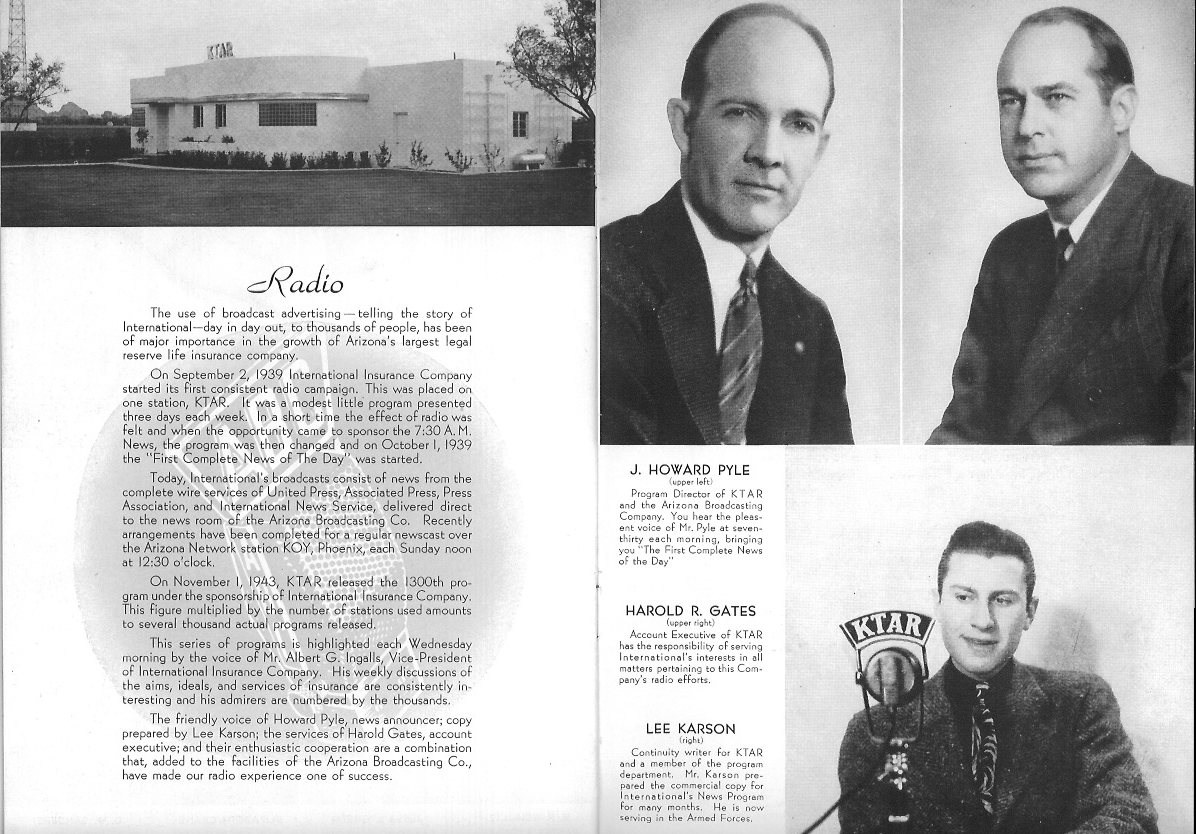
J.
HOWARD PYLE
(upper
left)
Program
Director of
KTAR and the Arizona Broadcasting Company. You hear the
pleasent voice of Mr. Pyle at seventhirty each morning,
bringing you "The First Complete News of the Day"
HAROLD
R. GATES
(upper right)
Account
executive of KT AR has the responsibility of serving
International's interests in all matters pertaining to this Company's
radio efforts.
LEE
KARSON
(right)
Continuity
writer For KTAR and a member of the program department. Mr.
Karson prepared the commercial copy for International's News
Program for many months. He is now serving in the Armed Forces
|
|
International Insurance Company (click for view) |
|
The
use of broadcast advertising -telling the story of
International-day in
day out, to thousands of people, has been of major
importance in the growth of Arizona's largest legal reserve life
insurance company.
On
September 2, 1939 International Insurance Company started its First
consistent radio campaign. This was placed on one station, KTAR. It
was a modest little program presented three days each week. In a
short time the effect of radio was Felt and when the
opportunity came to sponsor the 7:30 A. M. News, the program was
then changed and on October 1, 1939 the "First Complete News of
The Day" was started.
Today,
International's broadcasts consist of news from the complete wire
services of United Press, Associated Press, Press
Association, and International News Service, delivered direct to the
news room of the Arizona Broadcasting Co. Recently
arrangements have been completed For a regular newscast over the
Arizona Network station KOY, Phoenix, each Sunday noon at 12:30
o'clock.
On
November I, 1943, KTAR released the 1300th program under the
sponsorship of International Insurance Company. This figure
multiplied by the number of stations used amounts to several
thousand actual programs released.
This
series of programs is highlighted each Wednesday morning by
the voice of Mr. Albert G. Ingalls, Vice-President of International
Insurance Company. His weekly discussions of the aims, ideals, and
services of insurance are consistently ir\teresting and his
admirers are numbered by the thousands.
The
friendly voice of Howard Pyle, news announcer; copy prepared by Lee
Karson; the services of Harold Gates, account executive; and their
enthusiastic cooperation are a combination that, added to the
facilities of the Arizona Broadcasting Co., have made our
radio experience one of success.
|
| |
|
J.
HOWARD PYLE
(upper left)
Program
Director of KTAR and the Arizona Broadcasting Company. You
hear the pleasant voice of Mr. Pyle at seventhirty each
morning, bringing you "The First Complete News of the Day"
HAROLD
R. GATES
(upper right)
Account
executive of KTAR has the responsibility of serving
International's interests in all matters pertaining to this
Company's radio efforts.
LEE
KARSON
(right)
Continuity
writer For KTAR and a member of the program department. Mr.
Karson prepared the commercial copy for International's News Program
for many months. He is now serving in the Armed Forces
|
|
|
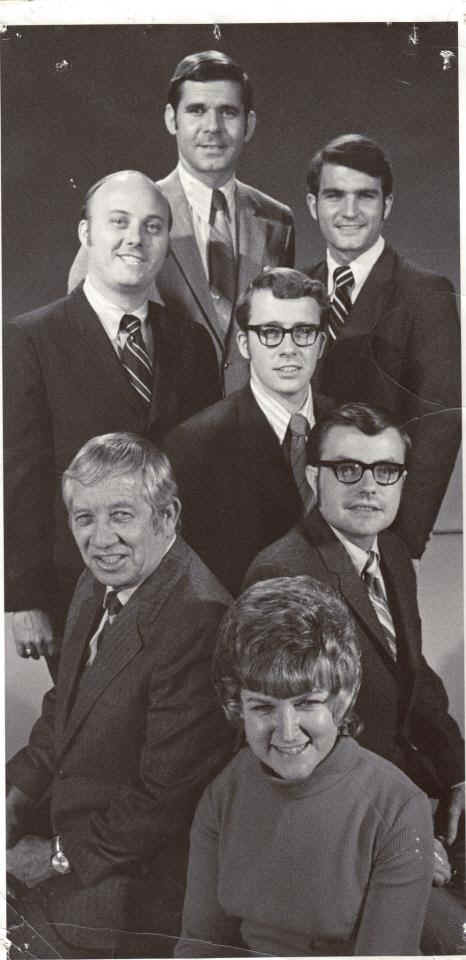
(from Diane Kalas )
Clockwise from top, John Culea, Bill Redeker, Dan Webster,
Jack Frazier, Diane Kalas, Gene McLain, Dick Gaither.
|
|
|
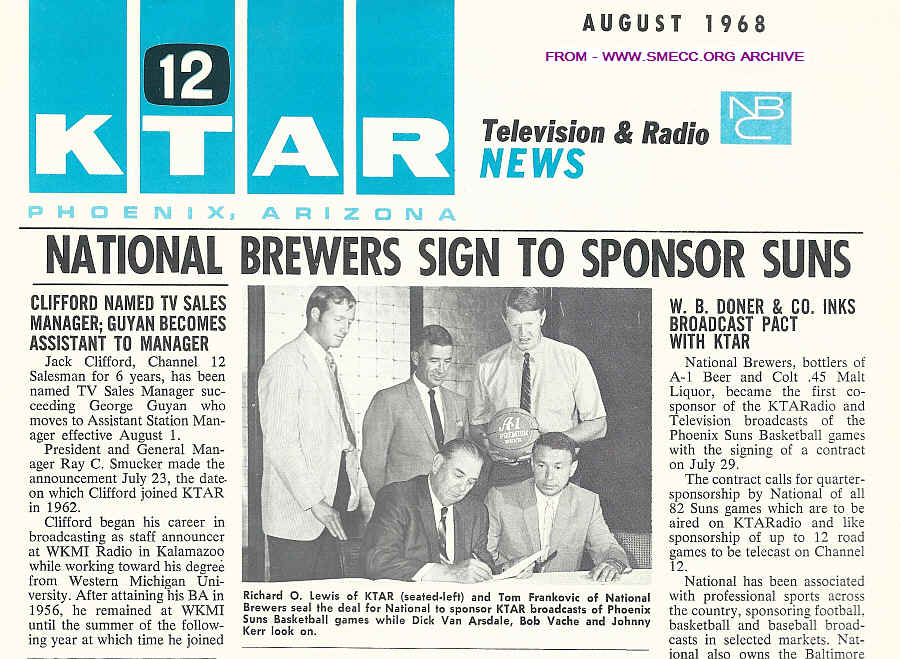
KTAR Newsletter
- From the Ray Lindstrom collection at
SMECC

KTAR Newsletter
- From the Ray Lindstrom collection at
SMECC
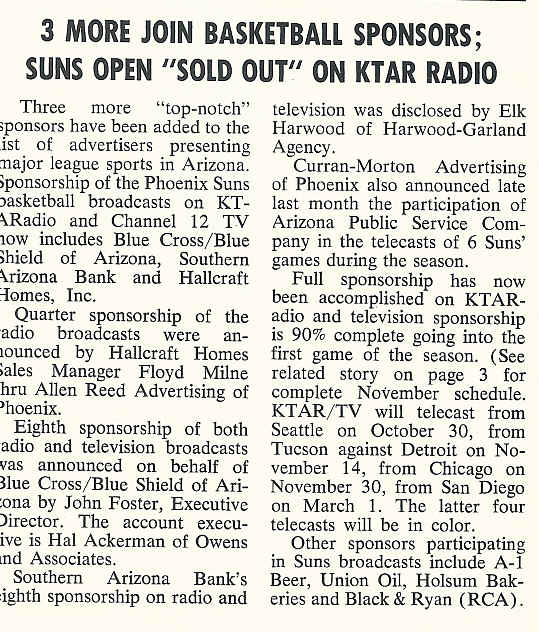
November 1968 KTAR
Newsletter - From the Ray Lindstrom
collection at SMECC
MORE JOIN BASKETBALL SPONSORS;
SUNS OPEN "SOLD OUT" ON KTAR RADIO
Three more "top-notch"
sponsors have been added to the
list of advertisers presenting
major league sports in Arizona.
Sponsorship of the Phoenix Suns
basketball broadcasts on KTARadio
and Channel 12 TV
now includes Blue Cross/Blue
Shield of Arizona, Southern
Arizona Bank and Hallcraft
Homes, Inc.
Quarter sponsorship of the
radio broadcasts were announced
by Hallcraft Homes
Sales Manager Floyd Milne
thru Allen Reed Advertising of
Phoenix.
Eighth sponsorship of both
radio and television broadcasts
was announced on behalf of
Blue Cross/Blue Shield of Arizona
by John Foster, Executive
Director. The account executive
is Hal Ackerman of Owens
and Associates.
Southern Arizona Bank's
eighth sponsorship on radio and
television was disclosed by Elk
Harwood of Harwood-Garland
Agency.
Curran-Morton Advertising
of Phoenix also announced late
last month the participation of
Arizona Public Service Company
in the telecasts of 6 Suns'
games during the season.
Full sponsorship has now
been accomplished on KTARadio
and television sponsorship
is 90% complete going into the
first game of the season. (See
related story on page 3 for
complete November schedule.
KTAR/TV will telecast from
Seattle on October 30, from
Tucson against Detroit on November
14, from Chicago on
November 30, from San Diego
on March 1. The latter four
telecasts will be in color.
Other sponsors participating
in Suns broadcasts include A-I
Beer, Union Oil, Holsum Bakeries
and Black & Ryan
(RCA).
|
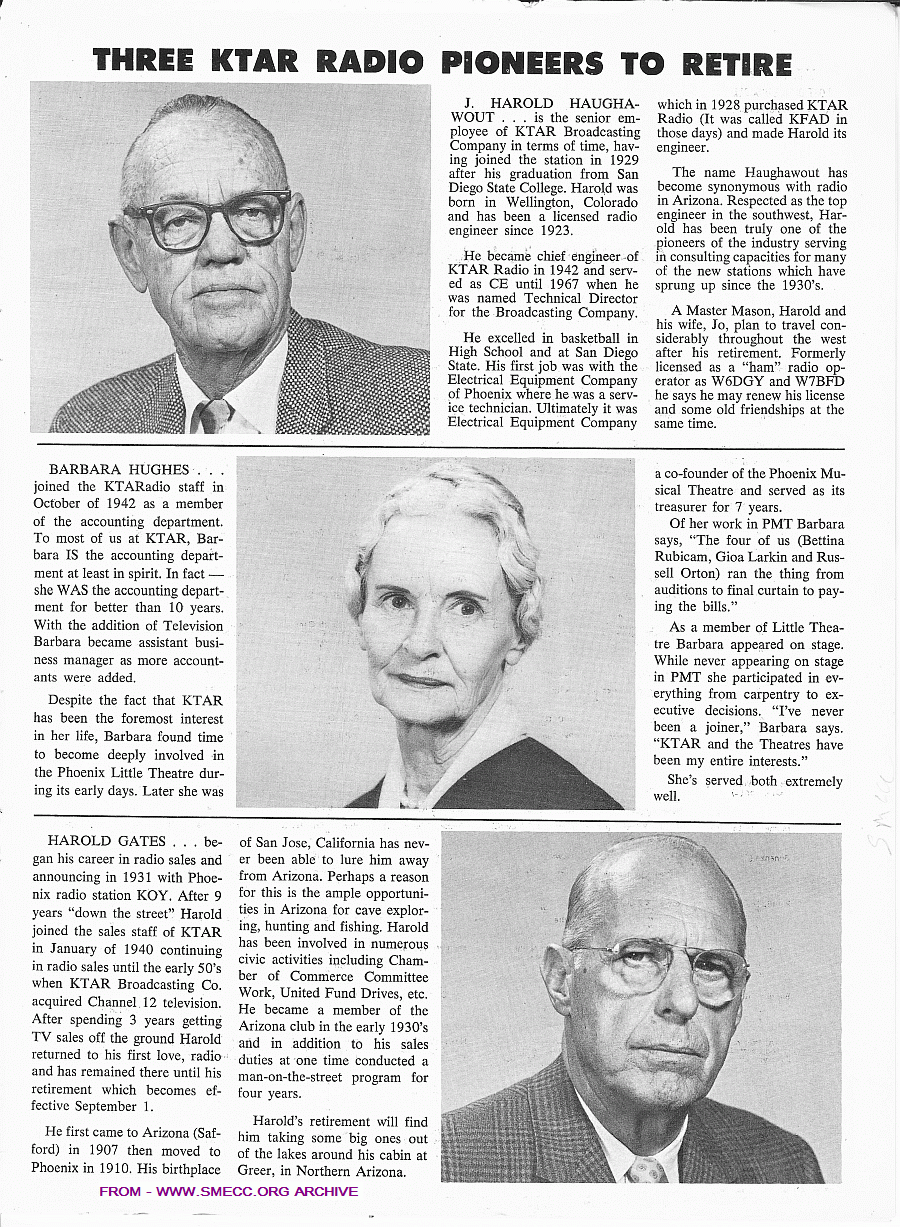
September 1968 KTAR
Newsletter - From the Ray Lindstrom
collection at SMECC
IN MEMORIAM
B0B
VACHE 1924·1970
SPORTS
DIRECTOR
- KTAR
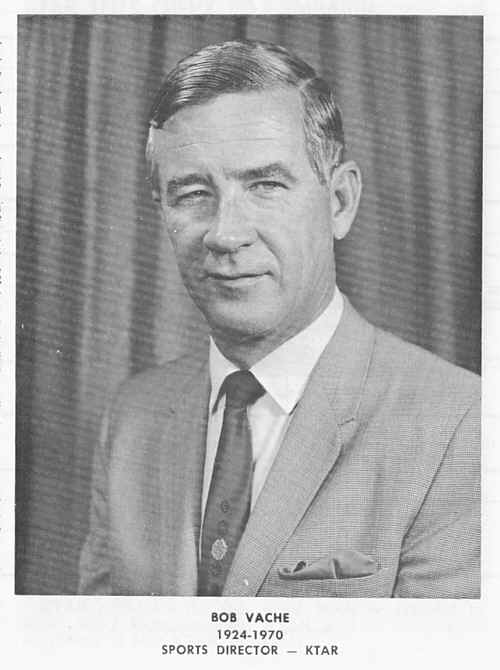
B ob Vache,
45,
Sports
Director
of KTAR Radio
and Television
was killed
early
Saturday
morning,
January
17 in
a one car automobile
accident
at 26th Street
and Washington
in Phoenix.
A native
of Phoenix
- educated
at Tolleson
High School
and
Phoenix
College
- "Vash"
began
his illustrious
career in'
1942.
He joined
the staff
of
KTAR
in 1953
where he broadcast
sports
programs
and
play
by play
descriptions
until
being
named
program
director
of Channel
12 (KTAR)
TV
in 1957.
Coupling
sports broadcasting
with his
executive
duties,
Vache
continued
as the voice
of Arizona
State and
University
of Arizona
broadcasts.
A desire
to return
to
full-time
sports
reporting
culminated
in 1962
when
Bob
returned
to his
first
love-sports.
I n the
8 years
which
followed,
Vache
was named
Arizona's
outstanding
sports broadcaster
an
unprecedented
five
times
by
the
National
Association
Of Sportswriters
and Broadcasters.
When
the Phoenix
Suns National
Basketball
Association
franchise
was
granted
in Phoenix,
Bob was
logically
assigned
as the
"Voice
of the
Suns"
on KTAR radio
and TV.
A p ilot
with
the
Army
Air Corps
in
World
War
II, Bob
remained
in
the
Air
Force Reserve
after
his
discharge
rising
to
the
rank
of
Lt. Colonel
with
the
302nd
Air
Rescue
Squadron.
H e is
survived
by
his
wife,
Bettie
and
their
two
children,
Marilyn
18 and
son
Tommy
13.
T he
following
is
a portion
of
Bill Stull's
newscast
on
Channel
12
which was
broadcast
the
night
following
Bob's
death.
" . . .
a sportsman,
a gentleman
and a
friend.
As a thorough
and
dedicated
craftsman
Bob
set
standards
that
the
rest
of us
will never
live
up
to.
Few men
in broadcasting
have
earned
the respect
which
we felt
for him.
He
was, in
every sense
of the
word,
a professional.
Bob
Vache
was indeed
a sportsman,
a true
gentleman
and
an
irreplaceable
friend.
The
words
fit
Bob
Vache.
The
hard
part,
and
the
still
unbelievable
part,
-the
word was."
M ay
we all
add
our
endorsement
to
Bill's
words.
T he Staff
and
Management
of
KTAR
This KTAR Radio and Television
newsletter from February 1970 containing this article now resides in
the Ray Lindström Collection at SMECC - www.smecc.org
- SMECC endeavors to get as much Arizona Broadcast History online as
we can. If you have old documents and photos please contact us at
623-435-1522 or email us. Do you have a drawer full of old photos
and a scanner? Fire it up and lets get them online! - Ed# |
| |
 |
| |
| |
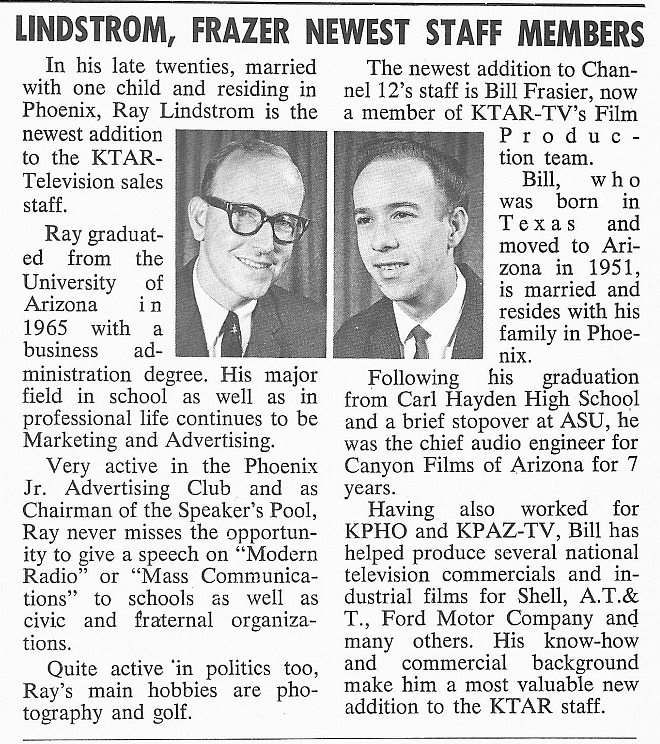
October 1968 KTAR Newsletter
- From the Ray Lindstrom collection at
SMECC
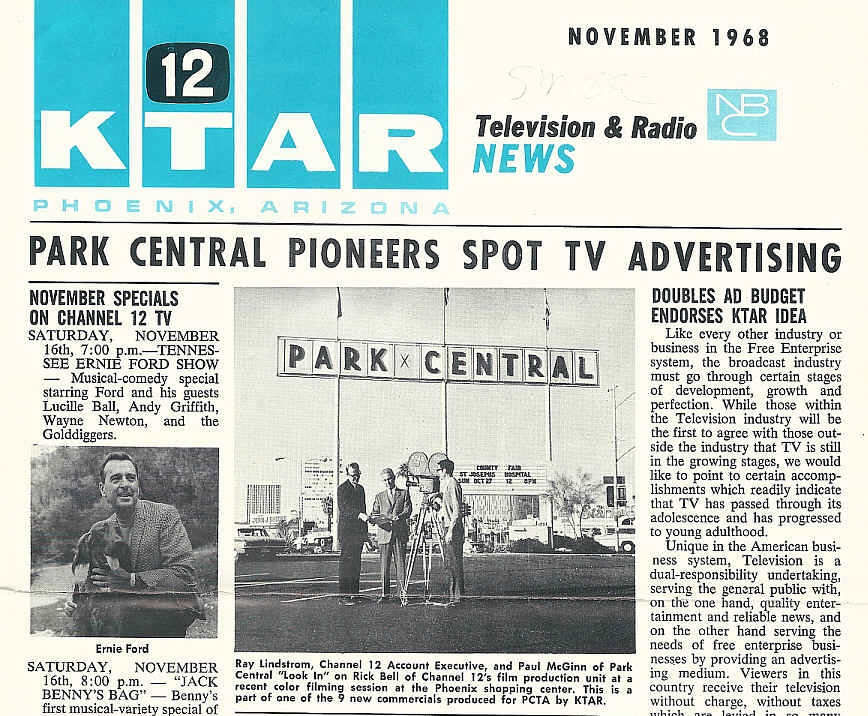
November 1968 KTAR
Newsletter - From the Ray Lindstrom
collection at SMECC
January 1970
Januart 1970 KTAR Newsletter - From the Ray Lindstrom collection at SMECC
UTILITY, HOME BUILDERS
TEAM UP IN CO-OP
PROMOTION
A cooperative advertising
campaign designed to promote
growth in the homebuilding in
dustry in Arizona was announc
ed late last month by Arizona
Public Service Company, Valley
Homebuilders and Channel 12
Television.
The 20 - week campaign,
placed exclusively on Channel
12 thru Jennings and Thompson
Advertising Agency, will feature
commercial minutes in and
around News 90, the Andy Wil
liams Show, The Tonight Show,
Saturday Night News and Big
Valley.
The messages will feature the
APS Builder's Information Cen
ter in Christown and will also
highlight a valley home builder.
The Builder's Information Cen
ter is a service of APS to pros
pective homebuyers. It lists all
new homes for sale in the Valley
and features of each such as
price, location, options, etc.
Ray Lindstrom, Channel 12
Account Executive calls it a
one - stop information head
quarters.
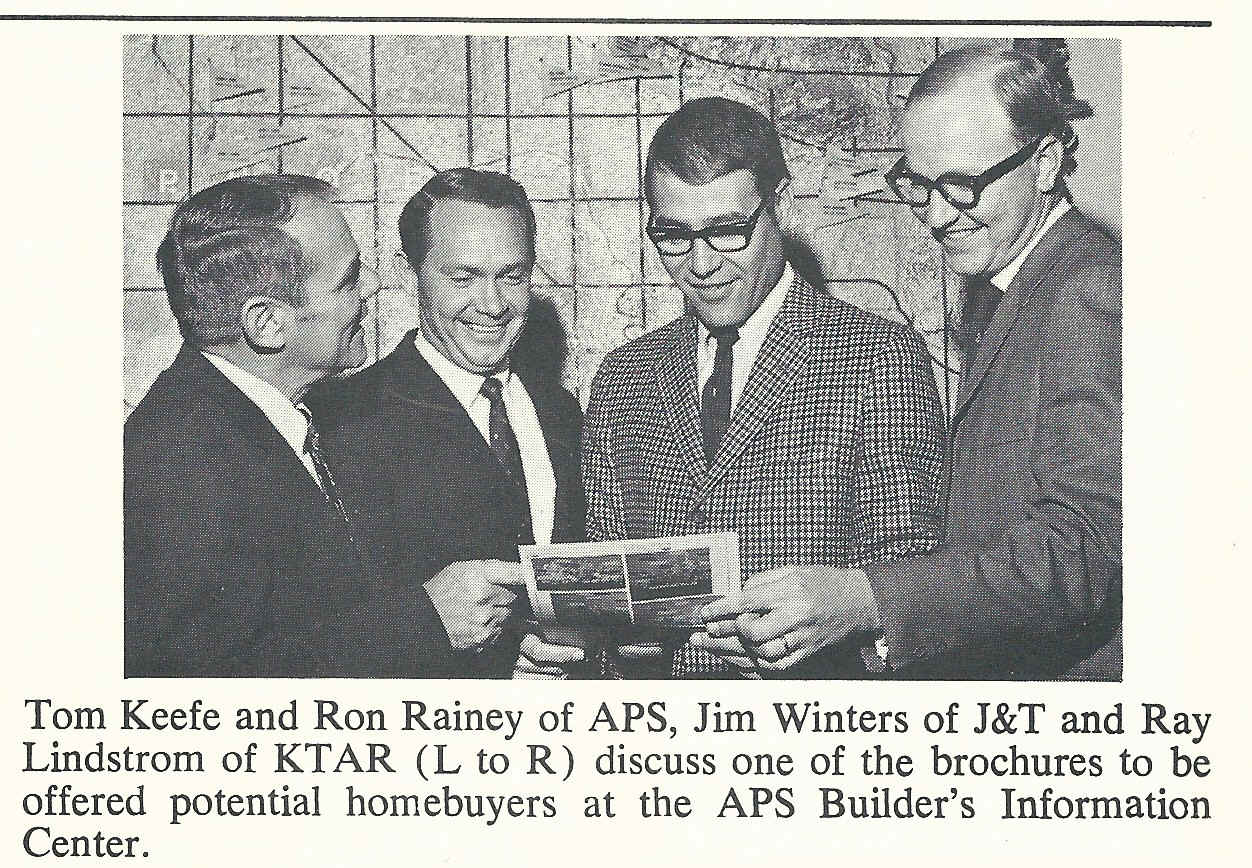
Of the campaign, which be
gins January 14, Tom Keefe of
Arizona Public Service Com
pany says, "This is one more
way that APS can help promote
growth in Arizona Homebuild
ing."
APS also sponsors "Indispens
ables" and "Weather Sketches"
on Channel 12.
|
| |
| |
FILM UNIT BECOMES
COMBINED CINEGRAPHICS
(April 1969 KTAR Newsletter - From the Ray Lindstrom collection at SMECC)
Long recognized as the quality
production unit for television
films and commercials, KTARTV's
Film Production Unit
takes on a new identity as of
April 1st.
Now operating under the
name of Combined Cinegraphics,
the film production unit will
continue to serve as the production
company for Channel 12
Television but will expand its
operations to a regional and national
level.
New, enlarged editing and
viewing rooms and additional
office space are being constructed
on the second floor of the
KT AR Building to house the
operation.
Increased demand for the
services of the unit by regional
advertisers and the addition of
new personnel and more equipment
has made the expansion
necessary.
In addition to commercial
work Combined Cinegraphics
will serve as the production unit
for the newly established Documentary
Division of the News
Department.
RUSSEll & BELL TO
HEAD FILM PRODUCTION
(October 1969 KTAR Newsletter - From the Ray Lindstrom collection at SMECC)
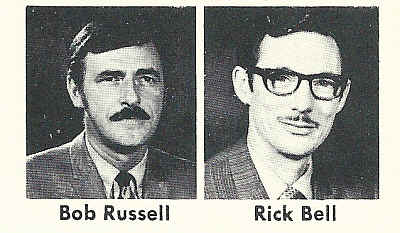 Bob Russell Ritk Bell
The appointments of Bob Russell
as Manager and Rick Bell
as Film Production Manager of
Combined Cinegraphics were
announced September 15 by
Ray C. Smucker, President and
General Manager of KTAR/TV.
Russell, who will retain the
position of Production Coordinator
for KTAR/TV, joined
Channel 12 in 1967 in the production
department after serving
two years as a director for
KTVK. Prior to coming to
Phoenix in 1966, Russell was
employed as writer, director
and on-air talent at KPRC- TV
in Houston.
Bob Russell Ritk Bell
The appointments of Bob Russell
as Manager and Rick Bell
as Film Production Manager of
Combined Cinegraphics were
announced September 15 by
Ray C. Smucker, President and
General Manager of KTAR/TV.
Russell, who will retain the
position of Production Coordinator
for KTAR/TV, joined
Channel 12 in 1967 in the production
department after serving
two years as a director for
KTVK. Prior to coming to
Phoenix in 1966, Russell was
employed as writer, director
and on-air talent at KPRC- TV
in Houston.
Bell, a member of the
KTAR/TV staff since 1953, has
served as television cameraman
producer and film cameraman)
director in that time. He was
instrumental in establishing the
predecessor of Combined Cinegraphics,
the KT AR Film Production
Unit.
Combined Cinegraphics specializes
in the production of television
film and video taped
commercials, documentary and
industrial films and recently was
awarded "Best In Class" for its
"Today In Arizona" film besting
more than 400 other entries
in the 11th Annual Industrial
Photography competition.
KTAR RADIO LOG
(July
1971 vol 2 #4 CCC ( was KTAR newsletter before)
Newsletter - From the Ray Lindstrom
collection at SMECC)
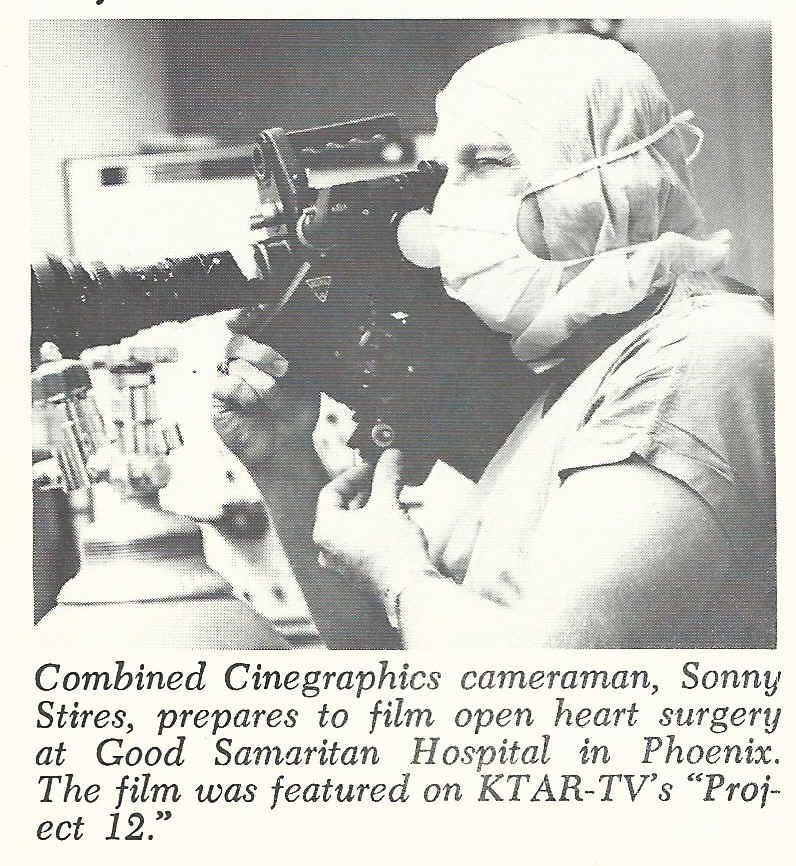
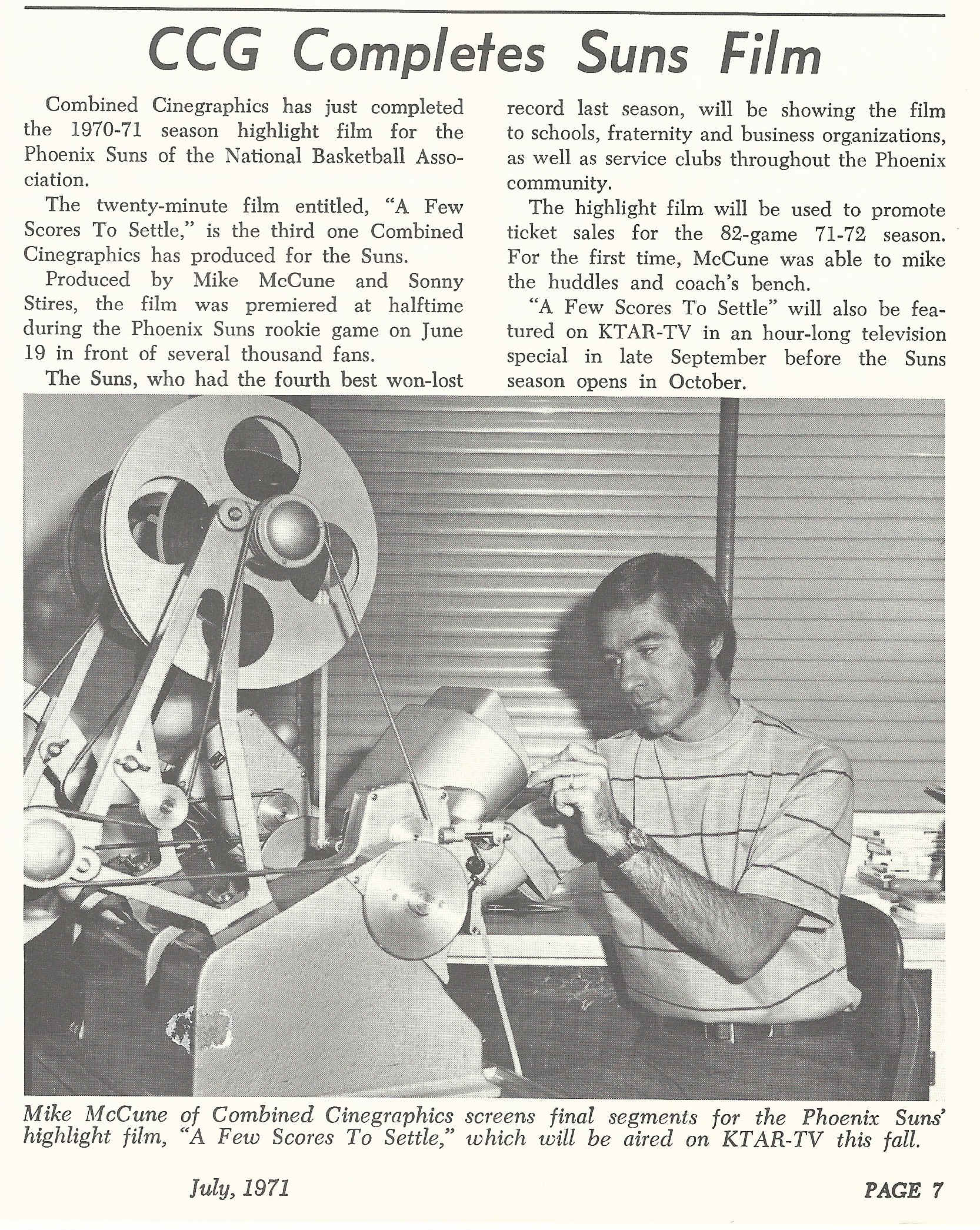
Combined Cinegraphics cameraman, Sonny
Stires, prepares to film open heart surgery
at Good Samaritan Hospital in Phoenix.
The film was featured on KTAR-TV's "Project 12."
(April
1972 vol 3 #1 CCC ( was KTAR newsletter before)
Newsletter - From the Ray Lindstrom
collection at SMECC)
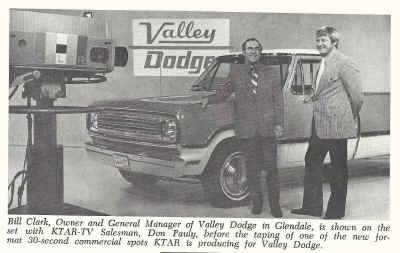
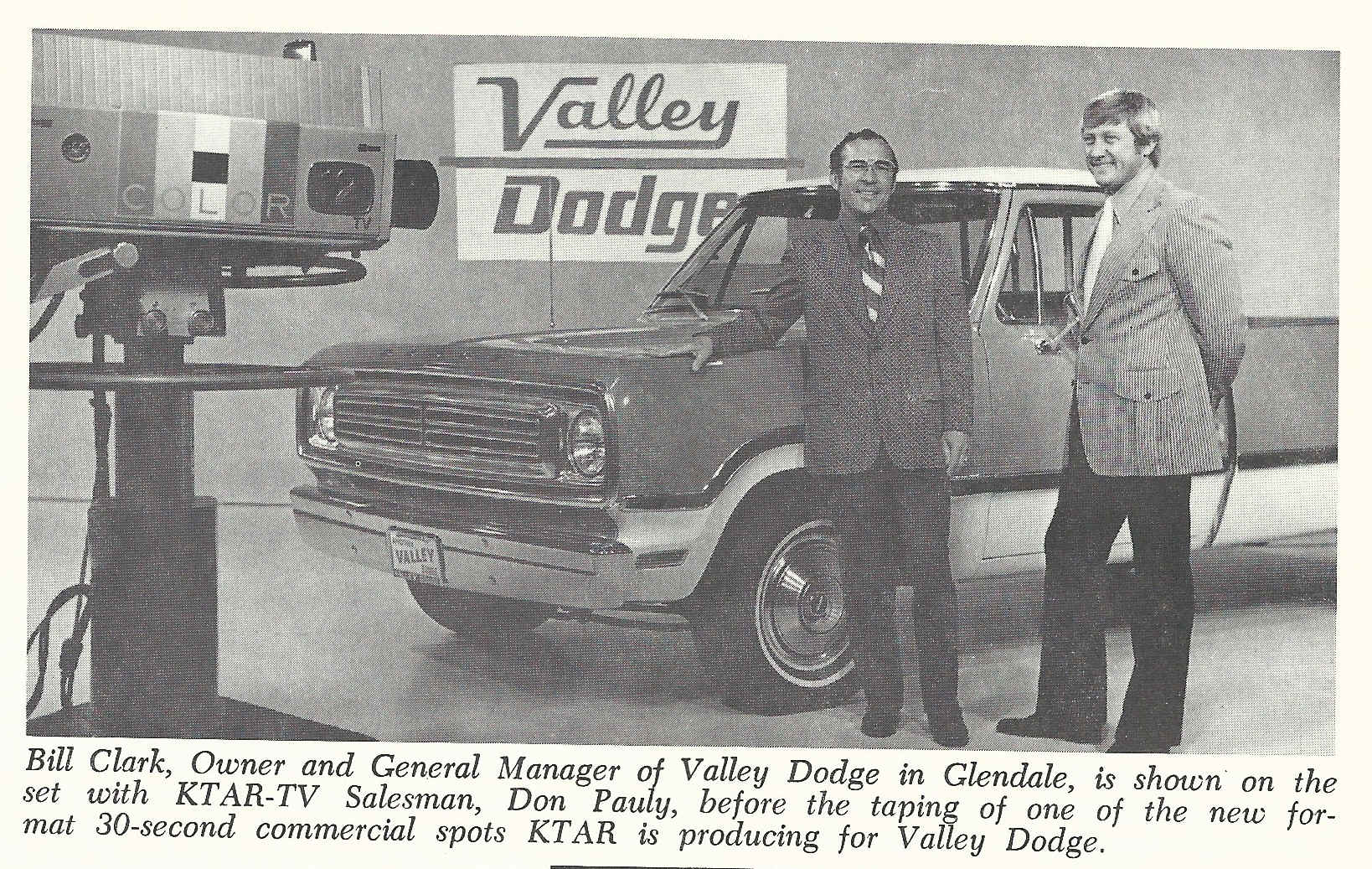
Bill Clark, Owner and General Manager of Valley Dodge in Glendale, is shown on the
set with KTAR-TV Salesman, Don Pauly, before the taping of one of the new format
3D-second commercial spots KT AR is producing for Valley Dodge.
(April
1972 vol 3 #1 CCC ( was KTAR newsletter before)
Newsletter - From the Ray Lindstrom
collection at SMECC)
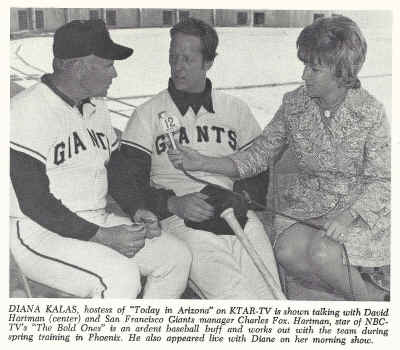
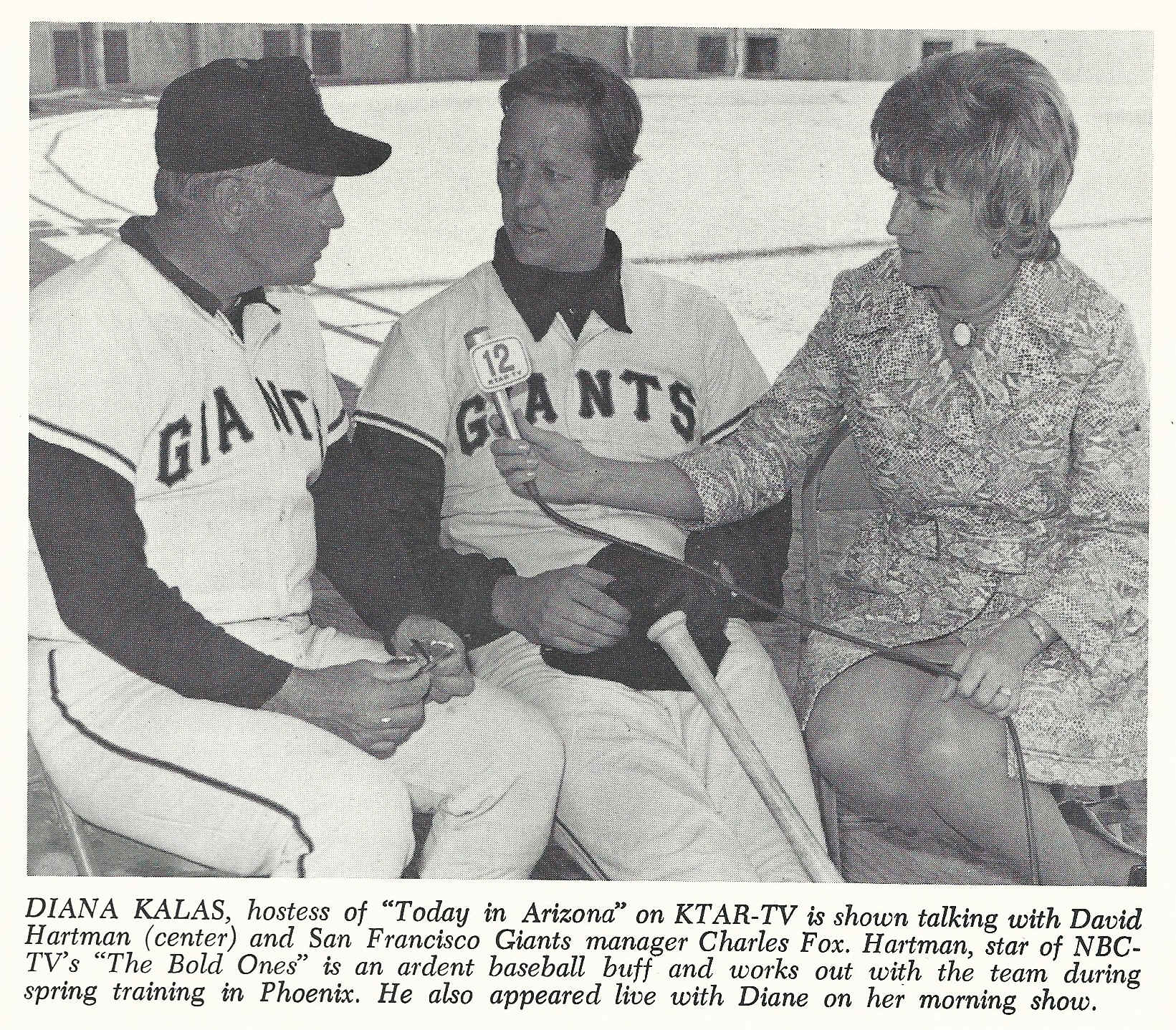
DIANA KALAS, hostess of "Today in Arizona" on KTAR-TV is shown talking with David
Hartman (center) and San Francisco Giants manager Charles Fox. Hartman, star of NBC TV's
"The Bold Ones" is an ardent baseball buff and works out with the team during
spring training in Phoenix. He also appeared live with Diane on her morning show.
(April
1971 vol 2 #1 CCC ( was KTAR newsletter before)
Newsletter - From the Ray Lindstrom
collection at SMECC)
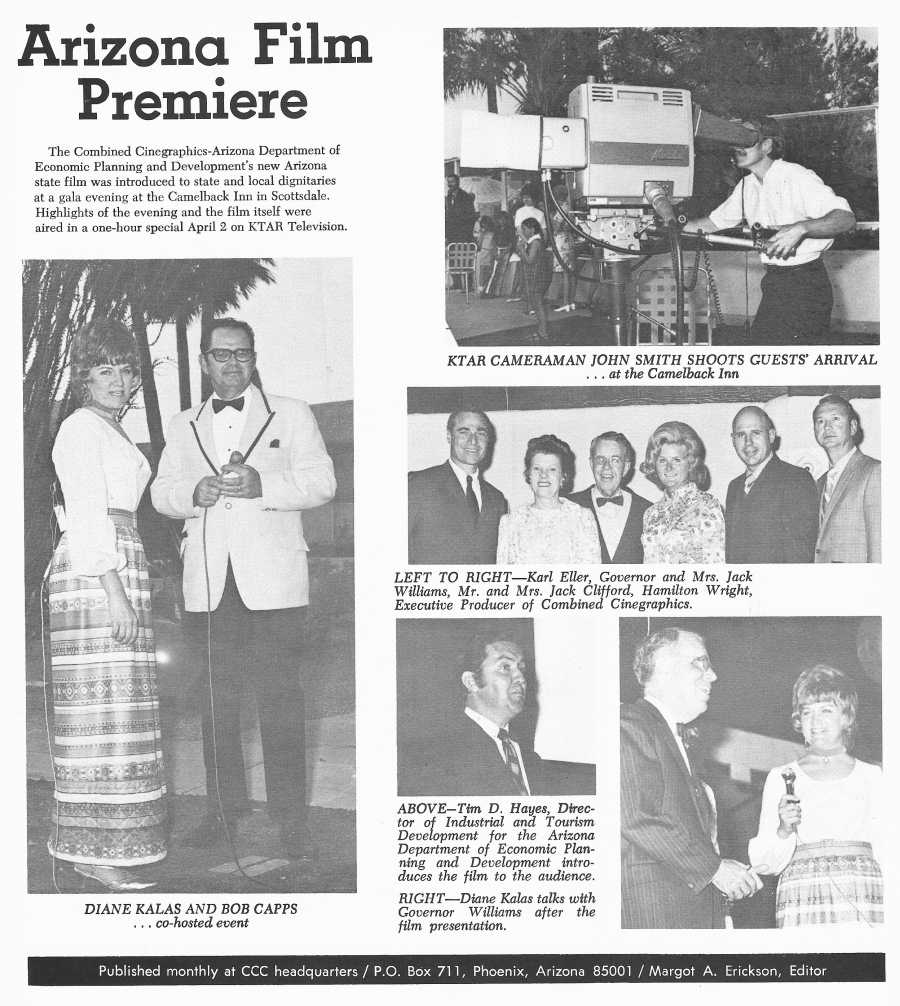
Arizona Film
Premiere
The Combined Cinegraphics-Arizona Department of
Economic Planning and Development's new Arizona
state film was introduced to state and local dignitaries
at a gala evening at the Camelback Inn in Scottsdale.
Highlights of the evening and the film itself were
aired in a one-hour special April 2 on KTAR Television.
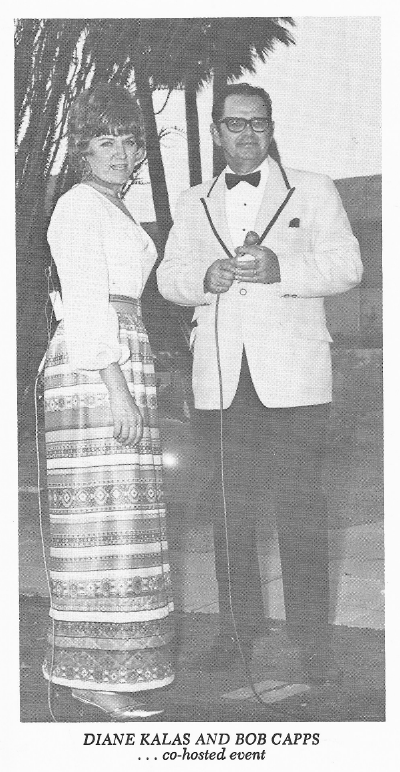
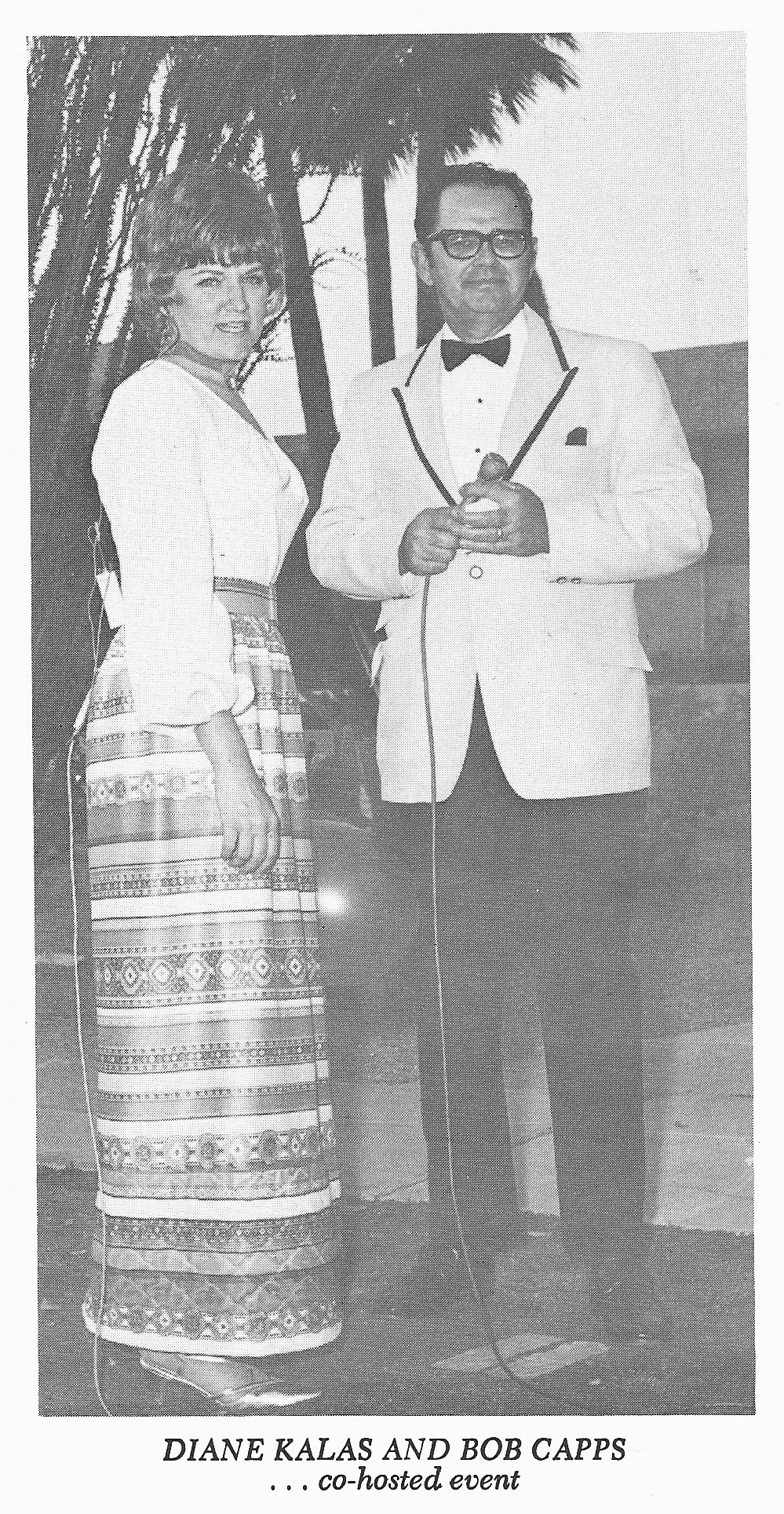
DIANE KALAS AND BOB CAPPS
... co-hosted event
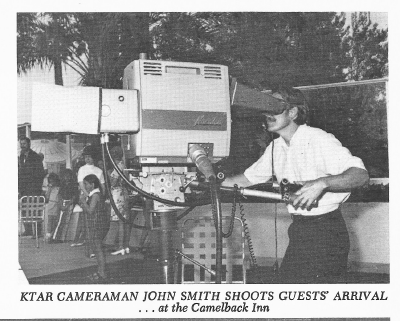
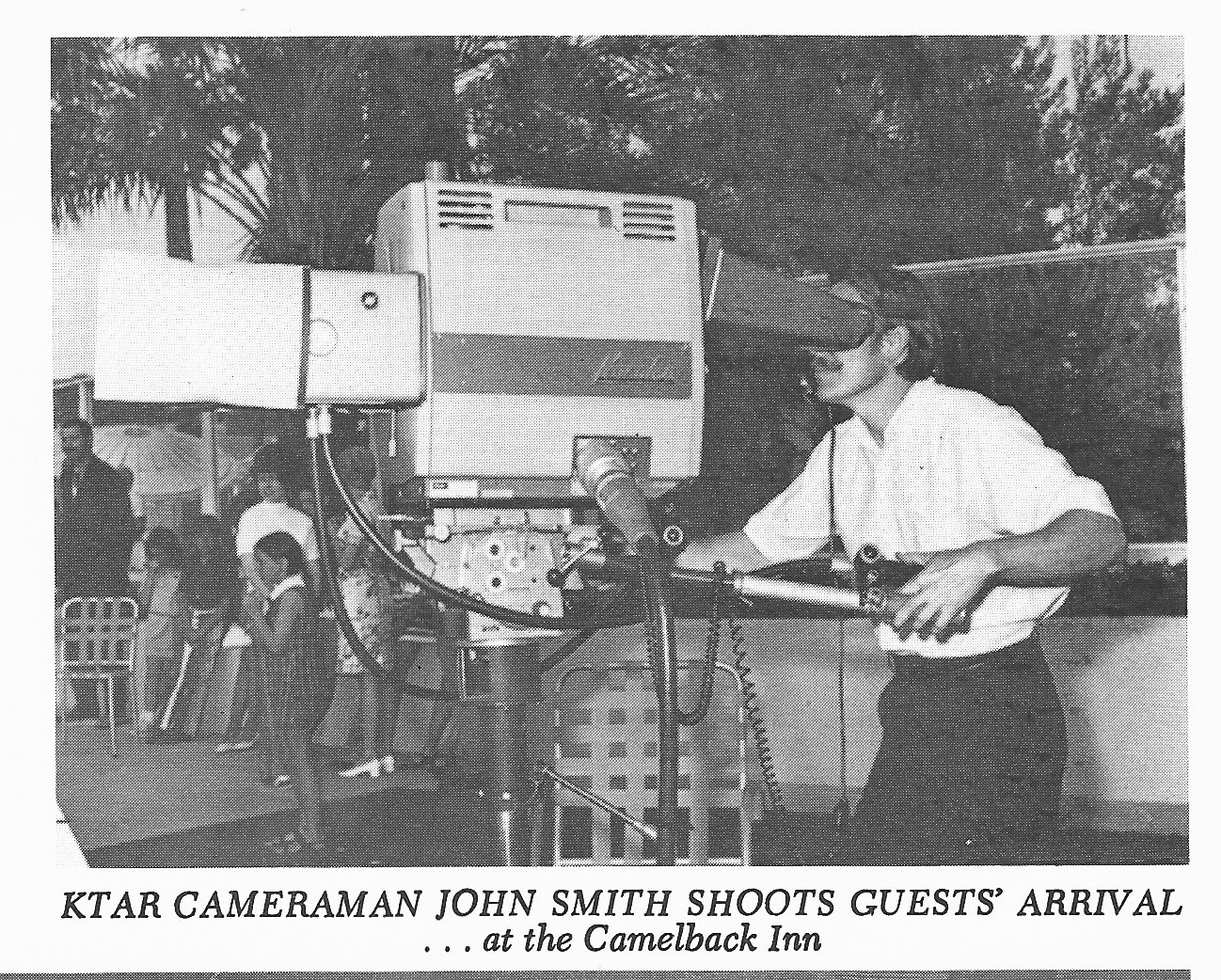
KTAR CAMERAMAN JOHN SMITH SHOOTS GUESTS' ARRIVAL
... at the Camelback Inn
LEFT TO RIGHT -Karl Eller, Governor and Mrs. lack
Williams, Mr. and Mrs. lack Clifford, Hamilton Wright,
Executive Producer of Combined Cinegraphics.
(April 1971 vol 2 #1 CCC ( was KTAR newsletter before) Newsletter - From the Ray Lindstrom collection at SMECC)
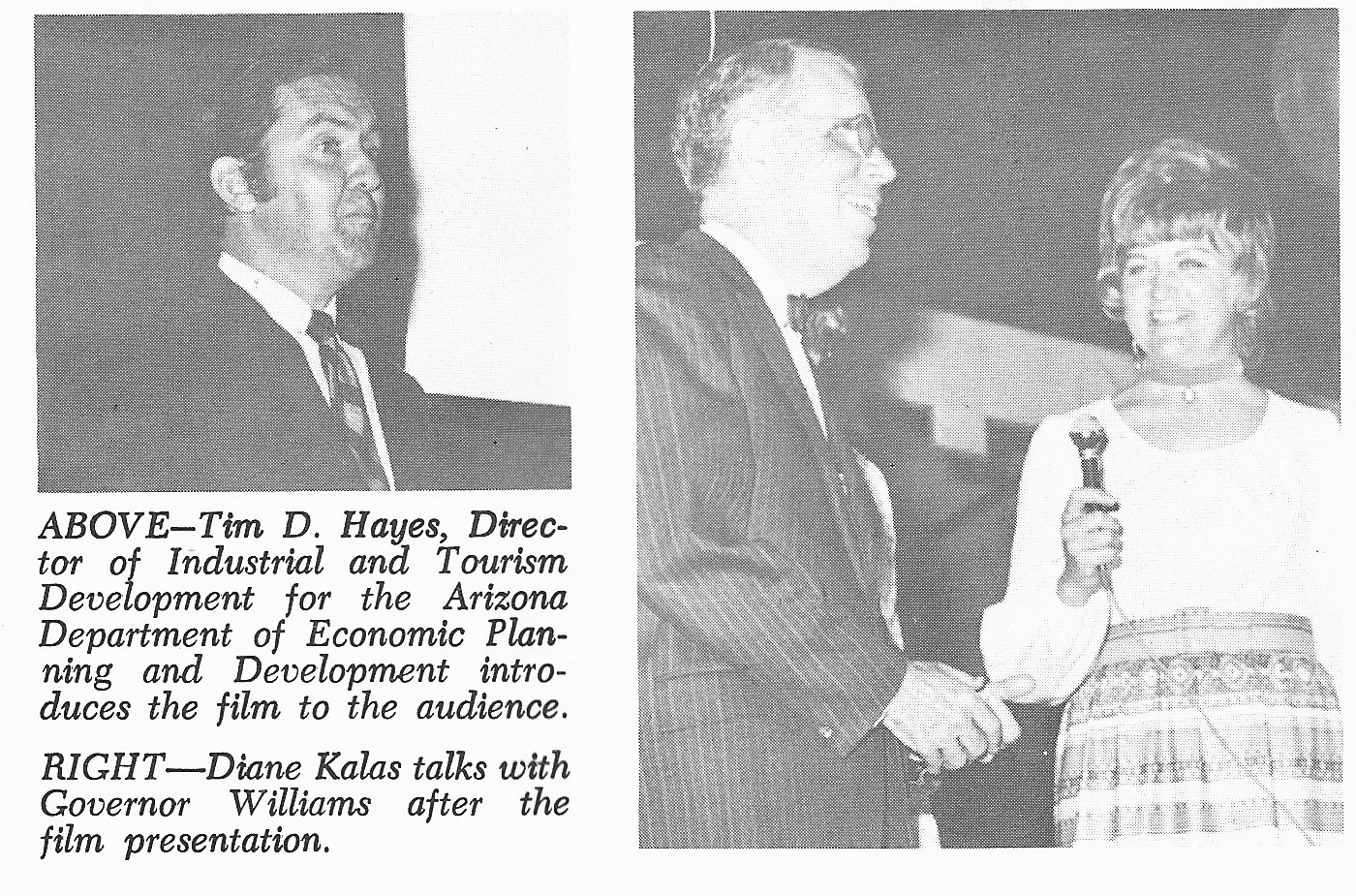
ABOVE-Tim D. Hayes, Director
of Industrial and Tourism
Development for the Arizona
Department of Economic Planning
and Development introduces
the film to the audience.
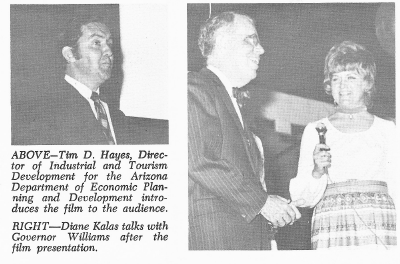 RIGHT -Diane Kalas talks with
Governor Williams after the
film presentation.
(April 1971 vol 2 #1 CCC ( was KTAR newsletter before) Newsletter - From the Ray Lindstrom collection at SMECC)
RIGHT -Diane Kalas talks with
Governor Williams after the
film presentation.
(April 1971 vol 2 #1  CCC ( was KTAR newsletter  before) Newsletter  -     From the Ray Lindstrom collection at  SMECC)
(April
1971 vol 2 #1 CCC ( was KTAR newsletter before)
Newsletter - From the Ray Lindstrom
collection at SMECC)
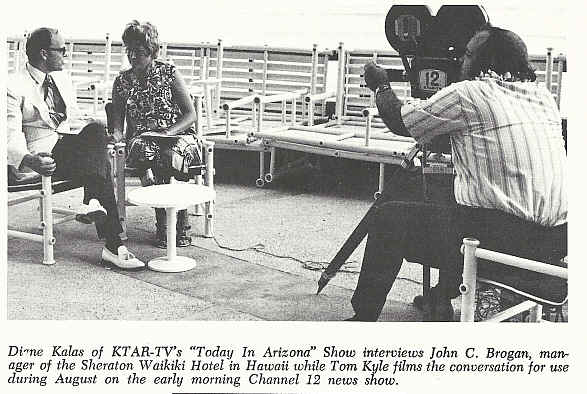
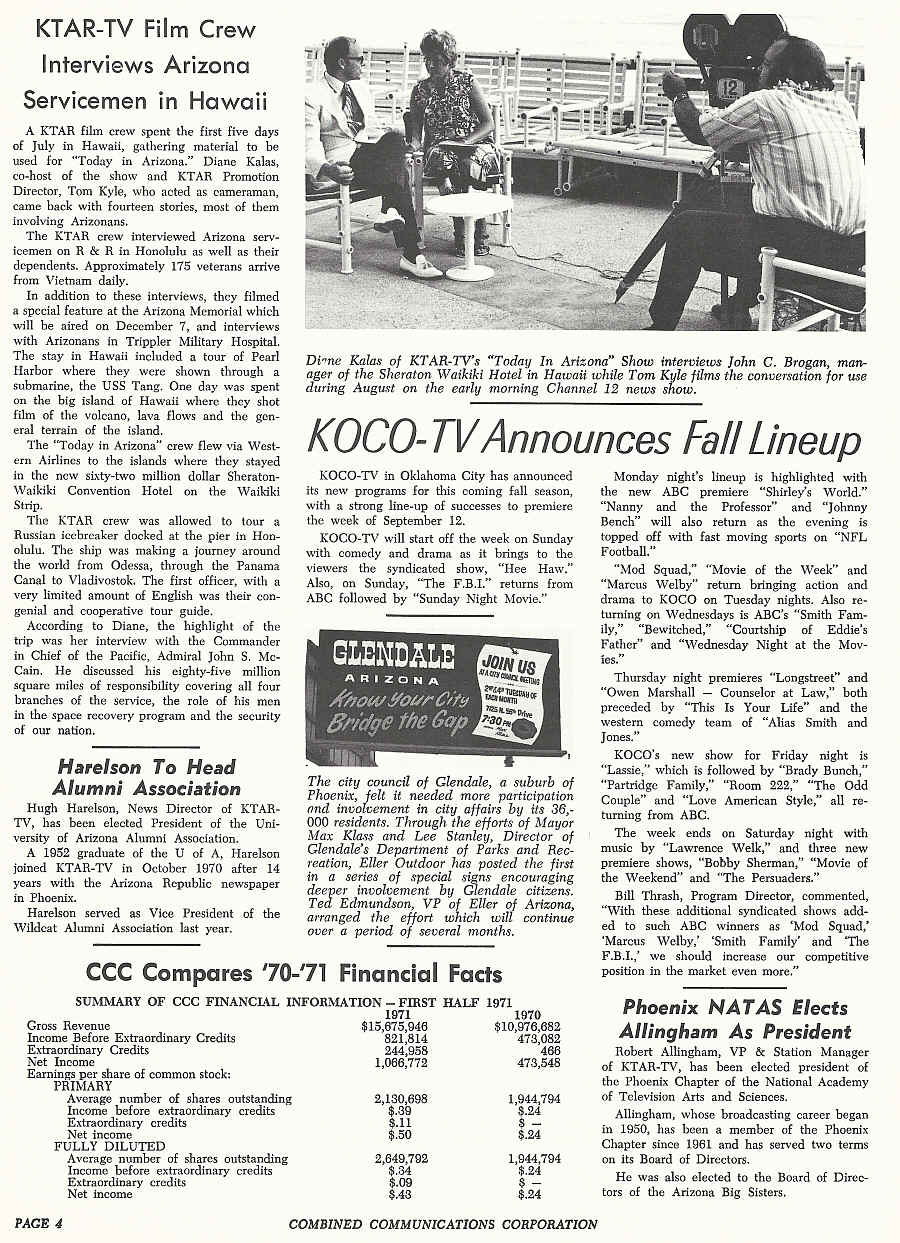
Diane Kalas of KTAR-TV's "Today In Arizona" Show interviews John C. Brogan, manager
of the Sheraton Waikiki Hotel in Hawaii while Tom Kyle films the conversation for use
during August on the early morning Channel 12 news show.
KOCO- TV Announces Fall Lineup
(Aug.
1971 vol 2 #5 CCC ( was KTAR newsletter before)
Newsletter - From the Ray Lindstrom
collection at SMECC)
(Aug.
1971 vol 2 #5 CCC ( was KTAR newsletter before)
Newsletter - From the Ray Lindstrom
collection at SMECC)
KTAR-TV Film Crew
Interviews Arizona
Servicemen in Hawaii
A KTAR film crew spent the first five days
of July in Hawaii, gathering material to be
used for "Today in Arizona." Diane Kalas,
co-host of the show and KTAR Promotion
Director, Tom Kyle, who acted as cameraman,
came back with fourteen stories, most of them
involving Arizonans.
The KTAR crew interviewed Arizona servicemen
on R & R in Honolulu as well as their
dependents. Approximately 175 veterans arrive
from Vietnam daily.
In addition to these interviews, they filmed
a special feature at the Arizona Memorial which
will be aired on December 7, and interviews
with Arizonans in Trippler Military Hospital.
The stay in Hawaii included a tour of Pearl
Harbor where they were shown through a
submarine, the USS Tang. One day was spent
on the big island of Hawaii where they shot
film of the volcano, lava flows and the general
terrain of the island.
The "Today in Arizona" crew flew via Western
Airlines to the islands where they stayed
in the new sixty-two million dollar Sheraton-
Waikiki Convention Hotel on the Waikiki
Strip.
The KTAR crew was allowed to tour a
Russian icebreaker docked at the pier in Honolulu.
The ship was making a journey around
the world from Odessa, through the Panama
Canal to Vladivostok. The first officer, with a
very limited amount of English was their congenial
and cooperative tour guide.
According to Diane, the highlight of the
trip was her interview with the Commander
in Chief of the Pacific, Admiral John S. Me-
Cain. He discussed his eighty-five million
square miles of responsibility covering all four
branches of the service, the role of his men
in the space recovery program and the security
of our nation.
(Aug. 1971 vol 2 #5 CCC ( was KTAR newsletter before) Newsletter - From the Ray Lindstrom collection at SMECC)
(Aug. 1971 vol 2 #5 CCC ( was KTAR newsletter before) Newsletter - From the Ray Lindstrom collection at SMECC)
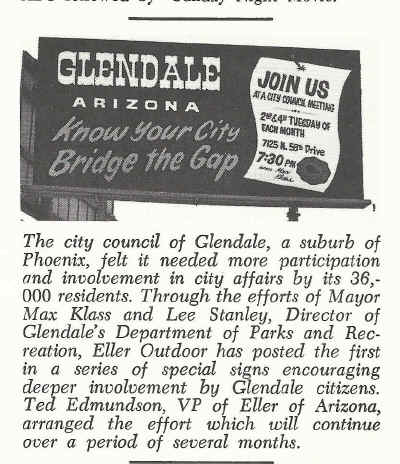
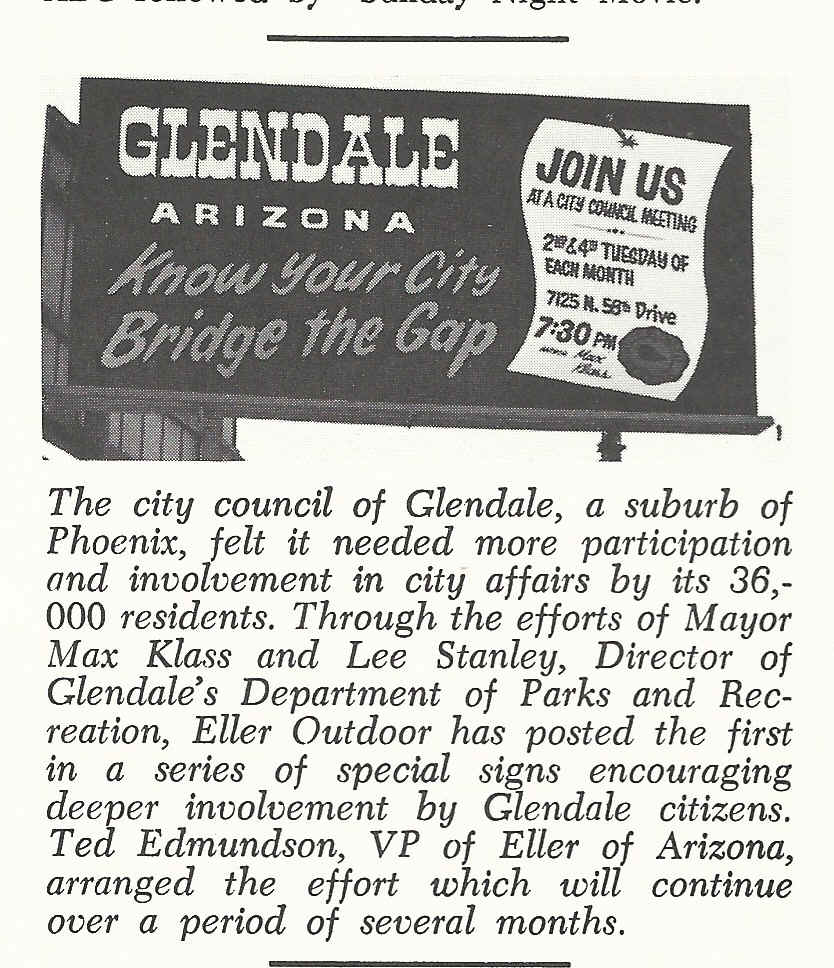
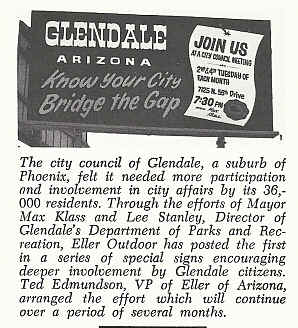
The city council of Glendale, a suburb of
Phoenix, felt it needed more participation
and involvement in city affairs by its 36,-
000 residents. Through the efforts of Mayor
Max Klass and Lee Stanley, Director of
Glendale's Department of Parks and Recreation,
Eller Outdoor has posted the first
in a series of special signs encouraging
deeper involvement by Glendale citizens.
Ted Edmundson, VP of Eller of Arizona,
arranged the effort which will continue
over a period of several months.
(Aug. 1971 vol 2 #5 CCC ( was KTAR newsletter before) Newsletter - From the Ray Lindstrom collection at SMECC)
|
Oct. 1968
KTAR Newsletter - From the Ray
Lindstrom collection at SMECC
MUZAK DIVISION
NOW OFFERS COMPLETE
SOUND SYSTEM
(July
1970 vol 1 #4 CCC ( was KTAR newsletter a year before)
Newsletter - From the Ray Lindstrom
collection at SMECC)
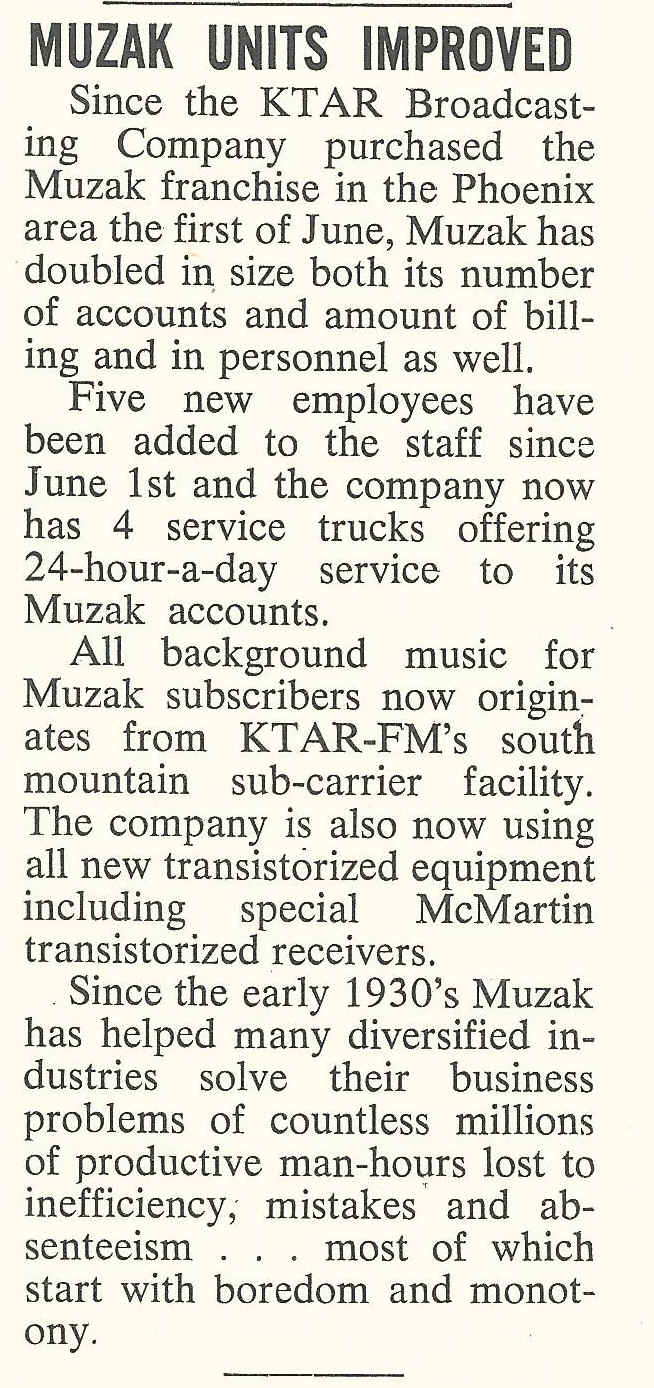
The MUZAK Division of KTAR Broadcasting
was recently made the exclusive distributor
for McMartin Products for the State of Arizona.
The announcement was made by Jim Starkloff,
Vice President of MUZAK Division.
The complete sound system is flexible to
meet each individual need - from small intercoms
to large, complex Dial Telephone Systems,
from small paging systems requiring one
microphone to large systems requiring paging
from every telephone in the plant or office.
"The unique feature of the sound system
is that by the use of its own dial phones,
there is no tie-up of the outside lines," stated
Starkloff. "In addition, since it's a centralized
system, there is more privacy of inner-office
conversations."
The complete sound or intercommunication
systems may be leased or purchased either
with or without "Music by MUZAK" to include
an optional complete maintenance
service.
FCC APPROVES TRANSFER OF YUMA STATION
AND CCC NEGOTIATES FOR OKLA. TV PURCHASE
Dec.
1969
KTAR Newsletter - From the Ray
Lindstrom collection at SMECC
The Federal Communications
Commission has approved the
transfer of control of Eller Telecasting
Co., licensee of KBLUAM
and KBLU-TV in Yuma,
Arizona to Combined Communications
Corporation. The
transfer is subject to the future
ability of the Federal Communications
Commission to require
Combined Communications to
comply with the "one-to-a-market"
rule if it is adopted by the
commission.
The FCC ruling also approved
the proposal of CCC to
donate AM station KBLU to
Arizona Western College, a two year
Junior College in Yuma.
The donation provides Yuma
with its first educational radio
service. Eller Telecasting will
be a wholly-owned subsidiary
of Combined Communications
Corporation. KBLU-TV will be
operated in conjunction with
KYUM-AM, another company
of CCC, in the Yuma-El Centro
area.
Welch emphasized editorial
policy of the magazine will remain
completely in the hands
of its own editorial staff. He
pointed out that Phoenix Magazine
has always attempted to
reflect the pleasure of the Phoenix
way of life but has never
hesitated to explore city problems
such as teen addiction, air
pollution or the rising crime
rate.
In another recent announcement,
CCC President Karl Eller
said tentative agreement has
been reached with representative
shareholders of Cimarron
Television Corporation for the
purchase of the stock of KOCO-TV
in Oklahoma City.
The transaction is subject to
arrangements as to financing
satisfactory to CCC and the sellers,
to final written agreement
and approval by the Federal
Communications Commission.
Announced purchase price is
$6.5 million. KOCO-TV is an
affiliate of the ABC Television
Network and operates on Channel
5.
|
Gary A. Smith
The Society of Broadcast Engineers Chapter 9
2014 Engineer of the Year Award Recipient
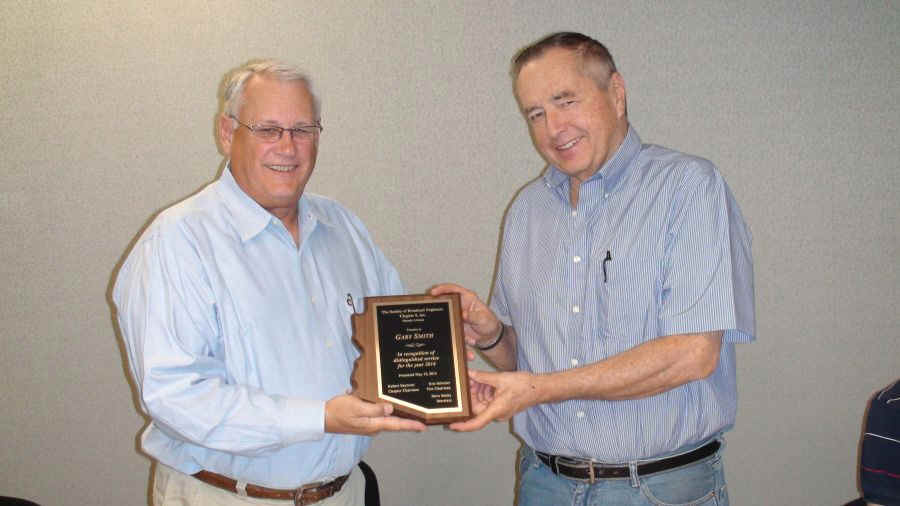
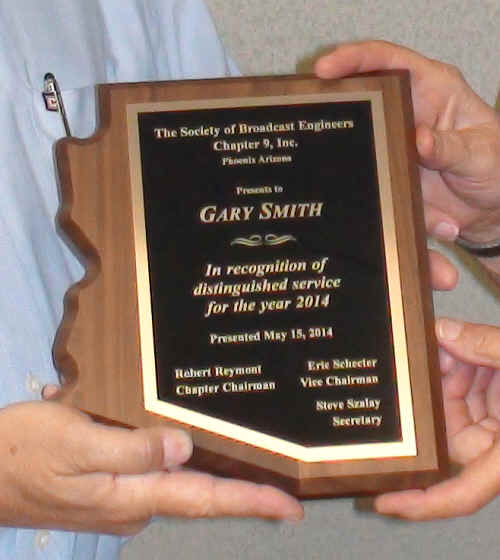
Gary A. Smith
The Society of Broadcast Engineers Chapter 9
2014 Engineer of the Year Award Recipient
Gary A. Smith – Bio
Gary A. Smith completed a two year technical degree in
television and electronics from Laney College in 1972.
While working at Far West Laboratories for Educational
Research and Development in Berkley, he earned his
First-Class Radiotelephone License.
In 1980, Gary entered the broadcast field as the field
service tech and research & development for Gentner
Engineering. In 1984, Gary became the Chief Engineer for
KLUB 570 and KISN in Salt Lake City. Gary has served as
Director of Engineering for Simmons Media Group in St.
George, Utah, and as the DOE and General Manager for the
Bonneville Intermountain Radio Group in St. George, Utah.
As Director of Engineering for Bonneville Phoenix, he was
a member of the Maricopa County Local Emergency Planning
Committee, the State EAS Committee, the SECC and the Amber
Alert Oversight Committee. Gary is an active member of the
NAB CSRIC WG3 and has just assisted with recommendations
for EAS rule changes and state plan recommendations. KTAR
AM/FM and KMVP FM are the Maricopa County LP-1 Stations
and the state relay. KTAR AM/ KMVP FM simulcast is a full
service sports talk station and KTAR FM is a full service
news/talk station. Gary has retired from Bonneville and is
currently the chief engineer for Cherry Creek Radio in
Saint George Utah.
Gary A. Smith - EAS
Gary has been actively involved in emergency broadcast
issues since starting with KLUB in 1984. As chief engineer
he has been involved with the development and training of
radio station staff members for the origination and relay
of emergency messages.
During his time in Southern Utah, Gary worked with
stations from Nevada, Arizona and Utah to facilitate
effective state coordination and insure that EAS messages
would be sent and received in the unofficial operational
area that comprised the tri-state area, which was
effectively isolated from the official operational areas
of each of the states. Today Gary is working with the SECC
from each of the three states to form a new operational
area and update the state plans accordingly.
During his tenure in Arizona, Gary was active in the
Maricopa County Local Emergency Planning Committee,
teaching emergency management personnel how EAS can be
used in state and local crisis. He worked with officials
at the Palo Verde Nuclear Generating Facility and
regularly was involved in FEMA monitored tests of the EAS
system and the plant emergency information systems. KTAR
is the county LP-1 and the state relay. As Chief engineer
he was in contact on a weekly basis with broadcasters
around the state, the FCC, the EAS Chair and the Arizona
Department of Public Safety, insuring that the EAS system
and the traditional daisy chain was operating as it
should.
With the introduction of the CAP system, Gary added the
ability to generate CAP messages on behalf of the State of
Arizona to the KTAR newsroom. To this day the state has
relied on KTAR to provide CAP message generation for the
EAS system. Gary sits on the SECC, the State Amber
Oversight Committee. He was instrumental in writing the
new State EAS Plan and coordinating with state officials
to adopt the new plan.
Gary currently sits on the CSRIC WG3 developing
recommendations for updating EAS rules and addressing both
security and foreign language EAS origination.
|
|
|
|
 International Insurance Company (click for view)