|
The new photo-electric device, shown here about nine times actual size. ( add
photo here)
An entirely new type of "electric eye" much smaller and sturdier than present photo-electric cells and possibly cheaper-has been invented at the Laboratories. During the past quarter century, electric eyes have found widespread use in electronics because of their ability to control electric currents by the action of light. To the layman, one type is perhaps best known for automatically opening and closing doors, but such devices have many other important uses in television, sound motion pictures, wirephotos, and still many more in industry.
One of the major advantages of the new electric eye is that it delivers very high power for a photo-electric device-in some cases enough to operate a switch directly without the preliminary amplification usually required.
Appropriately, the new device has been named the Phototransistor. The whole apparatus is housed in a tiny cylinder about as big as a 22 calibre rifle cartridge. Like the Transistor, it has no vacuum, no glass envelope, no grid, plate or hot cathode. It was invented by Dr. John N. Shive in the course of development work on Transistor-like devices.
Although the Phototransistor is still in the experimental stage, Laboratories scientists and engineers expect that, after the necessary development, it may have far-reaching significance in electronics and electrical communication. Just as the Transistor is not expected to supplant vacuum tubes, but rather to supplement them, so the Phototransistor is not expected to displace existing photo-electric cells. Because of their small size and expected long life, however, together with economies that might reasonably result from mass-production, Phototransistors should find many applications where it is not now practical to use present-day photoelectric devices.
Consideration is already being given, for example, to using them in a machine under development for toll dialing, a plan whereby a telephone operator directly dials a telephone in a distant city.
The heart of the parent device, the amplifying Transistor, is a tiny chip of germanium, a semiconductor material, against one side of which the points of two hair-thin wires are pressed, hardly two-thousands of an inch apart. The flow of very small electrical currents in one of these wires (the emitter) controls the flow of currents in the other wire (the collector) in such a way as to give signal amplification.
The Phototransistor is similar in operation to the amplifying Transistor, but it is controlled by light rather than by the electric current of the emitter. It also uses a piece of germanium but only a single collector wire. The tip of this wire rests in a small dimple ground into one side of the germanium disk. At this point the germanium disk is only three thousandths of an inch thick.
Light focused on the opposite, un-dimpled side of the disk can control the flow of current in the wire, thus making a control device similar in function to a photo-electric cell.
The Phototransistor has a high power output for a photo-electric device and gives good response to a rapidly fluctuating light source. It is particularly sensitive to the wavelengths of light given off by ordinary incandescent light bulbs, and is well suited to operate with these easily available sources with good fidelity. Another virtue is the device’s low impedance.
Fig. 2 Longitudinal section of the Phototransistor
With Permission, Bell Laboratories RECORD
|
CARDS FOR CONVERSATION
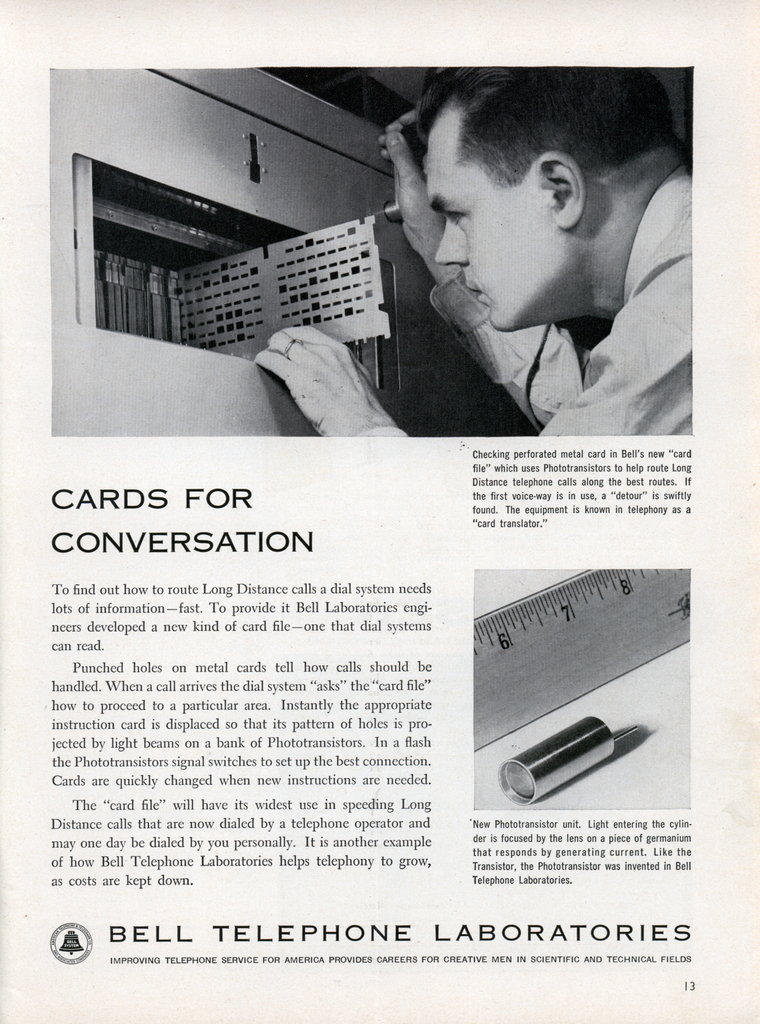
To find out how to route Long Distance calls a dial system needs lots
of information—fast. To provide it Bell Laboratories engineers
developed a new kind of card file—one that dial systems can read.
Punched holes on metal cards tell how calls should be handled. When a
call arrives the dial system “asks” the “card file” how to
proceed to a particular area. Instantly the appropriate instruction card
is displaced so that its pattern of holes is projected by light beams on
a bank of Phototransistors. In a flash the Phototransistors signal
switches to set up the best connection. Cards are quickly changed when
new instructions are needed.
The “card file” will have its widest use in speeding Long
Distance calls that are now dialed by a telephone operator and may one
day be dialed by you personally. It is another example of how Bell
Telephone Laboratories helps telephony to grow, as costs are kept down.
BELL TELEPHONE LABORATORIES IMPROVING TELEPHONE SERVICE FOR AMERICA
PROVIDES CAREERS FOR CREATIVE MEN IN SCIENTIFIC AND TECHNICAL FIELDS
How your telephone call asks directions… and gets quick
answers
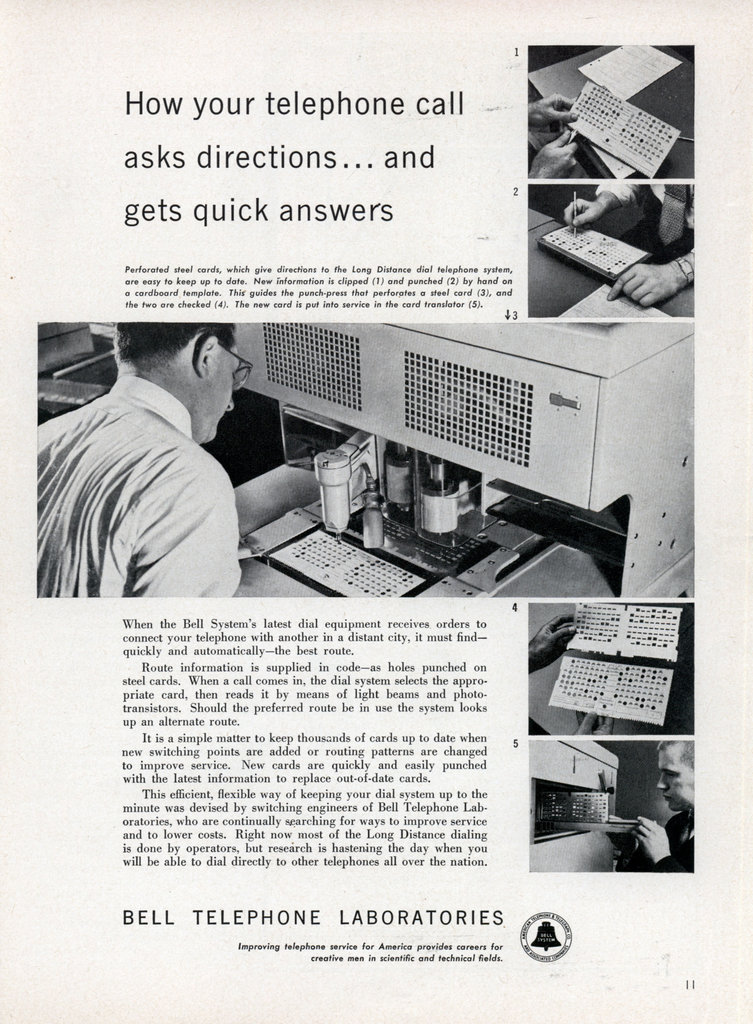
When the Bell System’s latest dial equipment receives orders to
connect your telephone with another in a distant city, it must
find-quickly and automatically the best route.
Route information is supplied in code as holes punched on steel
cards. When a call comes in, the dial system selects the appropriate
card, then reads it by means of light beams and photo-transistors.
Should the preferred route be in use the system looks up an alternate
route.
It is a simple matter to keep thousands of cards up to date when new
switching points are added or routing patterns are changed to improve
service. New cards are quickly and easily punched with the latest
information to replace out-of-date cards.
This efficient, flexible way of keeping your dial system up to the
minute was devised by switching engineers of Bell Telephone
Laboratories, who are continually searching for ways to improve service
and to lower costs. Right now most of the Long Distance dialing is done
by operators, but research is hastening the day when you will be able to
dial directly to other telephones all over the nation.
BELL TELEPHONE LABORATORIES
Improving telephone service for America provides careers for
creative men in scientific and technical fields.
|