|
|
||
|
|
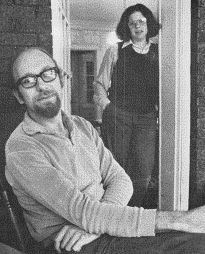
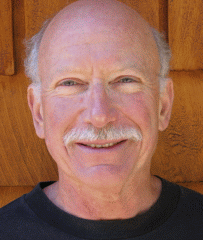
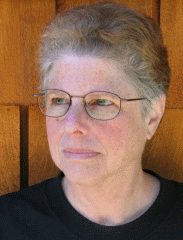
How this manuscript This journey I have begun started with a contribution of back issues of Radical Software to the museum's reference library. When I accepted them, the title lead me to believe they would fit in the History of Computing section that deals with hackers, crackers, etc. On examination, I realized that they had to do with the proliferation in the early 1970's of 1/2-inch video equipment in the consumer market, not just to shoot family video, but to go out and document the world, even displaying it sometimes as art. I read through the issues of Radical Software and, remembering my High School experiences with a Concord Video recorder in the late 1960's, had an epiphany which lead me to develop a History of Video Equipment display for the museum. Through many avenues, I pursued some of the older equipment. Parallel to building the display, I started using the video camera in my HP RX 3715 PDA to do a little 'guerrilla television'! It was my companion at city council meetings and city task force meetings as I participated in an effort to save an historic church building. My videocam and I also traveled along the streets of downtown Glendale, Arizona documenting many of the construction projects taking place to enhance the area. One day, some AV/AVC-3400 cables (for the old Sony Portapak) showed up on Ebay. I purchased them and telephoned immediately to see if the seller had any other material related to the Portapak. I chatted with Kaye and Roberta Miller. Indeed, not only did they have more connectors and an AVC-3400 camera, but related the story of the manuscript contracted with Radical Software authored by them and others from the Chicago area and elsewhere. What an interesting world! Not only was I able to add to the museum's collection, I had a chance to learn about this video "movement" from people who had participated in it, I made two new friends, and can now also bring to publication a piece of history from my new interest area. I will let Kaye tell you more of the details in his introduction letter below. * * * Ed Sharpe, Archivist for SMECC
|
|
|
|
||

|
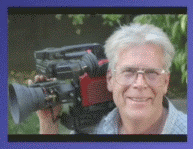
Kaye Miller's letter, June 24, 2005, introducing the text of what was to have been Radical Software #6
Dear Ed,
Other projects in 1972 included (1) a series of tapes on poverty
under subcontract to the School of Social Welfare at the University of Chicago; (2) the use of half-inch video to assist a colleague of mine,
who was also a Chicago alderman (councillor), to tape town hall meetings in an attempt to open up the political process in Chicago; (3),
the recording of brain surgery on a monkey, as part of a process of ensuring
that ethical standards were adhered to in the treatment of laboratory animals. (4) In the summer of 1972, we worked with a fledgling
community video action group in North Vancouver, British Columbia, that was trying to apply locally some of the ideas that had been worked out
by the Challenge for Change programme of the National Film Board of Canada. In these settings, we were sometimes concerned only with the
process, but in others the finished tape artifact was central. For example, the poverty tapes eventually made their way to the U.S.
Department of Health, Education and Welfare. Re-reading the text of this issue after 32 years has
been a remarkable experience. The old expression, "The more
things change, the more they stay the same" seems so appropriate
here. Now, in 2005, we have the Internet, with the utter ubiquity of
images and instantaneity of distribution-- things, in 1973, we could only
imagine might happen "one day."
Title: Inside-Outside: The View From The Hyphen By Roberta Kass Copyright 1973 by Roberta Kass
Raindance Shakes The Gods Loose
Since Videotape began speaking it has frequently implied that words are not particularly necessary either to understand or to work with the medium. Personal experience matters most, and it is always characterized as joyful, positive and consciousness-raising. There is a sense that everything is new, and experiences are a series of fresh beginnings. This notion has been explicated in counter-cultures for years, demonstrating that people who do not believe in words and have little or nothing to say, always find a way--often wordy--to say it. Maybe Raindance realized this when they decided to farm out issues of RS. The characteristic qualities of most video tape talk are hyperbole, ambiguity, logical contradiction, a disregard for historical information and a soaring from the trivial to the cosmic. Nobody vocal in the movement seems willing to analyze (an alienating task); they seem only capable of expressing a sense of the world and their electronic hopes for it (a self-fulfilling pleasure). Some, however, are embarrassed by this tenor of talk and frustrated by the redundancies. (Cf., for example, Dan Driscoll of the National Film Board in Challenge for Change, ACCESS # 10, p. 22. He says there is a "tendency for becoming dependent on the aphorism, the groovy phrase, even the cliché, in a kind of ritualized confrontation with our shared anxieties.") The penchant and tolerance for redundancy is not unusual given that we are force-fed. TV commercials which we refuse to believe, or hum until their themes are repeated and varied into infinity. Video people are, in this respect, well-socialized children of the culture. Tapes, process and product, tape projects, and increased Sony sales are proclaimed harbingers of the new culture. The only reported negative of the vtr experience is getting money from the agents of the system.
From Development to Hype, Without A Stop Bath In the edition of RS, VoL 2, no. 1, the editors asserted RS had printed "long theoretical discussions" about the technology and consciousness of the new media. I don't mind ignorance as to what constitutes theoretical talk as much as I do that others might believe it and refrain from public discussion of the yet unresolved meanings, protocols and best uses of videotape. I am afraid that without further serious talk there will be no counter-force to the technology or the initial hoop-la of early half-inch days. There are many reasons why nobody much bothers with serious thought. For one, theory is an unpopular word, conjuring up images of emaciated spirits and dessicated souls hiding from life behind academic balustrades. A few spokesmen leave the tower to fight the wordy battle against yahoos while the rest sit shaking their heads over rebel youth and plan the best way to get to Washington to apply salve to gaping social wounds. But what a frivolous reason to stop thinking or to abandon the language of thought, as if the mere attempt will contaminate one's being. I don't think we are yet ready for theory anyway; that is the result of long experience and thought, both of which first lead to many dead-ends. What predominates now is what in an earlier age would be called "shop girl" philosophy, a construction of World-views from the narrowest range of experience. Though video people glorify personal experience, in spite of themselves, most are worldly and book-educated. They feign ignorance of social details -1- |
| because the new media is a way, basically,
to empty consciousness, to force the old culture out, and to get ready for
the new. When they honestly try for analysis, they tend to confuse the use
of words with the content of words. In vtr words are used to rouse rather
than convince, to assert rather than prove. The codes and esoterica become
more important than the specific content.
Thus, as an audience eager to receive ideas, we in the videotape milieu are in a perplexing position. There is silence about serious things. Or the words are too crude to contain our experiences with tape. Videotape words tend to say too much while the explanations say too little. Some words like culture, evolution, technology have a long and complex history. But without a backward glance, they are now said to mean different things. And to add to the confusion, concepts such as global consciousness and cybernetic revolution are short-handed into all-encompassing cultural containers. Or else they are called "myths of the future," that is, things that don't exist and can't be articulated in a very concrete way, but serve to inform people that the future is going to be not only better. but theirs. Brice Howard (in his books, VIDEOSPACE and VIDEOSPACE AND IMAGE EXPERIENCE) is onto serious things, but he is more suggestive than precise about the phenomenology of doing tape and mixes. He knows something is there, as anybody does who creates tape, but he can't quite say what it is. But at the same time the words we hear are too busy inviting and expressing a consciousness that is hyperactive and seems to deaden our minds and blunt our senses. That is vtr hype, and examples can be found anywhere somebody is talking or writing about the future of tape/cable/cassettes, etc. Right now, though, any criticism or even analytic discussion of ideas, tapes or the future provokes anger and cuts off the critic from the movement. Kaye and I, for instance, were told (off) that reviewing tapes is highly authoritarian. There is hostile reaction to even the notion (VIDEO CITY RS, p. 15) of holding videotape festivals where public judging and judgment occurs. By talking outside the limited language which dominates vtr the critic steps outside the communal boundaries. Since most video people are pretty mellow and nobody is too firm about his preferences or prejudices, there is a place for everybody once he shuts his mouth and just goes about his own business of "being." Logically, hype can't hold its own against the concrete contradictory knowledge that making tape imparts to us. And it certainly can't offer balance to videotape technology, which is entering our cultural framework unchallenged. To keep silent about serious things will allow the conventional and corrupt forces of public opinion, the state, and business to swoop up the meanings and definitions. Without a foil to conventional social forces, there is only a lot of enthusiasm and some poorly stated and re-stated hopes. Even half-inch people are finding it harder and harder to swallow hype for anything except recruiting purposes or conning rich outsiders. Though for now, the only real struggle is to see how fast the technology can be spread and how many opportunities can be parlayed into funding and equipment. Though a lot of people don't like the hype and suspect that after a while the organizing and consciousness-raising potentials of half-inch will be smothered, leaving to the freaks the disputed glories of knowing better, having pure dreams, and displaying demonstration projects, they don't think that serious talk will do anything either. They suspect or hope that hype or whatever sketchy words are shot from the lip will hold their own until the technology transcends itself and ushers in a post-political era where men live, at long last, integrated within themselves and with their social world. This is the sanctifying umbrella and if you believe it, then nothing special needs to be done, for it is as
When Bishop Berkeley said there was
THE DETACHED Retina The detachment from a critical attitude protects the believer from certain kinds of despondencies which might drive him away from the belief that tape will do anything socially transforming. A story of an encounter: Recently, Kaye and I happened upon a cardboard cubicle placed between the mod shop and cosmetics in an E.J. Korvettes. Inside, two suburban ladies sat watching tv. I said, "Oh, look, a Sony cassette." The fatter one smiled up at us, -2- |
| condescending and smug, but with a look
just passable as friendly. Then she turned back to the tv. Then Kaye said,
Jeez, look! They're watching a Betty Crocker commercial in color on a cassette." The fat lady again looked up, this time piously, and said
snobbily in hushed tone, "It's videotape" For her, as
with others, there was nothing else to say.
So the high hopes of movement people are not based on recognizing what Sony is doing, or how people are putting meanings to vtr. Their optimism reflects personal involvement, which is kept at a high pitch of (hustling) engagement. And so long as the opportunities keep coming, the income is livable, some moderate successes are scored, and some creative work is done, all looks very beautiful and hip. Things don't feel bad, and as long as one refrains from long careful analytic looks, there is little impetus to serious thought. I am not suggesting self-abandonment to a unified mass movement, but I am saying that the belief in an inevitable electric utopia means that conversations with oneself and with others in the public space of print or making tape tend to stay at a very low level. How to argue with somebody who insists, for example, that a vtr unit and electricity in general alter the basic structure of mind, and then says nothing more? And shrugs off the consciousness that Sony is marketing on a vast scale. It is hard to talk seriously about such things because the vtr etiquette prescribes that we either take or leave the offered ideas or take or leave the person offering them, because everybody is entitled to "do his own thing." Any suggestion of interference with the euphoric feeling that everything is possible is taboo, for that is what the Establishment does. This reluctance to judge or opinionate, devoid of coercive power, is in some ways the grand apexal synthesis of traditional American optimism freed of its sobering elements. There is a great clamor about the future but no notions about what may lie between here and there. There is phatic expression, but no mutual search for definitions, meanings, and bodies of argument. There are only assertions, and one chooses from among them. It is like democracy--you vote, you write letters, you run for office if you do not like the way things are (or with vtr, you do your own issue of RS), but what really holds it together is only a technology, a procedure, and not mutuality of meaning beyond one's small cohort. Differences and exceptions are ignored, and this stance of refraining from even wishing to work things in your own way symbolizes the lowest level of building a new culture. The videotape movement is unlikely to produce theory or even a body of careful thought until it begins to doubt, for it is around doubt and its implications that men build a grammar and vocabulary with which to concretize their lives. Without doubt, talk will tend toward reportage. We've seen this often in past issues of RS: reprinted articles, a video directory, activity summaries, technical information. This isn't to say this isn't necessary; it is only to say that it is preliminary. It is the informational underpinning of entering the videotape sphere, but it doesn't contain the vital meanings of work in vtr. The movement is also unlikely to produce serious thought except sporadically, because in America as a general cultural and historical phenomenon, work is fecund and ideas scanty. Only the barest minimum of reasons has been needed to spur the greatest of efforts. Ideas are usually private and harmless. When critical thought has offered its logic and efforts, it cannot dampen enthusiasm which stays at a high pitch in the old culture with the whispered names of effort, work and progress. Videotape shouts to us of new experiences, new consciousness, real community through process. Etc. "More" is the answer to all questions of "why?" As a consequence, thoughtfulness can't find a space for itself. The U.S. (and why not the world?) is so big and so fucked up that it can absorb the biggest of technological dreams of applied problem solving by half-inch method. An example: An Army hospital in Nuremberg asked for a second respirator. Instead they were sent two color video cassette outfits. With more gadgets ever available, the basic questions of meaning might never have to be seriously answered.. In a parable about how to avoid meaning with technology, Kaye tells this story: "Once upon a time, a UN Task Force came to India to convince the people to practice birth control. They went to many villages -3- |
| with a big machine called a Telebeam.
This machine projected a videotape onto a big screen so that all the
people could easily see. While the natives squatted on the ground, very
crowded together, they saw two stories about the future. The first showed
a future of famine, illness, and political instability because not enough
men volunteered for sterilization. the second story told of how future
generations lived peacefully and happily in good health and prosperity because
many men volunteered for sterilization. The tape ended with a plea that
men come forward and make the future bright by having a quick and painless
operation. The audience sat stunned, but the old ways were strong
and no men came forward. The UN task Force left, very sad, until they were
many miles away. Then celebration. What they had not told the villagers
Was that the Telebeam machine had sterilized everybody in the
village."
How to account then, in a reflective way, for the sloppiness in the videotape movement? I think there is much right about the videotape movement and, as Shamberg asserts, many of its stances are survival mechanisms.
The Friendly Barbarians Probab1y the smartest thing video and other counter-culture people have done is to discard history in its predominant historlcal use. That sense is a body of social, politica1 and cultural governing rules which historians and the politically conservative (that is, practically everybody in the U.S. if you were to press them) say a society can't live without. To them, history in this sense means disorder, chaos, and discontinuity. In fact, we have lived long without much spontaneous attachment to civic values and social trust. The videotape people feel openly that they know something our predecessors did not: that we can live freely at last, enjoying all our senses--except the sense of the past--as unremembering, honest, and friendly barbarians all, in a technologica1 Eden." (Philip Rieff, THE TRIUMPH OF THE THERAPEUTIC, p. 4.) Rieff characterizes this sensibility correctly but he doesn't approve of it. Santayana, one of the first to be turned-off of American values, said all traditions were at one time practical solutions to human needs, but when the exigencies pass, the traditional can only be revived to regain its personally compelling authority when it is made over to deal with a new reality, "to face the world squarely, in the interests of the whole soul." (SANTAYANA ON AMERICA, p. 35.) History today fails to do this; instead it acts as a legitimizer of modern ways of dehumanizing people without any redeeming features of a rich ritual life, social trust, or psychological security. Scoundrels use history to maintain a harsh economic and political system and their position in it. I think a sure indication that history has been crippled beyond use, at least for a while, is that we as a nation are feeling a pus-like contamination and the ill feelings that arise when "history comes too close." (Levi-Strauss, TRISTES TROPIQUES, p. 32.) We have stopped living our own history as a nation and as individuals and are living the histories of other nations. We act on behalf of goals we don't feel the concrete referents for; we make policy for the world; we have only the feelings of exploitation of Nature. It always makes me sad when video people so flippantly welcome the rapid transformation of other cultures into electronic space, not realizing that all missionaries create havoc with culturally integrated people, even if it is for their own good. But that is an aside. Abstractions promise happiness but concrete daily living belies that: phoney-war isn't peace; tension, anxiety, and pollution aren't good for you; and advertising images are poor emotional realities. Of course role distance is a necessary survival mechanism. In THE GODFATHER, Michael at the christening, vowing to uphold the laws of God, is intercut with the extermination of his many enemies. Most feelings of role distance don't get acted out in such a grand gory style, but the same feelings run through our talk and behavior. To try to capture the right to interpret history seems futile. That means revolution or the slower task of burrowing from within. Revolution seems out of the question. And becoming a source of authority within the system seems morally risky and only marginally fruitful. Video people either know or sense that history is connected with the incapacity of most successful people to feel the freshness of life. -4- |
| Time in the world of bureaucrats is heavy
and stale. The intellectuals we have encountered are unattractive. The
quiet scholarly ones seem somehow not present in the space of a moment;
they seem "away" as if life were a side-involvement. The actively
successful have aligned themselves with a corrupt political and social
system, trying to find the buzz word that will get them big grants and
promotions. Both types occasionally give life a try, emulating the
supposed vitality of the people they think are not too smart. Their
efforts are a little like listening to a good Christian swearing: the
words are right but the melody is all wrong. So there is a deepening
conviction that we must shed history and its modern out-workings and act
once again first with the authentic assumption that life first is, and
then it becomes transformed into abstractions which are useful and linked
to emotions.
The other difficulty which makes it hard to emulate or take seriously thinkers who rely on history/analysis is that thought doesn't last. Nothing happens more frequently than the unexpected. Wise men in a modern world stay in the present as much as possible, avoiding the future until it is present. Video people excel at this, but it is not a semantic trick. They continue to know and talk about the future, but they refuse to succumb to the two claims that accompany history: 1) history dictates the future and the future is therefore known and 2) once the future is known men are obligated to bind themselves to it emotionally and intellectually. If video people were to accept current versions of history, the future they envision would never arrive. And to bind oneself to a future, even a welcome one, violates the joy and satisfactions of living, now, in the present of one's life. The cultural savants who monopolize history cannot be persuaded away from their power or ideologies. They cannot be driven out of power by political revolution. We can, however, runs the current belief, wait a while for the inherent revolutionary powers of the new media to undermine the system by altering the consciousness of those who are now its victims. Nobody will make change, but change will occur. This argument surfaces most often in the contention that all those children who have been watching network TV six hours a day have had their basic mind structure altered so it responds to electron bombardment rather than print. The old society, therefore, cannot hope to socialize them into full cultural membership because it relies on print, besides being generally oppressive. The children will waver awhile until the pervasive/persuasive technology of half-inch, and other new media, forces them into the leap across the consciousness chasm. It is Marx's old notion that the system carries the seeds of its own destruction. Video people look around and see that the sprouts are up, and they will mature because the system welcomes all technology blindly (machines it can absorb, ideas and movements it fears) aware only of the new media's money-making powers and not its mind-expanding powers. So the videotape movement like so many other counter-culture groups abandons history in the interests of community. It seems like a smart trade. Now the new media serve to disengage oneself from and invalidate the past. People use "history" minimally, to establish that they are not men from nowhere, that they aren't a quick hype. Shamberg, for instance, in GUERRILLA TELEVISION, offers us a "history." He moves from agricultural societies in general to the modern age of autos and videotape in three sentences. He tells it simply, suggesting that the last 100 years aren't as complicated as our teachers told us (one breath is enough). Complexity gets you stuck in the muck and why make a big deal about past events when all the cultural merchants desire is oblation, rather than real understanding from their followers. History seems only to interfere with the pursuit of one's best interests. Getting Heavy If it is true that events and not ideas change the world, and that there is no real connection between them, then there is no particular need for anybody to do serious ideational work. The future will happen without us either planning for it or thinking about it. What matters, and follows from this view, is experience. All that is needed to carry one over emotional and situational interstices are a few notions to connect all the various projects people do. If and when people begin to falter, then somebody will throw out a few new sustaining ideas. The tensions of living this way don't result in thought so much as in discharge--activities which -5- |
| help make the transition between times, to
cool yourself out prior to getting involved again. In this sense, a vision
is functionally as good as a theory. Analytically it might be in error; in
fact, it works.
Despite the frustrating absence of serious talk, there is a bit to be said for vtr's reluctance to talk seriously. People simply are not ready to do more than announce themselves as kindred spirits to one another. Part of the reason for half-inch hype is that technology has traveled faster than symbolic or metaphoric meanings. These meanings develop more slowly and aren't yet available to complement the movement. Once the equipment and the first easy lessons of video are learned the search should begin for shared symbolic meanings. But everybody is still too busy to do much more than spew out accounts of their projects, wish everybody well and move back into his group space. The hype itself is a rouser, but concomitantly it also encourages a devaluation of language, which further hinders a direct surge towards serious thought. No longer does talk have a problematic character. No longer does it matter if you aren't perfectly understood or if you make much sense. But so what? In a pre-Madison Avenue day when language meant something more than a gimmick, a mask, a way to trick people into self-alienation, vtr's abuse of talk would be unpardonable. Now it is not so bad; it is more important to know who your brothers are. The new experiences we have had are much too precious to subject to the twisted meanings of the old culture which wildly attempts to absorb anything which even vaguely threatens change. A new language with a new vocabulary and shared meanings is only now being devised, but until it is more pervasive and precise, the old words are used, with hesitation and some embarrassment. Because much of this new videotape reality is, in the words of Alpha 60, "too complex for oral transmission," the notion of experience will prevail. What language there is is used not so much to communicate to outsiders or to those who want proofs (that would necessitate a logical argumentative style) but to announce one's presence, one's activities and one's membership in the new culture. So until meaning and word come together, metaphor and exaggeration suffice to break through the official versions of reality. And on that score, video people are champs. Many videotape people see themselves as a culture-creating community rather than a doctrine-creating community. They have no interest in the rationality of the out-going order, but only in being the living expressive embodiments of the new electric sensibility. Very central to the videotape mentality is the analogy between electric energy and experience. Energy has no past; it is pure flow, process and motion. To be fully alive is to live in this energy flow, to live socially, emotionally and culturally in the present. Hence opportunities are more important than ideas, action more important than thought. If thought occurs it will develop organically when the time for it is right. The thread that keeps the movement tied together in its public, shared existence (and not in its private individual and group experiences) is images, which carry meanings to us beyond our ability to spell them all out. Images present meaning in a visual language, and resolve experientially all logical contradiction. We can syncretize a meaning from the RS front and back cover where a Sony monitor floats in the sky, more easily than we can tell ourselves with words what it all means. The SEG brings us meanings. The names of groups like Videofreex, Global Village, Ant Farm, Video Free America, etc. tell us how they imagine themselves in relation to the surrounding culture. Raindance even has its Sundance. And the monkey climbing up a TV antenna, juxtaposed with the perfectly socially placed 1950's teenagers in GUERRILLA TELEVISION is more evocative than all word comparisons between then and now. Thus, logos, marginal drawings, and video art are the poetry of the future which give half-inch a basis for understanding itself. These images are vitally important because in looking at most tape, meanings are not obvious. The tapes aren't particularly polished, aren't illustrative of the radical claims imputed to them by the author(s) whose ideas and feelings tend to be much better than the work. "Wisdom is nerves; art is meat." (Gasworks, in the film, STEREOPTICON) In these last paragraphs I am not abandoning my desire for serious talk. I think the future envisioned by video people is a poorly proven case. VTR has made some -6- |
| extravagant claims about the beneficial
effects of the new media, and that is not at all self-evident. There is
continual celebration, enthusiasm, passion, and high energy hype. Words
can help to fill in the chasm between reality and the wish, though this
effusion will probably be around as long as there is
a continuous infusion of new talent into the tape consciousness. The
neophytes will take the same emotional bath we all did, and the feelings
will wash over everybody else again, and we will remember together the
great joys of this worldly activity of making tapes. But to confuse this
ritualistic emotional outpouring with serious and world-culture building
activity is akin to having the shakes and calling it rhythm.
I think we should not speak against serious thought because it is not a heart and soul. We should not get angry because words aren't feelings and images aren't substance. I think that images cannot alone carry us into a complete involvement and understanding of all that is around us and inside us. We should talk and make tapes, being careful to resist confusing language of description and analysis for acts and experiences. We shouldn't stretch to severe strain what academics and pedants have abused and misused shamelessly and without much awareness. We are, most of us, beyond the soul-destroying temptations of the old culture, even though we manage to live off the droppings of that world. But I fear that without thought we will lose ourselves in a fog of self-consciousness, certain that we are creating ourselves, forgetting about the other and multiple realities that surround us. Copyright 1973 by Roberta Kass
Title: Reflections On Two Media William Gwin is a painter. He was the first artist-in-residence at the National Center for Experiments in Television at KQED in San Francisco, and is presently working at the Television Laboratory of WNET, Channel 13, in New York. During the summer of 1973, he was again artist-in-residence at the NCET, and has had his video work broadcast by KQED and exhibited in museum and theatrical environments in Paris, Mexico City, and Tokyo. Video is a very new medium, painting a very ancient one. This fact inevitably creates great difference in the two, but not nearly so great as the confusion of this moment makes it seem. What I hope to do here is to verbalize the sensibilities underpinning my work and to point out a few of the similarities between the two media, or at least between the two ways I have come to use the two media. In this effort I find myself returning to four concerns: naturalism, surface, a respect for the properties of the medium, and motion. These things do not represent the goals of my work, which are creation and expressiveness, but they do represent the ways I have devised to reach these goals. Naturalism is the context within which I work; it describes the basic attitude from which all my work comes. Naturalism describes a synthesis of memories from the visual world and feelings produced by confrontation between nature within the artist and nature outside the artist, and does not depend on any particular observation. Naturalism represents a very different concept from realism, has very little to do with photographic or even nearly photographic representation, and may manifest itself in very abstract forms; but there is always a strong reference to a world outside the work, to a world shared, in a general way at least, by all people. Surface means the visual feel of the work. This notion includes the development of formal relations between various pictorial elements. These relations provide the structuring that allows a work to have the internal integrity that is -7- |
| necessary if it is to have the freedom to be
expressive. Colors, shapes, lines, and textures create and combine within
some sort of spatial framework to generate the image which carries
whatever message the artist might wish to convey.
Motion is either real or implied and is not usually the clearly directed movement of a discrete pictorial element happening in a precise interval of time, but a more general fluttering of the entire field activated at times by currents. The motion of leaves in wind is a close analogy. Respect for the properties of the material means searching out those qualities within the chosen material which best lend themselves to expressiveness and shaping them by combining them with an intelligence rather than using the material only as a vehicle for ideas. Naturalism, surface, motion and a respect for the properties of the material are the four cornerstones on which my art is built. They support the video and the painting, but not always in the same way nor with equal force. By looking at these four ideas and the differences or similarities in the ways they function within the two forms it should be possible to arrive at a clearer understanding of my work and of the potential for creative expression within these two media. Since the context provided by my notion of naturalism is a very general one and has to do with basic attitudes, including the ways I respond to the visual world and the place I want my work to take in that world, it has basically the same function in my painting and my video. While the framework alludes to the natural world, the working out of each image is a more formal and involuted matter which deals with the nature of the medium, with color and with textural, linear, and spatial relations rather than with any relationships between the work and the world outside the work. Surface is the visual feel of the work. Since I've defined this word to include most of what one is looking at when he looks at my work, it might be valuable to see what sort of surface is created, why, and how it is done. Color, texture and discrete pictorial elements, the basic components of surface, are developed by building up interrupted layers. This is achieved in my paintings by applying the paint so a great number of transparent, translucent or opaque layers are produced. In IRVING BRIDGE, my most recent video work, it is done with layers of videotaped imagery. These layers relate to one another in a very dense and complicated fashion, and are defined basically by color, although shape plays some role as well. These overlapping layers create a sort of shallow, ambiguous space; there is no use of perspective or other illusionistic devices in the painting and only little in the video, so that very dense images can be created without losing the breathing space which is necessary for the interaction of the various elements within a work. Video has an advantage here because unlike painting, you can move the elements around, get rid of some, substitute others, and keep the surface from becoming clogged. On the other hand, painting has a decided advantage in the fact that the actual surface can be altered; at present, video must be displayed on a glass television screen. The size and shape of a canvas is flexible, but video must always be a 3x4 rectangle, and is most often quite small. Image resolution is also a serious problem in video but no problem in painting. Many of these factors will one day, no doubt, be eliminated or at least relieved by technological advances; but for a time they erect serious, though not insurmountable, blocks in the path of the creation of video art. The method of working in successive layers has an analogy to the dynam -8- |
| ics of the creative process itself. I begin
with a notion, and usually have a fairly precise idea of how it might be realized;
but I carefully stay prepared to receive feedback from the work as it
progresses, or from any other source, so that the final work is a
composite of my beginning ideas and many other ideas which might have
developed as the work was in progress. It is a non-linear kind of act,
capable of shifts, reversals, and changes when unforeseen possibilities
present themselves, appropriate, I think, to the property of non-linearity
which can be an aspect of both painting's and video's expressiveness.
These potentials are things I'm always interacting with as I work. In the
end the work shows the layers of thought and activity which combined to
create it.
It is this ability to receive feedback and shift to make use of it that allows the notion of respecting the particular qualities of a medium to play such an important role. Whenever something happens as a result of a combination of whatever materials are being used, it is important to be able to see the possibilities inherent in it and then to build on these possibilities rather than having an idea which is so inflexible that every chance happening deviating from that idea becomes a mistake, something to be done away with. That isn't to say that there is anything sacred about a medium or that every chance relation which develops while a work is in progress is necessarily good; and certainly it doesn't mean that materials and chances are enough to make a work of art. Whenever something happens that runs contrary to the idea behind the work--and it frequently does happen--then that thing must be eliminated or modified. The ideas must always remain the most important things; but good ideas are fairly flexible and can usually accept a lot of change without being violated. The point is that each medium should be approached as a unique possibility rather than as only a way to carry the aesthetic. I think things have particular qualities in them, whether they are pieces of wood or pieces of cloth or paint or electronic systems. And some of these things are very, very beautiful. The more completely these things are used the more they can contribute to and increase the overall impact of the work. A videotape of a tree can be made and played back onto a monitor bringing a moving picture of a tree into your living room. This uses video as a storage and transmission device, and ignores many possibilities for creative expression. On the other hand, that picture can be made in such a way as to be useful as a compositional element in a video work made by synthesizing form, color, texture, other pictorial elements in motion to produce something that utilizes many more beautiful possibilities inherent within the medium of video. In television and in most experimental video, time is structured in a linear, basically filmic fashion. Compositions, even the most abstract, have a beginning, a middle and an end. They have a duration and move linearly through that span. This notion of time creates movement, a very different matter from motion. Motion is created when time is thought of as something other than the interval-measures used to structure the daily flow of peoples' lives, when time is thought of as unrestrained change, rhythm, the turning and exposing of another part of the prism to the sun. Motion expresses the kind of time one experiences with Nature. Ideally, my video pieces would be presented in a loop, running continuously. There would be no beginning, no middle, and no end, and no particular duration, save the length of time a viewer wanted to spend with it in much the same way a person spends time with a painting. I don't want to structure the -9- |
| viewer's experience, to tell someone: if you
want to see what I have done you have to come in and sit here for fifteen
minutes or an hour, and if you look at it again, you'll be looking at a
repeat. The notion of a repeat has no meaning in relation to painting and
need not be a part of a video experience. The work is there and what you
see will change to the degree that you're perceptive. I would prefer
presenting a work in such a way that it didn't require one to take a
particular length of time out of his life and give it to the work, which
is what film does or music in concert does. I would let you move in and
out of it in the same way you can move in and out of the things that you
see when you're walking in the woods, or sitting by a window, or doing
most of the things you do when you're alive. That lets the tape, the work
of art, have the same position that any other object has. It is there--you
can look at it, and stop looking at it, and come back to it, and you
haven't missed an important point in its development because it is not
developing in that way because time is not a deliberately compositional
element. It exists in time as you exist in time. It is of the flow, of
that same continuum in which we all exist. It is closer to the kind of
time one experiences with Nature, and much less of the intellectual idea
we impose on experience to order it, structure it, attempt to control it.
Video's non-linearity does have its other side, which is the danger of sloppiness in the making process. But if the maker has mastery over his craft he can give the viewer a great deal of freedom. Obviously the artist does shape the experience--red is a very different feeling from blue--but Nature does that too. Walk into a desert and Nature shapes you in one way. Walk by the ocean and Nature shapes you in another. The way this concept of time expressed as motion structures video brings this medium much closer to painting than to film. In video, motion is real, in painting it is implied; but both can fit into the flow of a person's life in very similar ways. It is like the difference between looking at a rock and looking at water. If you look at a rock the changes you perceive will be internally generated changes initiated by the presence of the rock. It is moving too slowly for the eye to see. Water, on the other hand moves at an easily perceivable rate so the changes we see when looking at it are both internal and external. These notions are evolving because video art itself is evolving. It has almost no aesthetic history of its own, only the aesthetics of other media. In a sense it is too new for an aesthetic to be formed about it, but any art form that is a living, vibrant art form is always too new for an aesthetic about it to be formed. If it stops being too new, then it is an historical phenomenon and is probably no longer being done. That is true of painting as well as video. - Copyright 1973 by William Gwin -10- |
| Further Reflections
After reading William Gwin's article, we addressed several questions to Mr. Gwin. Following are the questions and his responses, abbreviated in some instances. RS: In paragraph 1, you speak of sensibilities rather than theories. Have you deliberately chosen to speak of a sensibility rather than a theory? Is your artistic sensibility derived from a body of artistic works or more from personal experiences? GWIN: Art is never created out of theories. Theories are often created as a way to verbalize and/or justify art; but the creative impulse springs from a need to manifest a response to the human condition and hopefully to achieve a greater understanding of one's own situation through that manifestation. Sometimes one's work affects some other person and allows a greater understanding. When that happens it's a very happy situation, and if the artist is allowed to be aware of the connection that is made, he may be enriched in turn. My artistic sensibilities derive from everything to which I have ever responded. That, of course, includes certain works of art. Most things I encounter affect me in some personal way; and everything that affects me affects my life and art. This might be taken to be the beginnings of a theory about life and art, and I certainly don't discount it; but I do recognize it as an attempt to verbalize and make understandable to the intellect something that is made of as many non-verbal, non-intellectual parts as verbal parts. RS: Not many people talk much about Nature; those that do tend not to sharply differentiate between Nature and themselves, as did many European theorists. People in video tend to talk about the environment as the primary element of experience and consciousness. What do you mean by Nature as an idea? GWIN: Nature is oneself and the place in which one finds oneself. RS: In the last line of paragraph 4, you refer to a work as carrying the message of the artist. What do you understand by "message "? GWIN: The message has to do with offering someone the chance to use the waste-product of a personality's notions toward wisdom through interaction with Nature. RS: In paragraph 5, you say, "... lend themselves to expressiveness and shaping them by combining them with an intelligence, rather than using the material only as a vehicle for "ideas." What kinds of materials have you used, and with what ideas? GWIN: The best way to understand the nature of something is to use that thing. To use something well, it is necessary to place yourself in an interactive relationship with it. If this doesn't happen the meeting of the artist and the thing chosen for material will produce an object incapable of carrying energy from one personality to another. My main materials are acrylic paint and cotton duck, video systems, pencils, ink, and paper. Occasionally I use other things like film and words. Each of these things allows me to do particular things. I've managed to understand a few of the many attributes of these things. I'm always trying to understand more because I've found that by understanding more about my material I manage to understand more about myself. I mean that all my activities are a searching, but never the expression of something I've found. This searching takes place within a combination of my personality, my thoughts, my physical being, and the portion of the world in which I share. RS: In paragraph 8, you speak of the "visual feel of the work". What are the difficulties you have getting the effects you want with video on a flat, smallish screen? Besides the layer effects you talk about, what other ways have you developed to compensate for these difficulties? For instance, how have you dealt with a classical problem of visual arts, such as perspective? GWIN: This is the hardest thing to verbalize in any meaningful way. There is little that is less verbal than the means used towards something that is purely visual. -11- |
| The basic question is how to create a
situation on a basically two-dimensional surface that allows for the
greatest possible involvement of the artist and others who might
look at the work. Since two-dimensionality is the thing that most sets painting and video apart from the world and most strongly
conditions the creation of a reaction to the work, questions of
illusion--its use or elimination--must be central to my search. The
layering I spoke of is one way to deal with this question. It allows the
development of very dense images which remain, nevertheless, open, thereby
allowing entrance into the work. Perspective is another tool designed to
deal with the same problems. It isn't something that has been very helpful
to me. Whether it ever will be or not, I don't know. The strict
limitations of tv screens is certainly a serious problem in video. It is a
problem that must await technological development for a solution. The
limitations are somewhat offset by the pressure of real motion and its
accompanying possibilities for change.
RS: In your opinion and experiences what are the differences between looking at one of your video paintings and a painting on canvas? Is there a difference due to the way time is shaped and experienced in each? How do you expect or want people to interact with each? GWIN: The main difference between video and painting is that a painting is clearly an object, while video has time and motion as a basic attribute. It is in this that video is closer to the traditional notions of music and theater than to traditional painting. It is in its two-dimensionality that it is closer to painting than to music and theater. One thing I'm trying to do with video is to use time in a way that is uniquely appropriate to two-dimensionality. I try not to have particular notions about the way someone else might respond to my work. RS: In paragraph 11, you say that the "more completely" things are used, "the more they can contribute to and increase the overall impact of the work. " Do you mean that you wring from materials all their qualities? Do you, for example, spend much time feeling into things, studying them from all angles, including their histories and uses, or do you work with them until you know them intimately? Do you feel that video can mediate between a tree and a person by itself, or does an artist have to mediate between the tree and man by first creating the essence of the tree, as he sees and feels it, on the videotape or canvas? Is looking seeing and feeling? GWIN: All the things you said. I don't think materials or tools, and that certainly includes video, can do anything by themselves. The only thing that carries my value is the personality that is preserved on canvas or videotape or anything else. RS: Do you have a usual way of reaching the most comfortable internal time experience which allows you to create? For example, do you bracket or suspend the world before you create? GWIN: I don't think the kind of separation of my life into clearly defined functions exists in the way you seem to treat it. I try not to bracket or suspend the world. My work is a major portion of my existence and the flow between it and other portions of my life is very smooth and unbroken. I feel that I never stop working; that my art is something that underlines the whole of my life in much the same way my heartbeat does. RS: What is the flow of time you experience with Nature? GWIN: For the sake of efficiency man decided that it would be good if everyone decided to do similar things at similar times. This has become more basic to our lives than it should ever have become and has therefore become arbitrary. There is another ordering of motion that is more natural to life. It has nothing to do with appointments and everything to do with the pulsing of the organism. RS: You talk of your works as objects existing in time, as other things exist in time. Yet people on occasion feel themselves to exist or be outside of time. A usual test of great art was that it would exist through time, and when people looked at it, they would not know at that moment the real time of the world, wherever that particular social reality was. Have you abandoned this position for your art? Does it have the quality--do you even want it to have this quality--of existing out of time? Do you want people to feel this when they view your work? Do you think that reality is coterminous with experience? Do -12- |
| you think that reality is on a continuum
with experience? Which would you prefer your audience to fee l when they
look at your works?
GWIN: I have never been able to understand the notion of forever. I can't imagine the boundaries of reality or experience. I cannot comprehend a reality outside from my experience.
Title: My Life In Video by Barry N. Schwartz Barry Schwartz, author, poet and educator, is Director of the Cultural Alternative's Network, a collective working in education, video and the visual arts. His new books are THE NEW HUMANISM: ART IN A TIME OF CHANGE (Praeger, March 1974); THE VOYEUR OF OUR TIME (Barlewmir House). The Cultural Alternative's Network makes social change software and is concerned particularly with the interaction of art and community.
I Like The Way I Am Killing time with television, I spent innumerable hours propped up precariously on elbows, dead center in front of the screen. Though I put in my time at the Peanut Gallery, I am certain the electronic stultification of '50's TV did little to mold or erode the form and substance of my mind. No, for the greater part of my life I was a generalized learner; a person affected by so many things, I was influenced by nothing in particular. In my late teens I became what is known in video/cybernetic circles as a print person. As an outcome of my encounter with Camus and Sartre, I trusted good books. Their intelligence and passion are radical software. I immersed myself (an anachronistic term for saying I was synchronous with), I learned about freedom, responsibility, the shortness of life, and the fullness of life. I emerged from my reading with a reasoning ability which faithfully transforms any situation into its quintessential peak experience. ("You can do betta' wit' your meta! ") If I was a linear man, I earned that ignoble status because I was too busy to contemplate my navel. At 20, I graduated college with a degree in chemical engineering. I tell you this to explain why I don't get off on fondling technology. Unlike some of the cybernetic wunderkind, I find it impossible to fall into the mystique of electricity, hardware and interfaces. Etched in my brain is the memory of me, standing absurdly in the middle of a 10-foot diameter vat, trying by prayer, good humor and a few basic principles, to keep millions of particles suspended in a colloidal existence, while water came in and left and a large rake turned slowly, coming closer and closer. Two summers I slaved for an electronics distributor, and in the process learned the sad relationship between electricity, media and cruelty. My graduation in engineering coincided with my graduation from it. I began working in the Humanities. My Ph.D. thesis was on McLuhan. At the time it seemed a reasonable thing, so I compiled a fine bibliography of his works, and never asking why he still went to church, I went into research. McLuhan's ideas contained a very important half-truth. He showed us the price we pay for the benefits of print technology. For instance, at this precise moment, you are isolated. Despite your lover lying beside -13 corrected number-
you, manipulating your genitals in an effort to improve your diadic relationship, you are working in delayed time. You do this every time you read. ("Honey, do you think you manipulate my genitals to improve our diadic relationship?") Reading requires the reader to leave real experience in order to undergo an experience which changes him; this change is perceived when he enters real time again. ("Honey, get me a towel") Such stuff used to be called investment, much valued by the older generation, but now high on the list of cybernetic no-no's. McLuhan also helped me to see that if I wanted a clean dossier I had to regard print as a dead end. But as a writer I want your undivided attention. (You there! Get your hand off those genitals and read your own magazine.) Print supports private property, secrecy, individualism and social fragmentation. Thus print, at least by the measure of instant gratification, takes a person away from life in a very limiting communication experience. Though the reader may ultimately be led to a more fundamental engagement with reality due to what he read, it is half-true to say that print is a poor container for experience. Print demands linearity, while radical social change-save-us-all new media encourage simultaneity. (" honey, manipulate my genitals while we read this book.") Print experiences, when compared to electric ones, seem utterly lethargic, with the slowest of time trajectories. (Damn it, honey, you got the pages all wet.") Further, print begins in isolation, reaching an audience of more than one only by a wasteful expenditure of energy. The new media are electronic; they need no distribution, only connection. It is certainly true that intellectuals, spoon-fed print as a substitute for life, conform to the characterization of linear man. A print-person is thinking, not feeling; logical, but not open to common sense; patient or argumentative, but never simultaneous; always working out the analysis, but seemingly incapable of coming to conclusions ("Honey, pass the towel ") and acting on them ("Get it yourself!"). Our universities are mortuaries for print-types; but I wonder if they are print-types or if the particular bondage chosen by these programmed masochists doesn't just happen to be print. Unfortunately, McLuhan was packaged as a whole truth product. And idiots used him as fuel for the eternal debate between the whole truth and no truth at all, rather than acknowledge the important insights developed in his work. If McLuhan were left standing he would win; then comparisons between him and Darwin and Freud and Marx would be permissible. If he lost, which is what happened, he'd be sent to pasture to play with the graduate students, fertilizing their seeds of imagination. (America is bullish on McLuhan.) Buckminster Fuller, that other grandparent of the new consciousness, always interested me. I was born only in time to catch the last decade of his work, but ever since I talked with him in 1966 ("I met Fuller sooner than thou!") I've admired his genius with love and detachment. For he has shown me that the closer we are to a subject, the less we know about it; that the more detached our perspective, the greater the inclination of the mind to achieve metaphysical insights. He is, of course, architect, designer and scientist. But for thousands of passionate admirers who talk planet earth with him, he serves as a master storyteller of the new consciousness, a wizard who ferments analogy and logic, combining metaphors of man, nature and universe into a more coherent, and more humane vision of Mother Ship and her astronauts. Fuller is orbiting somewhere in intellectual space, radiating celestial comprehension from the special vantage point of genius, surveying the human condition with undisturbed ego. With wit, brilliance and flexible intuition, he wishes earnestly, if somewhat naively, that we should all realize we are not each other's enemy, that there is enough to go around, that man's technology has opened the door to happiness and abundance, that our present ways of thinking work against our own wellbeing, and that once we have perceived this we should think differently. Fuller, in his way, is a cosmological moralist. If men believed what Fuller believes and acted on those beliefs, Fuller's analysis would be flawless. A world of Buckminster Fuller's would be a world of sharing, of planning, of the greatest human needs receiving the greatest human attention. But it is not Fuller's world. A moralist is one who argues for the ascendency of a value system in the face of its -14 corrected number-
|
| denial. Fuller is a faulty designer, for his
design is inappropriate to the human species. His vision of the future is
only one of the many we might develop if we believed that we could create
our futures. Most of mankind does not. The man who does not believe he can
create his future is less inclined to do so. Though Fuller acknowledges
their presence, he does not adequately deal with those who know we could
lave abundance but who still do not choose to share the wealth. This man
of good--for Fuller is a good man--has not yet come to terms with the
question of evil. By assuming that destructive acts come from mentalities
believing war, exploitation, and divisions between rich and poor are
needed for survival, he also assumes that, when shown abundance is
possible, men will cast off their competitive, destructive, greedy urges
and give peace a chance. He assumes basic good will but that isn't easy.
And I Heard... I have shared these perceptions with you to show something of the head I bring into video interaction. Prior to shooting any tape I was essentially a composite of two different perceptual modes: a very cognitive person largely concerned with ideas and analysis; and a feeling person, possessing a heated response to life and an unquenchable thirst to experience all of the best of it, within a world that felt sick, morally empty, and unnecessarily cruel. Like most working in video, I was deeply affected by the 1960's. For ten formidable years social protest was a powerful adolescent, capable of strong acts, little reason and infrequent analysis. Breathing the social air of this decade gave a feeling of strength, of rebellion, of energy. It was a time of rebirth, of renewal, a time when we believed that if only we could speak loud enough, we would be heard. For many, the '60's were an investment in communication, but our benevolent Daddy had wax in his ears. When we yelled loudly and frequently Daddy heard and answered, as is Daddy's way, with bullets, cops, laws and manipulation. In the end we found the rip of shotguns and morgues for students who had been to class the day before. Heavy it is, talking to Daddy. Great Energy in the '60's! But the end was tragic. Among the political activists I knew, most decided finally to become the adults their parents always wanted them to be; in the end the old values endured. They chose to do less with more, found small boxes to work in, or small niches to get stoned alone in. Many now occupy a world more with things than with each other, a world of anxiety and a fixed state of being permitting nothing so unpredictable as personal growth. For those who preferred a more active existence, there was always the cultural thing. A smaller number, hardened in their hate of everyday America, pulled back into themselves and formed communes and collectives. Though they vary in content and form, in success and failure, they have in common a desire to maximize control over life. Yet the most important, most vital of these oases of sanity are not safe. In America there are no peripheries, only regions scheduled for development. Those who went away gained strength, insight, and generally a much-improved perspective on the current struggle between life and death in America. Now, it seems that it is more difficult to stay away than to get away. We are now told that media will save us. Here is the way to be relevant, to carry the cross of social change, to use the tools of the system against it, to be able to spread the word like it has never been spread before, to turn people on to themselves. All these antibodies fighting the sickness! Media. What magic the word has, particularly to the first generation growing up loving up a television screen. How easy, how right for the times that we should believe technology is going to do for us what we have thus far been unable to do for ourselves. Those who are serious about using video as an alternative to conventional broadcast modes usually have one of several distinct orientations. One type of video user wants to expose reality. They want exposure to lead to awarenesses that lead to action and then change. An example of this is People's Video Theater. Here they use video as "people television," as a kind of software. They focus almost entirely on new content; the qualities and properties of video itself are seen merely as available techniques to this end. They tend to produce specific examples of social feedback to social situations. -15 - |
| A second kind of video maker finds reality a
bore and wishes to create other realities--media realities. As opposed to
the first type, this group are medium users. Their highest priority is the
actual process of working with the medium and they claim no utilitarian or
socially useful goals for their tapes. An example of this approach is the
work of Stein and Woody Vasulka. Here video is seen as a powerful new
medium for aesthetic creation. [Ed. note: See also "Reflections on
Two Media" by William Gwin, this issue.]
These two perceptions of video are quite unalike. One sees the communications potential of video; the other sees the creative potential of the medium. Occasionally, the video users believe the medium users are frivolous and irresponsible, caught in that bag called art, a haven and a refuge from engagement with a sick society. But the "artists" often see the "communicators" as amateurs, using video in a primitive way for purposes long relegated to other media. Though each needs the other, they are separated by different values and different commitments. Still another use of video is for narcissism. These self-promotional tapes are made by video all-stars, already identifiable, aspiring to the same status in video as others enjoy in theater, painting and baseball. They float from one kind of tape to another. Their commitment is not to the development of a video aesthetic or a philosophical or political position, but to success itself. They will struggle to shoot and exploit what others commend. As tape continues to be "the thing," the video scene is riddled by entertainers, overnight wonders, and personalities who exploit the medium to provide "events"--the latest news of what's happening, where nothing is happening. A fourth kind of video user sees the medium as a platform for demonstrating intellectual insights. At best, some create a kind of video research that's very good indeed. At worst, video, an interactive medium drawing its intensity from the life it is exposed to, becomes the show and tell of philosophic conceptualization. In New York, the history of video and the influence of McLuhan have been intertwined since he conducted a seminar at Fordham. John Culkin, Director of the Center for Understanding Media was there; Paul Ryan, a pioneer in video research, was there; Theodora Sklover, a well-known advocate for public access cable TV, was there. And the wedding processional of an outlandish theoretical conception of media and the pragmatic use of video began. Although the seminar and all that flowed out of it is of historical interest, its early insights have been eclipsed by the development of video itself. Yet the fourth kind of tape I mentioned still derives its rationale from the mismarriage of theory and practice. Some believe that cybernetic consciousness can be transformed into an equivalent mode of tape. Cybernetics is a comprehensive overview, a system of thought resulting from investigation of informational processes, which not only tells about parts of the whole but describes the whole itself. Some believe it is the only existing metaphysical model now able to withstand scrutiny. But whatever name it goes by (whether cybernetics or systems analysis) it is today's version of the historical attempt to integrate human knowledge with a holistic view of the universe. Cybernetics can be thought of as the re-humanizing of scientific information, a generalization of all data into a metaphysical model. Cybernetics has been called holistic and it is. It is an existential science, for it enables us to describe the entire workings of a system without resort to first causes, to the workings of the divine, or to a cosmological order. It is a comprehensive model that does not necessarily refute the principles of relativity. It is a view of meaning that does not require the universe to be meaningful. Much video terminology has come from cybernetics. Most who claim that video has a theoretical language mean that the terminology of cybernetics takes in the phenomenon of video. But even though cybernetics is a satisfying approach to certain kinds of analysis, and though it has been very helpful in identifying the properties of such phenomena as feedback, videotape is not an intellectual experience and is little aided and often harmed by an overlay of such massive conceptualization. Holding a portapack, switching on the deck, is tantamount to uncovering a domain of moral choice. As soon as I select -16 - |
| something out of the entire range of human
experience I am tentatively identifying what I consider to be of value. I
may change my mind by erasing tape; refine my decision by editing; keep my
choice private by not showing tape; but all through the process I am
creating something that very much depends on how I have created myself.
I got into video through politics. When the big bread for video started coming down in New York City, those who believed in doing more with less revised their notions and re-dedicated themselves to the premise that you can best do more with more. While one media group did a rain dance, trying to motivate the heavens to literally burst forth with a shower of plenty, or at least $260,000 worth of plenty, another media group played a dirge throughout the global village. If the media groups were a video community, sharing some common goals and like values, they certainly suffered for lousy orchestration. I am a student of resources. Though money per se is no panacea, and since the whole system is a rip-off, I do believe that more money available to more people provides the best chance for something new under the bald eagle. It isn't a fanatical point with me but more of a working philosophy. So I got involved. Now, there was a time in the political hassling when it would have been possible for these media heads to live what they talked. If video creates global consciousness, where process is more important than product, then you would expect the goal of group decision-making and self-determination would be obvious. After all, if videotape democratizes information, weren't people who make this claim enthusiastic about democratizing their information and sharing in decision-making? Ah, wilderness. It was pitiful to watch.
"Don't Walk" In the end the money was divided evenly, which is about the best you can expect when no one believes anyone else is equal. I left the political madhouse to join a video group that wanted me. Why not? I worked with three under-developed people. One was raised on sugar cubes and believed the world was divided into two camps, those who wish to live and those who are dead and/or dying. I agree with him. This young man's problem was that he was able to live in one camp only if he died a while in the other. His survival mechanisms were shaky. Another young man was religious; all our problems, he said, stem from our Neanderthal-like state. We had not yet evolved into the next, higher form which he called Protean Man. Since there aren't great numbers of Proteans yet, we've not much to do but explore the Protean consciousness and wait for the cybernetic rainbow with its pot of Acapulco. The last thing he ever said to me, that I heard, was: "You're so beautiful I could punch you." He meant it. So in case you meet any Proteans out there... The third of our crew was one of those scarce forties who stood on the balcony of the old world, threatening to jump. He was enough alive intellectually to relate to the psychedelic generation and sufficiently experienced to approach social change by studying it. His rap was brilliant, his mind imaginative, and his heart connected by an umbilical cord to his checkbook. Unfortunately, he never took the leap into newer forms of being. There was a fourth, but he rarely got off the Long Island Expressway. We weren't what you call a formidable bunch. One got high. One told stories of a friendly Alphaville. One played godfather. And the fifth, once again caught in the historical role of Jew, laid press and patience to the processes leading from self-mutilation to self-congratulation at work well done. If our VTR equipment could only tell what it knew... We received patronage for a non-fiction video piece. And, aspiring to the highest fiction, a media event, we began the long process leading months later to the best tape we could make collectively. [Ed. note: DON'T WALK, discussed in this issue by Terry Moyemont. The levels of our interaction were multiple and sometimes unspeakable. If one was afraid of linearity, the other was equally concerned about outcomes on the person viewing. Impact vs. intention; process vs. product; direct statement vs. visual metaphor; reality vs. imagination; the sick society vs. heightened consciousness: these were the battles we fought incessantly. Each in our different ways was struggling to make video do something which we otherwise did not know how -17- |
| to do. Though the particular group process
we engaged in was unnecessarily painful, it was certainly fertile ground
for growth, insight and development.
My experience with video was then, and is now, a very positive way of relating to reality. As well as the actual processes of making tape, and the interaction of a group in the shooting of tape, there are many personal, social and artistic uses for tapes, which, though not mighty responses to fascism, are useful and significant aspects of the medium. Video is an artistic, perceptual goldmine. I love to shoot. I find exciting camera angles, pick up nuances in the little human dramas unfolding before my electric eye. I find quixotic ways of rendering reality in greater focus, and move in where the interaction is at its peak. Like most forms of self-expression, shooting video is a stress situation where you have to decide at every moment which aspect of the action initially in view should be framed. Videotape is a dynamic medium; life and art coincide for long journeys into time. Thus the aesthetic of video is indifferent to considerations of composition and balance, and is very sensitive to interaction, motion, visual metaphor and symbolic meaning. Some people use a camera like a gun or a ruler, They are visually didactic, demanding that the viewer see. Others believe that making video is merely a matter of acquiring portapack and venturing into the world of abundant software, shooting, to collect at once the significant and the banal. Editing, unlike shooting, always seemed a chore. It's a frustrating, demanding kind of work, usually involving more than one person, and with a time frame I find stultifying. Though on occasion it has its keen moments, especially when one cut will make a tape live or die. Mixing was the high point of my video work. Perhaps the reason I respond to it is related to the way it maximizes possibility. At anyone moment the widest range of choices are available. Sitting before a Special Effects Generator with multiple video inputs is like playing captain of a ship in rough seas. At any second the whole thing can capsize. Good mixing is like holding the rudder at even keel. It is a dance of decision. I am sure most have had similar experiences with video. Making tape is an enjoyable, pleasurable experience. Yet, few are willing to communicate about tape in terms of how they feel when working with it. Instead, enthusiasts claim for tape not what it can do, but what it is we need to have done. AGC Does Convert To Manual Video does have a great capability for providing feedback and that is fine. We need desperately to see ourselves in order to change. Video is a great opportunity for self-perception, group perception, and potentially, community perception. Video reality is like life reality, and can be used to "clean up" the data of life so that its essential qualities become visible. The widespread use of video in therapeutic settings, the Canadian Challenge for Change program, which uses video as an important tool for community awareness and development, the home use of video to provide reality-testing-feedback, are important and lasting experiences. Video does make it possible for subjective perceptions to become the subject of objective feedback. I also believe that, as an experience, video is fertile ground for the reconstitution of group experiences. I am truly convinced that if every school-bound child were first given a portapack and a monitor instead of a book list, young people would more effectively acculturate into our time and place. Most communal activity in the sick society--watching an Apollo launch, riding the subways, traveling on freeways, sitting in a baseball stadium--are group experiences emphasizing loneliness and the sanctity of each and every cubicle. Team teaching is still not an acceptable educational methodology. Team efforts in science, like those in advertising, are highly controlled situations, maintained by a visible hierarchy of power relationships. Spontaneity and openness are discouraged by the real pressures to win approval from one's superiors. Aside from sitting around stoned there is no pervasive social mechanism for group reconstruction. The closest thing we have to communal -18- |
| action in America consists of a few rural
communities and life in the local firehouse.
Video is open to the diverse contributions of individuals. At its maximum potential it is a mass medium involving everyone who will become involved. It does bring together or permit coming together, where most of society is committed to keeping apart. The inherent properties of the video medium are important. Nine million children watch Sesame Street daily. They are quite willing to spend many hours of their lives looking at a TV screen; they are a society well attuned and conditioned to the television medium. Thus they can be encouraged to discriminate between broadcast and people-originated software. Further, though the entire failure syndrome in schools is maintained by varying degrees of success with print and mathematics, video lends itself to achievement every time. But the uniqueness of the human eye, mind and imagination is always apparent as each person making video creates a really unique reality on tape. Caught in the vise of conformity, children can learn from video the relativity of perception and the infinite possibilities of human expression. Still another facet of widespread video use is the gain of confidence which accompanies the mastering of technology. Since we associate access to and use of technology with power, individuals whose previous use of it consisted of a car, a Polaroid camera and the telephone, can undergo a transformation, making it possible for them to reach many more people than they know. I have seen people in the streets and in institutional settings, with camera in hand, displaying confidence and a sense of efficacy they previously did not have. They now hold in their hand a recognized symbol of power in a media-oriented society. Finally, widespread use and familiarity with video may do much to carry forward the process of democratization. The widespread use of video suggests "every man his own perceiver"--a real blow against the mechanisms of brainwash and programming. Every human environment, every setting, every meeting, every life activity is available as mass information. What if we could see how the rich live, our leaders live, our heroes live, our losers live, our revolution lives? I can imagine media radicals short-circuiting the establishment's electronic information banks. We may yet see 21st century Robin Hoods stealing from the information rich to distribute to the information poor. No life activity would be safe from a video rip-off. And since most of what our leaders horde and society sells is information, not products, video pirating and video evidence may well become powerful tools in the hands of the people. That is, if we survive 1984. Unfortunately, the discussion of video is fraught with imaginative projections of things which are not real. Some believe that the media themselves will transcend all obstacles. These post-political thinkers see the technology outliving the social restrictions now placed on it. They see media as the circulatory system for a new consciousness--an ecological consciousness --which is destined to become synonymous with human thought. It is alienation from power structures, and a personal sense of impotency that leads people to believe that history comes into being without human choice. The world we live in now represents the values, ideas and beliefs of those who have the power to give a form to the human situation, which will change only when those who have the power are changed and those who are changed have the power. But as soon as we move from the process of making tape to the claims made in the name of showing it, the question of the importance of tape becomes obscured. While video people debate the "truth" about video, while some get their charges from playing with the central nervous system of humanity, while some are interfacing until they're blue in the face, it should be remembered that almost no non-establishment video exists without some kind of government or state subsidy. Needless to say, what is given can be taken away. History may later show us that those who now claim great hopes for a free and open video were temporary researchers, working for peasant wages and destined to be dismissed as soon as they exhausted themselves on the development of the medium. One can turn to the VIDEO HANDBOOK, AUDIO- VISUAL COMMUNICATION MAGAZINE, or a dozen other sources for confirmation of the fact that the communications industry is getting ready to all but seize cable relay television, to extend and magnify control and profit, and if necessary, to -19- |
| snuff out the video movement unless it
snuffs itself out first.
Although video, like all media, does have certain intrinsic qualities, it is, all the same, despite the raps, the theory and the meta-'s, only a tool. Now it is covered over with what R.D. Laing calls the "mystification of experience." A powerful tool used by people with powerful commitments, with sane and humane values, is the only winning combination. Yet, it is not surprising that individuals questioning their own self-worth, perhaps justifiably so, would speak so loudly of the properties of the medium and so softly about the qualities of those who use it. Values that emanate from words and not acts are doomed to stagnation. As ethical propositions, academic verbiage, media raps, moral persuasions, and philosophic learnings, verbalized values do little more than provide fuel to burnt-out fires. And as values without application are futile, new information without new values is equally useless. The truth alone will never set us free. The new media will only be of enduring utility if their potential contribution to the humanizing and liberating movements of our time is accomplished every step of the way. Thus video will come to be used for new purposes, generally, only when the medium and the new values are indistinguishable. Video is important; we cannot do without it. But video is not going to do some thing for us, without us. What can be done? First, every sane and life-affirming individual must learn the politics of media. Today ignorance is no bliss and is certainly a more advanced stage of alienation. Unfortunately, much information is either too technical--an outcome of that Tower of Babel called specialization--or too obscure--the language of bureaucracy--or it is enthusiastically mystified by those outside the power structure, whose aspiration for community is less vigorous than their wish for status. All those who divorce research, involvement and information from social struggle have already assumed their own impotence. A dehumanized society is not neutral to the forces that would change it. Never treat a brother like a passing stranger. If we had an agreement among half-inchers to pool 10% of earned, ripped-off and granted monies to form a national organization whose purpose was to direct the activities of lawyers working in the interest of free cable and the half-inch movement, we would find ourselves in better shape five years from now than we will be if things keep going on as they are now. At this very moment important political decisions are being made which later will be offered as the "normal" way society regulates cable and video. It is today's ignorance that will limit tomorrows options for human connection. Howard Hughes is a heavy; who IS going to take him on? And does Clifford Irving love you? Everyday we hear how cable will create great access to information; it will assist self-identity, democratic processes, educational environments and community organization. The degree to which we are sensitive and responsive to the emerging regulations and uses of cable will do more to determine the significance of this communication system than the technological development of cable itself. If cable and video are allowed to continue as laissez-faire activities conducted for profit motives or government-sponsored research, cable television will turn out to be a McLuhanized Montgomery Ward Catalogue. The only hope for cable is that government make a clear-cut distinction between the hardware, the content and the carrier. If cable relay becomes a common carrier, then like the telephone, we will be able to use hardware, pass the signal and inspire and produce the content. It is in the area of real struggles, like the cable question, that the post-political types are deadly, believing as they do that the technology itself will transcend all attempts to contain it. If media watchers believe that, despite regulation, obstacles and present industrial interests, the media will prevail, then who will create the media action programs, based on human values, that will seek to reorder existing priorities? The new media can communicate new values that are incarnate within the media itself or they can foster a new dynamic consumerism, an electronic package for the old values. DEAD FISH For some years now I have collected tropical fish. Only recently did I feel ready -20- |
| to maintain a marine aquarium. The challenge
of duplicating the requirements of ocean life is infinitely greater than that of fresh water. Though many aquarists believe that
precise controls on temperature, ph, trace metals, copper and nitrates are
required for the fish, the well-being of the invisible bacteria is
supremely important to the chemistry of the fish tank. If the bacteria
die, the waste, measured in nitrate counts, will build up to lethal
levels. Last October the bacteria in my tank died. As I gazed into the
fish tank I saw healthy marine specimens; I was unaware that all the fish inside were, for all practical purposes, already dead.
Sometimes I think that the situation for video and cable is the same.
It is clear that the existing communications media are, as they are used, sorely inadequate for the communication of their own crisis. As I look into the video world I see we give much attention to what We are doing, and very little attention to what They are doing. Like my fish, we may be enjoying it right up to the very end. - Copyright 1973 by Barry Schwartz
Multi-subjectivity: Our View Of Them Vs. Their View
Of Themselves In 1972, Steve Morrison, a student at the British National Film School, persuaded the school, over strong opposition, to support him and some others in a project in Belfast, Northern Ireland. They lived with and taped for a month a Catholic family, the McGourans, and a Protestant family, the Fletchers, The two crews shot about 30 hours of tape with each family, using Akai quarter-inch equipment. They encouraged the families to take an active role in the taping, including the initiation of shooting and the deletions of sequences already shot--a kind of control familiar to Canadian and American tapemakers, but new and a bit disconcerting to National Film School documentary and ethnographic filmmakers. Later, when the material was brought back to England, deedee Glass joined the project, and she and Steve worked for six months editing two tapes, with each family tape one hour long. Editing was done to half-inch, with the intention of going eventually to one-inch or to film. The editing principle that Steve and deedee claim for the tapes they call "soap opera, " and mean by that the organization of the material along the lines of "stories" that develop in the lives of the families, rather than according to the usual conventions of the political documentary or the ethnography. We found that the tapes worked for us, not because of the soap opera editing or because the families were especially interesting or insightful about their situations. The tapes worked because we knew that history was occurring; it is immanent in everydayness in Belfast. We know of the special context of "ordinary" life there and as viewers expect History to kick open the door at any moment. We include these rather lengthy interviews because we think they reveal some of the ethical and operational problems tapemakers face as they invade--for some social, political, moral, or aesthetic reasons- the lives of others. We conducted the interviews with Steve and deedee during their recent visit to America, where they showed the tapes to video groups, a few anthropology seminars, and to whoever heard about them and arranged for a showing. - The Editors -21- |
| RADICAL SOFTWARE: Why isn't soap opera
editing cinéma-vérité?
STEVE: As I understand it, ciné-vérité is built on certain formal principles, namely, you don't interfere with people and you try to develop an observational style. As much as possible, you try not to use extra lights. You never ask somebody to do anything twice. What is desired is the nearest possible thing to objectivity, the role of the detached observer. The choice of subject matter is something different. First of all, I don't theoretically accept the notion of objectivity anyway, and therefore I think setting up these rules is an illusion. On the other hand, I'm not in any way interested in saying, "Okay, there's no such thing as objectivity; there's only subjectivity; therefore, I'm going to be as subjective as possible and paint nice video images of what is going on in my head." I don't like that because it turns out to be one-head filmmaking. What I'm interested in is some area which doesn't claim to be objective, because that doesn't exist, but on the other hand isn't reduced just to the head of the tapemaker and is sort of mono-subjective. RS: Would you say the middle area is the two tapes you made? S: Well, I think they're on the line. I don't think we got there. But what we attempted to do was to create multi-subjectivity. In traditional filmmaking that means Realism. RS: Why didn't you interview people in your tapes? Why weren't you present as (honestly engaged) provocateurs? S: You remember the scene at the beginning of the Protestant tape, where they're talking about whether we can tape in the front room? Whenever I look at that scene I regret that the cameraman didn't include me in the frame because it is a dialogue. Also later, when Harry talks about Bernadette Devlin being a wolf in sheep's clothing and, on the face of it revolutionary, but really a Catholic, I am talking to him; it is a conversation and I should have been in the frame. I have no argument with you about this. I think that if I continue with the tapes or any other tape, at least some of the crew will be included in the tape. RS: Another thing that is missing in the tapes is coherence. They are confusing. There seems to be no structure of telling, no direction to them. S: Well, I'm coming to this. When we watch a soap opera in Britain, we are not told who the characters are. We're not told what age they are or where they work, what their sex relationships have been. We're presented with characters. We stay with them as a sort of personal thread and we are supposed to learn what they are like through an unraveling of their social relationships. RS: Right, you learn their history over time. S: Exactly. That is a normal fictional dramatic structure. It is not the normal documentary dramatic structure. People who watch documentaries assume that within the first five minutes they will be told who the participants are, where they work, why they are on film. That information is not supplied to them when they watch a drama. Even the worst B movie, right? RS: A drama does more than that because it uses a conventional language -which your tapes don't. Your people aren't even known types outside of Belfast. S: Right. The tapes partly come out of my gross dissatisfaction with media treatment of Northern Ireland, and I don't mean just the conspiracy theory that the media are British and that there are political restrictions on what you can report. This is nothing to my -22- |
| mind compared with the inherent limitations
of network tv in dealing with Northern Ireland. For example, your average
news editor, through no fault of his own, shuffles very similar
ingredients every night: a demonstration, a funeral, a woman whose kid's
legs have been blown off, an interview with a
politician, an interview with an army officer. And the decisions he makes
are vaguely connected with a news peg. People in Britain really don't know
anything about Northern Ireland. The political center is not the same
there as in Britain. This is why I got into it. I'm not an artistic
creative filmmaker. I come from the BBC end or the scale, the journalism
end. Given my irritation with what seemed to me not only political
considerations but the inherent limitations of the media--it's impossible
to explain the history of Northern Ireland before every news report and no
amount of specials in a year would make any difference--I went over to
Belfast just to see what I, as an ordinary British citizen following a
policy of deliberate naivete, would discover.
RS: So that brings us to a question we've had since talking with deedee: A frequent problem with tape (with film too, but it's usually not as apparent) is that it represents a partial reality. Tapemakers often find it necessary to be there when the tape is shown to explain what it doesn't. It is interesting that you and deedee have taken the tapes on tour. Many legitimate questions flowed from the tapes that the tapes didn't answer. What do you feel about that? Is that an inherent limitation of the tapes? S: I have two feelings about that. At first I thought that was a terrible thing. I thought the material should be self-revealing and that it would be absolutely ludicrous for me to go around every place with the tapes. Although there is an ironic contradiction there because universities have to pay me about $150 in expenses each time I accompany the tapes. If, on the other hand, they were renting them, they would pay $12. So, there's an interesting irony: if you have a partial tape which needs personal explanation, you get about ten times the amount of money you would have if the tapes were self-revealing. At first, particularly at American showings, I was very self-deprecating, and very mumbling. I didn't say much except, "This is the tape; I don't want to interpret it." But then, you know, as with deedee, people began to ask me questions, and I began to talk. On occasion people actually found me more interesting than the tapes. And this was fantastically worrying in the beginning. But gradually I got over this problem. The success of the tapes is to some extent dependent on their revealing the texture of Catholic and Protestant family life styles. Even now when I see the tapes for the 2000th time, it is a shock to me to see the different ways, given that they live only 250 yards apart, they deal with the houses they live in, the street they live on, the separation between public and private, politics, and so on. The questions that people ask me after watching are things they really don't need to know, like specific references. And if they didn't think they were watching a documentary, they wouldn't even ask. For example, in the Catholic tape, we cut from a kids' party to dancing and singing at a social club. Because the shots are very close-up, people often say, "Where are we now? What's happening?" But they don't need to know that. RS: Why didn't you make longer tapes? Even accepting that I should figure things out myself, one hour for each family isn't enough. Why don't you make a series? S: We intend to. I'll come back to that, but first Belfast. When I got there two things happened: one, I learned a lot of abstract information which I thought nobody knew. And here was me, little Stevie Morrison, able to get this information and tell the world all the things which had been suppressed by nasty media people. And I found out things about the Protestant community that nobody knows. I discovered that a vast majority of working class Protestants thought that the Church was trying to undermine the state, that all TV stations are run by Catholics who are agents of the Church. Some even think the Church has struck an unholy alliance with Communists in order to undermine the state. Of all this, there was no mention on the media in Britain. Well, obviously media people in Britain are liberal and cosmopolitan. They discount this as a simple, bigoted conspiracy theory of politics which does not resemble reality. And they will not be party to putting these views on their TV programs. Therefore, a whole chunk of Protestant ideology is just dismissed as if it doesn't exist. The point is that if you take it back into the structure of Ireland, it has some point, and whether or not you think it resembles reality, -23- |
| it certainly gives you an understanding of
what the Protestant perspective is. And that is not on the media. Having
said that, which if you like, is the high point of my journalistic
arrogance, here I am. I have discovered things that nobody else talks
about. I will bring back the message to the people of Britain.
RS: Hear, hear! S: I then began to retreat from that point of view. I said to myself, "Well, these are basically abstract things. Somebody, somehow, somewhere will get them into print." I ask, "Who am I, with my little resources and my videotape machinery--quarter-inch tape--you know, the puny nature of it sort of hits you! What can I do which can't be done if I were still working for the BBC or the SUNDAY TIMES?" In other words, I began to move from an arrogant position into one of, "Could I not be of more service to the people of Northern Ireland because I'm not encumbered with network paraphernalia and deadlines and all the rest of it?" And anyway, you only need to go there to get a dose of humility because the place is absolutely saturated with Italian cameramen and the like; every taxi driver you meet works for CBS. And, you know, do the Irish really want another media portrayal of their lives? I thought not. I began to talk to more and more people and asked them, "If you actually had the resources to posit any image of yourselves that you wanted on the air, what image would that be? For five years, at six o'clock every night, you get the image of what you are supposed to be." RS: To what degree do you think your shift of focus was due to your perception that the market for abstract political views was saturated. And given your "puny resources" it would be better to look elsewhere? S: I think that had something to do with it, but not everything. I'm still tussling with the problem of working out a synthesis of investigative work and abstractions, so I still feel some regret that I chucked the original approach completely, though I feel right in myself that I concentrated on the approach I did. Having got to that point, I just talked to people, having decided that was the best way to get beyond the public level presented by the networks. Even interviews force people to take upon themselves a public position, to become a type. This is the media reality of Northern Ireland. I wanted to get past these limitations. RS: That's what you learned before shooting. But what about the specifics of getting into the family scenes. How did you find the families? How did you work with them. S: Okay. I decided to use dramatic conventions, namely to get beyond the public level through character development. You know, you can start off any fiction film with a crowd scene. And as long as the camera keeps coming back to the same head bobbing in the crowd, that is enough thread for the audience. Okay, your question! What families? My reasoning was very simple; I asked myself, "What sort of material would make a working class family in Liverpool say 'there but for the Irish Sea would have been me'? This is not easy because a typical Liverpool family thinks British troops should get out and let the Irish fight it out amongst themselves. They think that all Irish are hooligans or at best moderate people intimidated by the rule of gangsters and terrorists. As subjects, then, it would be pointless to take a family that had been Republican for 50 years because they aren't the majority of Catholic families in Northern Ireland. Before 1968 Republicans were cranks who sat in corners of pubs and drank to the old times. The majority of Catholics may have a desire for a united Ireland some time in the future, but most of them don't want a united Ireland now , to the chagrin of the Republican movement. So I wanted a family which, prior to 1968, had not been terribly active in politics and which had, since 1968, because of all the trouble, become more involved in community life. But there were a hundred thousand families that fell into that category. So I narrowed it down through what I call the "pursuit of contradictions." I looked for families where the husband and wife held contradictory views about what was going on or where the views were ambivalent. RS: Where did you look? Did you just walk around the streets? -24- |
| S: No, no. One meets people who look after
you, and you explain to them what you're doing in Belfast. And they say,
"Oh, I've got just the very family you ought to meet." There's
no shortage of families and the IRA is delighted to offer you one:
"Ah, listen, there's the McGoogans down the road. They were in no way
involved in politics up till 1968, but in '70 old Mr. McGoogan was
gardening in the backyard. He stuck his head around the back of the house.
Pphh-tkk. He got his head shot off. Since then Mrs. McGoogan and the
McGoogan sons have been terribly active in the community, and you really
ought to live with them." Now, it's true, there are an awful lot of
people who have had their heads shot off, but I cruelly call such a family
a "soft-sell family." They have a story, and it's a true story
and a tragedy. But after five minutes of telling that tragedy, where do
you go from there? I have nothing against the many McGoogans in Northern
Ireland. And, you know, God speed them. But they were not the family I
wanted. So I began to develop other criteria. They had to be working
class. They had to live in what is conventionally called a "beleagured
area." They had to be caught in the dilemma of working out,
day-by-day, certain moral and political decisions without the accelerating
advantage of having been interned or having been shot, which sort of (pphh-tkk)
makes your mind up. I was interested in these problems of dealing with
daily life, and if I could actually project the daily struggles to that
Liverpool family I would be getting somewhere. Same on the Protestant side
except more difficult, because they have always been in the majority and
regard the state as theirs.
RS: That makes a lot of things about the tapes very clear and much more interesting in retrospect. Why, for instance, if you were so sensitive to these kinds of issues, couldn't you have given me that kind of information somewhere in the tape? S: Yes. This is a problem. We don't need to spend long over this for we haven't yet resolved it. Don't forget, the tapes you saw are only a rough-cut and not for widespread distribution. I brought them to America because they were available. [Eds. note: everybody in half-inch says this and it's believable.] They were the tapes the families saw of themselves though we now have more material of them reacting which explains some of your confusions. In other words, I would go along with the videotape movement to some extent that making tapes like these is not a one-product event. There's a lot more to come. And there's a lot of time one would have to spend in Belfast to get through to that area that you're talking about. RS: deedee says she's through. She doesn't want to go on and do a series. She thinks the tapes can stand as they are; she wants to move on to other things. You don't? S: I don't... RS: We don't think the tapes can stand in themselves. S: Okay. So now we come to the central question of the methodology: what is it? There's very little video work going on in Britain, so I didn't have any of that ideology to deal with. I mean, I wasn't worried "Is this process or is this product?" But there were people around--ciné-vérité documentary and ethnographic filmmakers--who were interested in what I was doing. And, given that I was going to spend a lot of the National Film School money, I had to convince professionals about my methodology of co-production. The first objection they had was that I was going to show the families the videotapes of themselves as we were shooting. The professionals objected: "They'll start acting. You won't get the authentic material." I tried to explain I'm really interested in their performance, in what they want to project. So that's not a problem. We got over that straightaway. Secondly, they objected: "You're going to give them the veto over the material? Uhhh-oooh!" I said, "Exactly. This is what I want to do!" They said, "What!! This is.. you're a filmmaker (sputter, sputter)." To people who have been reading RADICAL SOFTWARE, their arguments are probably so conservative that they've dismissed them already. But in Britain, I had to deal with this "professionalism." I managed, anyway, to get their go-ahead. RS: Would you say more about what you mean by "co-production" and your experience of it? -25- |
| S: Well, I spoke to the families, I got
their agreement, and we started to talk to them about co-production. We
started off on a very, very light level. Like, I would say to the Catholic
family, who were arguing the very first night I met them: "Look, you
know, if we have a camera around here for a month, a lot of things that
you argue about are going to go into that tape." And Rita got up and
she went to the front door where a pane was missing and said,
"There's a public argument," and she then went to the tv set and
there was a chip out of it, and said, "There's a public
argument." And she went to the fireplace and there was a brick out of
it, and she said, "There's...all our arguments are public anyway. The
camera's going to make no difference." Which is an interesting point.
Of course, co-production also includes the notion of the joint initiation
of shooting. But we found very quickly that this was fairly naive--that
both families were not interested, in the beginning, in telling me
what to shoot, telling me what my schedule was, how to shoot, where to
shoot, or even in using the camera. I would have been delighted if they
had, but they were simply not interested. They were more interested in
their right to veto. Therefore our shooting style was going to be
observational, very little different from ciné vérité. If we went
anywhere, and other people in the community came up and asked what was
being done, the families would point to the Akai machine and say,
"There it is, it's not hidden; and if you don't want us to go on,
we'll stop." I remember in one social club we went into Harry, who's
sort of a local politician and well-respected in the community, would take
us around and say, "Take some shots of those people and those people.
You won't use it, but it's good for public relations." He was very
conscious of the fact that he could show people on playbacks what was
being done.
RS: But deedee said they refused throughout the entire process. S: No, I would say there was progress. On the tapes you see there is some evidence of their initiation. But let me explain that, given their initial reluctance, I worked out three shooting styles: observation, participation, and review and argument. This latter meant that periodically we would view the observational stuff which, after all, was our image of them, and they would say whether that image accurately represented them. So, in other words, review would be the conflict of our view of them and their view of them. What I did not do is work out clearly enough what my role in this was, on tape, given that much of the review would be argument between me and them. How was that going to be revealed publicly on tape? That was something that only came much later and is unsatisfactorily worked out in that first month's shooting. Now, interestingly, and perhaps predictably, whilst the bulk of the shooting was observational, they did want to direct shooting whenever a political issue came up, as when the British army wrecked a house during a search. When the soldiers actually came into the street and searched the houses, we were not there, because we only had two machines for the two families, taping simultaneously. The machines broke down every day, and on that day, we didn't have a machine with the Catholic family. Rita got into a taxi and came over to where we were like a shot. "Get in this car and come right over. You spend far too much time over on the other side. They're living a normal life. It's all happening over by us." So we got over there straightaway and recorded what happened, what you see on the tapes. Rita's attitude to the camera crew in that scene is quite different from her attitude in most of the other material in that she actually directed the shooting. "Look there! Look there!" explaining what happened all the while to the camera. This was a different shooting style--a type not allowed in ciné-vérité. RS: Yes. But it's not soap opera either. S: No. It's not soap opera. These were the shooting styles we adopted. The soap opera thing is the belief that you don't need to explain to people what is going on if you present them with something they don't think is a documentary--which they think is a non-fictional or non-scripted soap opera. In other words, I was very anxious that the contradictions within people and in their relationships and their arguments about "Who's a militant? Who' s a moderate? Who's manly enough in this situation and who isn't?"--that these conflicts would get the audience so interested in the people that they would learn about the politics of Northern Ireland as reflected in domestic life. -26- |
| RS: We see your point. That's part of
the notion of videotape process, where the audience really has to do most
of the mental work. In the process of figuring things out, they become
very involved and engaged with the people. . . . .
S: Right. I mean, I've seen Irish tapes done by Americans. And without putting these people down, they tend to build around tracking shots through barbed wire, soldiers and kids throwing stones, raids on houses--all the things which may not have been seen in America, but which have bombarded the screens of British tv viewers for five years. We did not go out and shoot explosions because they were explosions. We did not look for raids and cases of army brutality. We did try to follow our subjects through their parochial drama. RS: With all that, why didn't you interview--no, I won't use the word "interview"--why didn't you talk to these people more. When you knew that things like this were pressing on their minds and feelings, and weren't coming through in their actions because actions are limited, why didn't you talk with them? Couldn't you instigate what was there; you wouldn't be fabricating or forcing feelings that never surfaced before. S: Well, because I started off with the belief that all that I knew about them may only be a tiny element of their lives. And if I started off relying on observational shooting, that material might actually teach me things that I didn't already know. It was a sort of Flaherty thought rather than a Grierson thought. If I went in straightaway and talked to them on-camera, that would dictate the level of all subsequent shooting. RS: Why didn't you do it later on? S: Later on, yes. In fact, we've started to do it a bit more as they've watched the original material. We've all started to sit round in groups, look at the material and talk about it. But that comes after. I didn't want to lose the texture or the richness of their everyday lives by going in straightaway and dictating the levels of conversation. They would feel they had to take up a consistent and coherent view about themselves. And I did not want an artificial coherence; I didn't want the old ciné-vérité principle of taking thousands of feet of film with all its inconsistencies and in the cutting room making it perfectly coherent. I wanted to go for incoherence and the contradictions and to make them as clear as possible. Given all that, I kept holding myself back. Probably overmuch in that all these things I'm talking about did not come over in the original shooting and we will have to talk more and review the material more to get a lot of these things out. RS: So, in your editing you avoided a coherent structure. What did you try to do? S: We tried to reveal as many levels as possible. RS: So, it's like a sampling of the incoherence you saw. S: Yes. For instance, we would cut from one scene to another because of links in our minds which were not verbal links. We had asked the families fairly early on whether they wanted the material to be intercut on one tape or kept separate. Three said they didn't mind intercutting, but Mrs. Fletcher said, "No! I want it separate. We will lose control over our story if it's inter cut. " Which is a very sophisticated point of view. If they do not have control over their material and I transcend it through juxtaposition, I am imposing things on it. That would have made things a lot clearer on a verbal level to an audience, but violated their images of themselves. If a Protestant says something about the Catholic Church and I immediately cut to a Catholic saying something about the Church that makes it coherent on one level. But it doesn't allow the texture of the life style of one family to develop organically on more levels than just the verbal. So I would cut from scene to scene trying to build up various clues to people's character. What is really interesting about people is how they, their history, their relationships with other people, their personalities, mesh with their views. Now, you're saying to yourself, "Hell that's video process; that's not soap opera." -27- |
| RS: No. I'm thinking that I like
everything that you say you want to include in this method of working.
You've been dissatisfied with both vérité and soap opera, but you're
working out something which pleases you better. But your method lacks
history.
S: ...missing history? RS: Yes. Their personal histories. S: The point I'm making is that history should come out in their behavior or if that fails then it should come out during self-review. The point is, I shouldn't go in there and say, "Okay, what's your history?" I should just go in and observe them. RS: That's a crude way of going for history. I like what you're doing with letting them review themselves. Could we talk about the editing process itself. For instance, why did you bring in an outsider like deedee, who hadn't been there for the shooting, to edit the tapes? And more generally, why did you impose a kind of semi-studio production scheme onto the tapes, using a separate editor for something as intimate as this? 5: I can answer this one simply. It's merely a problem of resources. If you want to tape two families simultaneously, you can't do it yourself. If you want to be sure that you have some back-up, then you need more than one person. And exactly the same thing with the editing. I got back from Belfast with 50 hours of tape. I also had a lot of other things to do. I'm a human being, too. So I said to the National Film School: "I'm not a solitary person. I'm not a disciplined person. I don't sit down and work things out on bits of paper. I'm not going to be able to edit this material at all unless I have an interested, bright, intelligent person who will argue with me the whole time." And a friend of mine knew that deedee was in England, that she wasn't working at anything in particular, that she might be interested in this material. Fine! So we set up a relationship where I said to her: "I don't want an editor who makes tea. Or splices tape to the director's decisions. I want somebody who will come in every day and tolerate me for six months because they really like the material, and we'll argue about what we should do with it." And so, we spent the whole time together in that room, editing. I didn't say, "I'm the director and you're the editor." But obviously deedee, who hadn't been in it before, had to think of herself as something. So, the term "editor" comes out. But I don't think it's a question of me saying, "Okay. Here's 50 hours of material. I'm off now; I've got an engagement in Saigon. You get on with it." RS: Are you going to find another antagonist when you return to work on the project? S: Hopefully. I can't work on my own. This is one of the reasons why the thing developed with the families. There are certain relationships, in making films or tapes, which are normally frozen, especially the one between the filmmaker and the subjects. Once you start unfreezing these relationships, a whole area of politics begins to emerge, which may be more fruitful than the actual footage you get. Same with somebody you're editing with. If you say, "there are no rules here, but let's argue about this tape," then the politics becomes richer. And that's how I like to work. I reacted against what I assumed to be the RADICAL SOFTWARE idea that network tv is authoritarian and fascistic and that the way to get over this is to give television to the people so that they can posit their Own image of themselves. Well, that to me seemed equally authoritarian in one way, because all you're doing is taking tv from one set of people with one set of fixed ideas to another set of people. Alright, better that you give it to the People because they've never had it before and their perspective will be interesting, and God! why shouldn't they do it? Why shouldn't everybody do it? But when you give people a camera they tend not to shoot ordinary things they consider unimportant, like dishwashing or tending to the baby. Instead they interview one another. People tend to repeat the public representations. That's not their fault. It's not my fault. No doubt things will change. But at this stage of the game, that's what tends to happen. Therefore, I thought it was good that an outsider should be there, and that some sort of relationship, in which the shooting style included the possibility of argument about our image of them versus their image of themselves would actually be locked into the process. I call this multi-subjectivity. deedee and I worked on exactly the same principle. There was no deliberate, ideological -28- |
| decision that people who shot shouldn't
edit. But you know, who wanted to sit in a room for six months? deedee
did, thank God.
RS: You mentioned earlier that you met Marcel Ophuls who also did a film on Northern Ireland, A SENSE OF SHAME. Could you tell us about the encounter? S: I was at the Flaherty Seminar. Ophuls arrived there as the major celebrity because of THE SORROW AND THE PITY. We asked him questions that he had been asked all over the world by audiences for a year, and he was very urbane, and very witty, and we all loved him. As the week progressed, I thought he began to lose his feeling of satisfaction with his place in the world. I don't know what had been going on in his head beforehand, but as we watched documentary after documentary, we were soon talking largely about the limitations of documentary, of ciné-vérité, of naturalism, of revealing only public areas of life--areas which fiction manages to get beyond--somehow he began to lose his certainty. He seemed very worried about showing us his film on Northern Ireland because he was unhappy with it. Then I met him, and I was just, you know, a jumped-up little guy who'd been brought over from London, and who had uncut videotape to show at a famous documentary seminar, where people watch 16 millimeter color movies, in dark auditoriums. And here was I, showing this uncut videotape, you see, which nobody could understand, because it was like in a foreign language. I wouldn't put him down by saying he thought I was a great threat to him, but it seemed to him that what I was talking about had something to do with what he was doing. And after this initial distrust--you know, "who is this cocky guy?"--we began to develop a little relationship, and it seemed to me that he was quite eager to know what I was thinking. So by the time his Northern Ireland film came on, he sat down in front of the audience, and before anybody could ask a question, he said, "I'm very unhappy with this film." Which was a funny thing for him to say. We'd just watched two hours-twenty minutes of it. It was filled with fast cutting and all the abstraction and context which I excluded. As I watched the film, I began thinking to myself, "Maybe his method is more effective. Maybe this cumulative interviewing, whilst I don't like it or the editing, and I don't like the insistence on public events the whole time, does tell the audience more. And if you interview endless people, like a two-hour news bulletin, maybe you're doing something." After the first hour, though, I knew I was right, because it didn't go any further than that. And then he said, "I'm very unhappy with this film," and he sort of turned in my direction and waited my comment. And my answer to him is fairly simple: "What you have done here is to give us a richer, more condensed version of what is the already-known media reality of Northern Ireland. And that media reality is not only limited, but basically it's insulting. What we have to work out is what methods of fiction are available to documentary work which will get us further." And I tried to explain what my methodology is and what I'm trying to do, and we argued about that at some length. I don't say that the family is the only vehicle to do this. Maybe a profile of one person would take us further. But one has to try to find vehicles to get in under the public level. And that is why I said to him, " I 'm dissatisfied with your film." And he agreed. So we came to a kind of modus vivendi at that point. And I thought that was quite useful. I mean, given the resources that he has, and his experience, I'd be interested to see now what he does. Maybe he'll come up with something that'll take me further in this type of inquiry. So this is my concern. This is what I'm trying to get on about. But how many years do I spend in this situation? We've already spent a year. The whole thing is fantastically rich and we're just beginning to tap it. The reactions that the two families had when they saw their own material, when they saw each other's material, when they talked to each other for the first time were fascinating stuff! Much more tape needs to be edited there. We must go back to Belfast and show the tapes publicly, in small groups, large groups, over the air, in church halls. People could actually work out what image of themselves they want to present against the image of themselves that they see presented by the media. This is a five year exercise. I mean, what do I do in this situation? How far do I take it? And so, this is how people drift in and drift out, and shoot this, and then shoot something else, and edit this and edit that. RS: Most people aren't willing to stay with a situation until it's exhausted. -29- |
| S: Well, it's never exhausted. That is the
point.
RS: But it can be. You have to stay with it and discover for yourself the end of the process. Without somebody staying, it might never get discovered. S: Shall we get a cab? I have to fly to New York.
DEEDEE GLASS RS: What do you mean by "soap opera editing"? DEEDEE: What it means is editing as close as we can to the ups and downs of people's lives, which is not to say that one begins in the morning and ends in the evening. We could also call the style "self-revealing," which is probably closer to the actual techniques that we used. In common documentary style, in contrast, one sets up the subjects, the people, and the environment right off. We didn't do this. RS: But in most documentaries there is usually a larger frame. I don't know if you've seen AN AMERICAN FAMILY, but unless you are especially interested in these people, or imposing some abstractions on the material, why bother revealing everyday lives? DD: We derived our theory of soap opera editing--or at least I derived it--not before the tapes were edited, but from watching them. Both Steve and I didn't like conventional documentary editing anyhow, and so we were looking for something else. Particularly we thought that documentaries like Fred Wiseman's were very alienating, tending to make you look at people as objects and to laugh at them, or to laugh with them, but never really to understand what makes them tick. RS: Let's take what you said apart a bit. I don't know the people in your tapes and, in looking, I don't feel connected to them when the tape begins or ends. Films and tapes that "work" for me cause resonations with my knowledge and imagination of the world. Why can't I perceive the tapes as you want me to? Or is your perception based on working with the full 50 hours of tape and so you see much more than is present in the edited versions? DD: I wonder. If it were a soap opera, in a weekly time slot, and you know generally what to expect, how would you relate to it? RS: Where the raw material is lives recorded only within select time boundaries--in your case one month--history is missing, and with it the esoteric meanings, the mental richness of events that people have integrated into their lives and no longer detail for others. So, unless you probe for this, the situations you view aren't as rich for you as they are for the participants. You didn't interview and probe, and thus I don't experience the tapes as rich in a way authentic to the lives of the people. I do find them rich but in ways that keep them as objects. I abstract them and understand them out of my own interest and experiences, but since I am not Irish or present in their lives, I am certain I don't understand their true situation or personalities. In viewing your tapes, I kept waiting for the material to move me towards the correct abstractions, but it remained for me quite diffuse. I was never certain of the meaning of what I saw; It was all a limited sample of the surface of their lives, and unless they happen to volunteer some of their insides, it is just everyday life, which tends to be very boring. DD: Well, there certainly can be a case made for Belfast family life being boring. RS: But all family life is boring to outsiders because it is repetitive and has to do with the tiny tasks of getting through a day. -30- |
| DD: But let me bring it specifically down to
the tapes we did. My primary consideration was to make tapes that the
families wanted made, but also tapes that Steve and I would be happy with.
We weren't thinking very much about the audience. We weren't trying for
objectivity, but for multi-subjectivity.
RE: And this is what you call soap opera editing? When I first heard you say that, I thought you meant real life infused with drama where, for instance, small looks contain the entire meaning of a failing marriage. DD: That enters into the actual style of editing. We weren't going for any absolute political kinds of statements about Northern Ireland unless it was revealed by the families. I've seen too many documentaries on Northern Ireland, and have been turned off by them, because they tried to impose the filmmaker's politics on the situation. We attempted to take a very media-hot situation and put it into what we thought was a more complicated, but a more satisfying, perspective. And that's why we concentrated on the things that were important to the families rather than important to us. I think that the situation in Belfast produces certain kinds of political awarenesses and immediacies that don't exist in certain working class areas of the U.S. or England. No matter what they are doing, everybody in Northern Ireland is thinking about the troubles all the time, and so it permeates their lives. And the original intention of the tapes was to reveal how family life, how everyday life, is affected. Definitely there is a cross-effect of politics on everyday lives. So, to that extent, there is politics involved in it. But it is purely politics from the viewpoint of the people in the families. Hopefully people will watch the tapes and catch this fairly subtle point: that politics and family life are the same thing. It is hard to make people in America. see parallels, but in Belfast, things have been hyperbolated to such an extent that the parallel is very obvious. Whether or not they go out to the bakery in the morning to get bread is determined by the political situation. RS: But nobody articulates that in the tapes. That realization you leave entirely to the audience. DD: Sure. Sure. That is possibly one of the points we weren't able to make. I have a great dislike for interviewing people in this kind of situation. I feel the things they reveal themselves are much richer than what Steve or I could force out of them. For example, in their arguments, Rita and Jimmy reveal more about their relationship, personalities, political ideas, their whole lives than anything any clever questions could evoke. If I didn't give the audience Rita's exact ideas about the IRA, which are very complicated, and people may wonder about them; well, I'm really sorry, but I think I have given them something else. The expectations of audiences are something I have been interested in. But quite honestly, in the final analysis, I have had to disregard them because people's expectations are so different. For example, people have seen our tapes and said that they have gotten a great insight into these lives. Others have seen the tapes and said they are British propaganda. So, comment has run the whole spectrum. It is so difficult trying to figure out how much you are giving people and what in fact you are giving people. But you are limited to the material you have, and in many cases we missed things, as in every documentary. And it wasn't ever possible to reshoot in Belfast for economic as well as personal reasons. Fifty hours sounds like a lot of material, and it certainly is, but much of it is repetitious and a lot of it is much more poorly shot than what you saw. In fact, most of it is abominably shot, which I really can't defend. Some material is priceless, but due to technical problems it couldn't be fixed. Some we left because we thought the content was so good. I'm not making excuses; I'm just pointing out the limitations. There are so many devices that filmmakers use to explicate and allow an audience to get into people: voice-over, sub-titles, title cards, narration. I've never seen any I've been completely happy with. I'm not a purist saying everything must be in sync. We did use voice-over, but grudgingly, and then only the people themselves talking about the actual events. RS: Why did you use voice-over so grudgingly? It does tend to be an integrating device. -31- |
| DD: In voice-over, you are stylistically
moving your audience onto a different plane. It didn't happen in the
Fletcher tape with the suddenness that I thought it would, but I've seen
it before and experienced it as too abrupt. I can't argue with the
ethnographic purity of this technique. It just jars with the rest of the
material, and has nothing to do with believability.
RS: Did you ever use projective interpretations, where you show the subjects the material and shoot them while they're commenting on themselves? That technique sometimes gets you the abstractions you want and that you feel are authentic. During an interaction, a person is unlikely to turn to the camera and abstract the action for you, but he can certainly do it later. DD: We did that the weekend we brought the families over from Belfast. RS: Did you get anything that was usable? DD: Yeah, and we will eventually edit it in; we just didn't have time to get it into the rough cut. We have used that technique, but quite honestly, it was pretty boring. I mean, the families didn't do anything outside of a couple of bits. RS: Wouldn't they generalize? DD: They were watching as though it were home movies, and it was "Oh, yeah, I remember then; it was really a great day," or "you were pretty drunk that night." I think when you are dealing with ordinary people, like the Fletchers and the McGourans, you tend not to get masterful intellectual insights. They are not particularly interested in the sophistications of video editing or self-analysis. Certainly, in a situation like psychotherapy you're going to get analysis right off, but that's not what we were going for. If they did that spontaneously, in their own way, that was fine, great! Definitely I would have been very happy. I certainly wouldn't force them to do it. People feel they don't have to make things explicit, and we didn't impinge on that, which is one of the major stumbling blocks of the tapes, and there is no question about that. RS: Did you have any political interest in working on the tapes? DD: Yes, my interest was political, but I didn't say, "I'm going to try not to impose my politics" and I didn't say, "I'm going to impose my politics." I just edited, and read five to ten books a week on Irish history and Northern Ireland. I wasn't trying to politicize others but to politically educate myself. RS: Could you have educated yourself without making this tape? DD: No, I don't think so. RS: You weren't even there, though; you just edited somebody else's raw material. DD: I did go to Belfast and meet the families. But watching many hours of tape over and over and over again to get every nuance and every bit of the interaction and every bit of the situation, and then talking to the crew and Steve for hours and hours, I got a pretty good idea of what life is like there. RS: But without those books would what you heard make any political sense? DD: Oh, sure. The two are intertwined. If I had just read books on Northern Ireland I would have been in the left field of political abstraction. RS: Yes, but how about all those people who watch the tapes without having read as much? Would they come away with anything besides a sense that politics is very important to these two families? Do you think you will link the families with the larger social scene in some later version of the tapes? -32- |
| DD: In some cases; but there's always the
problem of people not knowing anything about Northern Ireland. If we had
the money or if people had the endurance to watch 4-1/2 hours of tape, we
could have made the subtleties clearer. It depends on what you bring or
what answers you're after. If you had watched the tapes at the showing
like the woman from Ireland there, you would have no political questions;
she knew what these people were talking about. If you come from that angle
the tapes are easy as hell. They certainly aren't self-contained and I'm
sorry you couldn't make more political sense from them.
RS: Then with with these tapes, the center finds itself. You enter the sphere of the tapes merely by understanding what is there. DD: Yeah. For instance, it took me three weeks of working every single day until I understood the accents well enough, until I felt competent enough to even pick out shots. So I'm amazed that people laugh at the jokes. And I mean in American audiences. But I said quite early on in the game to Steve that we can't sit and worry whether people were going to figure it out or not all the time. We used to drag people in from the Film School and throw a bunch of scenes at them and say, "What happened?" And if 60% fairly much understood what Rita was talking about, it was good enough for me. And that's the basis we worked on. I don't bother seeking a universal audience. RS: But there is a risk in the kind of structure you used. Obviously you are willing to risk that the material might fail or might not work perfectly in ways you want. DD: I'm not against structuring, but each group of materials that you work with dictates its own structure. Next time I may make a real classical documentary if I find that the material dictates it. I don't disregard any techniques. RS: Many people in video are committed to avoiding certain techniques under all circumstances and the commitment stems from a notion, as far as I can make out, that you find your community by finding your audience. This supposedly holds because each tape is a personal expression and good people appreciate life when it is untransformed on behalf of other values represented by editing, narration, or intellectual abstraction. If it is life, it is interesting in the way that John Cage said, "I looked for something irrelevant and couldn't find it." Have you heard this argument? DD: Yeah, but I don't agree with it. First of all I think it's a very dangerous idea to say that people that like me will like my tapes or vice versa. I mean, a lot of real assholes make great movies, and a lot of really nice people make abominable movies, books, paintings, whatever. RS: But have you done anything to interfere with the lives as played out? DD: Oh, sure, I've edited the tapes. But there are different levels of imposing yourself on tape. There's crude editing. An example is the way most Viet Nam footage is edited: you know, bayoneting a baby and cut to a shot of Nixon eating dinner. Of course, I try to get away from that because I find it boring, annoying and superficial. But we did try to give our tapes an architecture. If you remember, at the end of the Catholic tape we have the soldiers question the credentials of the camerawoman, and the last thing the soldier says is, "If we can be of any further assistance to you... " We then cut almost immediately to a scene where soldiers had wrecked somebody's house. The director of the Film School violently objected to that juxtaposition. He said we were imposing our politics and blah, blah, blah...But getting back to what you said about all life being valid: I think it is a very nice sentiment, but only a sentiment. And I think unfortunately it is interpreted in a very liberal way--that everybody is really great and terrific and you should watch their lives. RS: You are hoping to get the tapes shown on BBC? DD: Yeah, but that's because we feel life in Northern Ireland has been poorly reported, not because we think that the tapes will suddenly capture the hearts of the English. We don't have any delusions about that. -33- |
| RS: Do you use your work as a way to find
your own community?
DD: You see, I don't buy the idea of "my own community". I find certain people as I go along in life who I can identify with and who I can work with, but I don't identify them as a community, because to me community is intimacy. My community consists of people I would want to work and live with. And I don't see myself succeeding in doing that now. RS: Changing topics a bit, let me ask if after seeing your finished tapes many times something happened to you that happens to me. The only time for me that the material is vividly real is during the editing process. The only time that I fully understand every moment and feel myself to be fully into the center of the events is during the construction of the final tape. During showings I am bored, mainly because I have exhausted the material for myself. I was wondering if you feel any of this. DD: While editing, Steve and I would say we would never get tired of our material. But in fact the first time we showed it in America I just about fell asleep, walked out; it was really driving me crazy. I couldn't wait until it was all over. After showing it now five or six times, I find my interest depends upon the audience I'm watching it with, the atmosphere, my mood, and how tired I am. There are certain scenes in the tapes that I don't like, that I've never liked. If I have to watch that discussion with the nun in that school one more time, I'm going to go right through the wall. So I'm still going through a change with it, but I definitely know how you feel. As far as getting something new out of it, that rarely happens anymore. RS: Do you think the type of tape you make is part of a new vocabulary, different from ciné-vérité? Do you think the main burden for understanding is now on the audience because the editing structure will no longer guide them to any single reality? DD: We were trying to tell a story in the tapes. RS: Yes, but a story that always has another chapter. As is, they aren't bounded except by the tape running out. DD: True, but this gets into a recent event. After Steve showed the tapes at Boston College, he came back and said, "I've just completely re-thought the whole thing and I've decided we have to continue with these families." He said that we had established rapport with them and since they've gotten used to the camera and other plastic aspects of shooting, we've got to continue. My reply is that I'm not interested in continuing. We have gotten as much out of it as we can. In fact, they have gotten as much out of it as they can. I even wonder whether they would want to do it. But it really hit him that he had to continue and maybe do a real soap opera. RS: Now, let's talk a bit about the methodology you used. You are seemingly trying to get away from brutal ways of dealing with people, almost in a technique of friendship. DD: It wasn't intentionally to make friends with them. The original intention was co-production which, in its ideal sense, means that the crew and families initiate shooting. In fact, this didn't happen. RS: What have you learned about the ethic of co-production? What particular disabilities are involved in working this way? DD: Well, I'm not sure about the ethic involved. RS: There are certain things you wouldn't do, and there are certain things that you felt obligated to do, and there are certain values you are committed to. For instance, even knowing the families might never see the tapes again, you still wouldn't sneak into a final edit material they didn't want in. DD: Oh well, that. For me that isn't a particular ethic of taping. I mean, I just would not do it. I do think that in the case of this kind of shooting you have to be more -34- |
| conscious of the personalities of the crew
members. In the case of conventional documentary shooting all you really
have to worry about is whether a person can operate a camera properly or
take sound well, but you don't have to worry about their politics because
if they're professional, they'll shoot what they're told. I think a lot of
pre-production work has to be done which, in our case for various reasons,
wasn't done.
RS: What wasn't done? DD: Just the crew discussing with the families in great long boring detail what co-production means. Except for Barry, I don't think the families were very aware of what co-production meant. Jimmy always used to say, "Steve, what are you really after?" And Steve would say, "I'm after revealing your lives," which didn't mean shit to Jimmy. RS: What do you mean by co-production? What would you say if you were giving the rap to people about to be taped? DD: I would say that it means involving the crew and the families in a joint effort to make a tape. The crew is there to do the shooting most of the time, but the families should initiate most of the shooting. The proportion should be determined not by political sophistication but by the personalities of the people involved. RS: We tried in all our community projects to co-produce in roughly the ways you have talked about, but we were told over and over to "shoot everything, just be here when something is going on. " And something was always going on. When it came time to edit and we asked for help and/or direction we were told we had been there long enough to know the scene and that they didn't have the time. After we finished editing they asked that certain things be excised and we did. That's what co-production amounted to. But there is another possibility, and that is engaging with people while the camera is on. To talk to people, you don't have to have a filmic goal in mind. Talking with people isn't a formal interview unless one or both people feel that the rules governing interviewing are operative. Why not act as you would act if you didn't have a camera and were a guest trying to come closer to the families? DD: Steve just wanted them to portray their own lives. He was not part of their community, not part of their everyday lives, even though in the situation his confronting Harry would have been perfectly logical. Intervention would have been a stylistic jar to the rest of the tape. It's funny though. Steve appears a whole lot in the Protestant tape and it doesn't bother me. It used to bother me whenever he was there because I kept thinking, "I know that he really isn't supposed to be there," but after a while I thought to myself, "he's not wearing a sign saying 'I'm a filmmaker'." He was only sitting next to a couple of people on the couch chatting. So, big deal. RS: Your reservations are out of the film ethic--this matter of being present only as a shadow rather than as a full interactor. The current videotape ethic is to not hide. DD: Being visible isn't part of the tapes we made. RS: We know that, but do you see it as part of a viable working method? DD: Well, not for me personally, but I wouldn't say no for other people. Part of my interest also is in fiction film; I'm not a video freak. I'm not interested in video for its own sake. I'm interested in it mostly as a political tool. I'm not particularly interested in problems of involvement. RS: Don't you want to break through to the surfaces below the surface of life? DD: Judging from our experience, it will happen by itself. Remember where Rita and Jimmy have a drunken argument with the radio in the background? Rita was performing, there's no question about that. But when Jimmy says to her, "If I had a higher education, I might never have met you," the camera could have been on the moon. The comment goes right into her and she's no longer performing. She's really shocked that he said that. And I think -35- |
| that, depending upon the situation, you
don't need other inducements. Why I say it won't work for me is that I'm
much more interested in the fact that somebody is performing in front of
the camera, because their performance tells me what face they want the
world to see. Then I can think, "Well, why does Rita want the world
to see this? Why does Mrs. Fletcher want the world to see that?" To
me that is much more revealing of their personalities and their situation
than saying to Harry, "You're very bigoted; what's this bullshit
about the Catholic conspiracy?"
RS: We use interviewing a great deal in our life history work, but it's not the short answer, turn-taking format. We use questions to prod memory. If you merely turn on the camera and wait for the kinds of information you sense is there, it often doesn't occur. And we think it doesn't occur because some feelings and thoughts don't have a legitimate space in everyday talk, which tends to be limited to banter, chit-chat, business or sports. We feel the true inner lives of people have only a very limited public space. So through interviewing, we create an audience--ourselves--and concerns for these feelings. And we have found that people remember, and keep for themselves as very important things they would never talk about not because they are inhibited, but because they don't know how to bring these matters into conversation. By not doing this type of probing at all you restrict yourself to a limited range of expression. Don't you feel you missed some very important components of the inner lives of the families? DD: No. RS: Why not? DD: Because I'm interested in showing what they want to be shown. I'm not interested in showing the movie inside my head. RS: No, but what about the movie inside their heads? DD: Well, if they want that shown, that's fine. I mean, if they wanted to sit and talk about something other than what they talked about which was very important to them, it certainly would have been included in the tapes. RS: But since they didn't take an active part in co-producing, and if you accept that some things under normal conversational and daily interactive situation won't emerge, then why not stimulate them? Weren't you really curious about their personal histories? DD: Yeah, yeah.vérité RS: But you didn't actively pursue it? DD: I can't really describe it other than if they didn't want it, if it didn't come out in an organic spontaneous way, then it didn't come out. That is the way I am and the way I related to these tapes. -36- |