|
THE LAWRENCE YEARS -I-
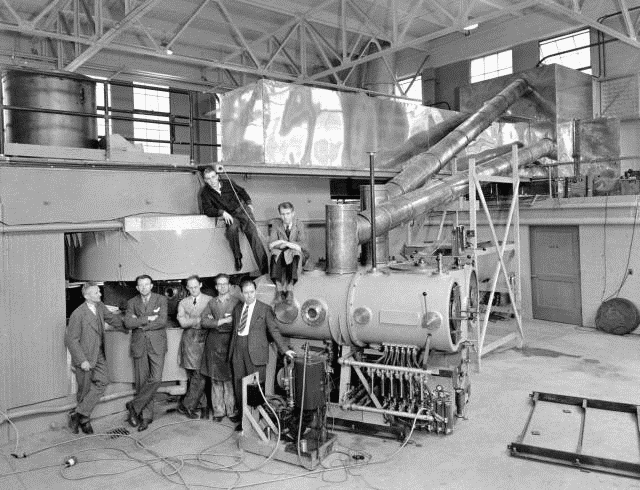
Posing with the newly completed
60-inch cyclotron in the Crocker Laboratory are (Note - WWS had dictated this and someone had typed it... let us know if there are any terminology misuses or misspellings Ed#) I will always remember vividly my first real meeting with Ernest O. Lawrence. I had met him casually at a physics seminar several years before, but carried essentially zero impression from that meeting.
Professor Porter of the Berkeley U.C. Chemistry Department arranged our real meeting. I was trying to get back into the University where I felt my real future lay. My position as Job Analyst for the Department of Labor had ended suddenly and, since I had been working evenings on ultrasonic effects in chemistry with Professor Porter, I naturally suggested to him that I would like to continue on an enlarged basis. This seemed natural because we had published together and were having some success.
Porter explained sadly, I thought, that he had no possible source of funds to support me because of the great depression. He suggested, however, that I might find a place with Professor E. O. Lawrence in Physics, as he seemed to be the only one in the university supporting a large laboratory. Porter asked if I knew Lawrence, and I replied that I had casually met him once and I was sure he would not recognize me. Porter said, "All right I'll make a date for you and leave it up to you."
The date to see Lawrence in his office was for 9:00 A.M. Saturday morning, March ( ? ) 1937. I had heard of Lawrence's Cyclotron Atom Smasher, as it was frequently referred to in the daily news. I, therefore, thought it desirable to see his lab. I was conducted on a tour by one of the research fellows on Friday and gained an exciting impression of the lab activity and spirit of progress.
It was , therefore, in a state of some excitement that I presented myself at Lawrence's office at the appointed time on Saturday morning.
His secretary announced me and Lawrence came rapidly from his inner office to greet me!
"So you're Salisbury," he said, "Professor Porter tells me you want a job!
"Well, in the first place, I have no jobs for anybody and in the second place you are the last man on earth that I would hire if I had a job.* I have heard of your reputation around the Physics Department."
I replied, "Well, since that is settled, would you be willing to talk for a few minutes about your Cyclotron?"
"Well, yes," he said, "come in. Have you looked around the lab?"
"Yes," I replied.
"What is your impression, what would you do to improve it?"
"The main thing wrong," I said, " is the resonating inductance for the 'Dee'," I answered.
"How could that be improved and what results could be expected?"
"You are using all your radio frequency energy heating cooling water for a small-tubing inductance. The best inductance would be a large coaxial line, but any way to make the inductance conductors larger and of lower resistance would increase your 'Dee' voltage with the same power input you now have."
"We made a model of a coaxial inductance, but it did not increase the 'Q' (resonance factor) of the system as we expected. Did you see the model?"
"Yes, I saw the model, but it was all wrong. Whoever made it could not calculate the 'Q' of the resonant frequency correctly and so the design of the model which I saw is a failure."
"Can you calculate the 'Q' and the resonance frequency correctly?"
"Yes," I replied, " I can, and I can increase your 'Dee' voltage without requiring any increase in power. It is true is it not that your beam of accelerated ions increases in current very rapidly with increasing 'Dee' voltage?"
"Yes, we can only get 40 kilovolts on the 'Dees' with 100 kilowatts input. Some very good people have worked hard on this. We need 50 kilovolts. Can you really increase that voltage?"
"Yes," I said, "I can."
Lawrence said, "I've changed my mind. Come to work Monday and I'll give you a two week trial at $100 per month."
So that Monday I appeared at 8:00 A.M. at the Lawrence Laboratory to begin one of the most exciting and rewarding experiences of my life.
When I returned home from my interview I was pale and shaking. Elma said, "What's wrong? You look like a ghost."
"I got the job," I stuttered.
"Then what's wrong?"
"Don't you see, this is what I've always wanted, and now I have to produce among the best scientific colleagues in the world. There is no possible excuse for failure!"
During the next three weeks I worked at learning to run the 37" cyclotron as a crew member and designing a crystal controlled amplifier to drive the main cyclotron oscillator. At that time Lawrence believed that frequency stability would improve the radio frequency driver for the cyclotron accelerating electrodes. ('Dees') Also, I worked on vacuum tube flip-flop circuits for particle counters. I believe I was being tested for compatibility with the graduate students and post-doctoral fellows who made up Lawrence's prestigious group of nuclear physics researchers.
I must have passed that test, because at the end of my trial period all I heard was a suggestion from Lawrence that I should move from San Francisco to Berkeley so as to be near the lab, so I could put in more hours.
After about five or six weeks I received word from "Buddie" Toles, for whom I had built a broadcast transmitter then operating in Roseburg, Oregon, that he had an engineering job there for me. The pay was to be more than double the pay in Lawrence's lab. I used this as an excuse to ask Lawrence if I really had a place in the lab. His reply (was) that I could be there as long as I lived was a bit startling, since I had not yet been allowed to make any of the changes I had recommended.
My wife, Elma, and I agreed that my future would be much better in a lab in the University, in spite of the pay, so I turned down the offer to be a radio-engineer-operator in Oregon.
I kept telling Lawrence that the high resonance factor ( -- - ) necessary for his ' Dee' accelerator electrodes would vary its frequency with temperature and ion load so that a crystal controlled driver would not synchronize with the 'Dee' system or help to produce more accelerating voltage.
I proposed that changing the resonant inductance of the system to one of less resistance would increase the 'Q' of the system and thus give more accelerating voltage for the same 100 kilowatt oscillator input then in use. Lawrence replied that if I could get the 'Dee' voltage up from 40 KV to 50 KV it would be a miracle as he had tried the suggestion of the best engineers, including Charley Litton, at great expense with no appreciable improvement.
I insisted that the suggestions tested were incorrect. I said, "If you will let me change the system my way, I will get 100 KV on the 'Dee's' without any increase in power."
Lawrence replied that I must be crazy as no such thing was possible.
However, I kept persisting and finally at the end of a period of thesis work Lawrence finally said, "All right, if you can persuade any of the Doctorate crew to approve and help you, you can have one week of cyclotron shutdown to make your changes."
I already had Dr. John Livingood on my side so we were allowed to proceed.
We worked, starting early Sunday morning, 16 to 18 hours per day through to the next Sunday. We had not only to replace the small coil of 1/4" tubing of the original inductance with 3" copper pipe with water cooling tubing soldered on to it, but also to build a copper shielding house and a turning vane with mechanical control from the control table. The 3" tubing had to be supported because the glass insulators and seals supporting the 'Dee's' and sealing the vacuum of the acceleration chambers were not considered strong enough to hold the weight of the new single turn of heavy tubing which formed the new inductance of the resonant 'Dee' circuit.
We also had to bring on the oscillator power slowly and calibrate the 'Dee' voltage with a capacitance multiplier against a General Radio radio frequency voltmeter.
When all this was done we came up to full power with the ion source on, since we correctly believed that this would now be an appreciable part of the electrical resistance load determining the 'Q' of the system and hence the 'Dee' voltage.
We were elated to find that under full ion load we had 110 KV on the 'Dee's' at the same power that previously produced 40 KV and that the external deflected beam of 8 Mev deturiums (sp?deuterons?) to the target was now 150 M amperes, rather than the 8 m amperes previously produced.
To say that Lawrence and all of the lab members were elated is a mild expression of the celebration that followed.
About Wednesday after this event, Lawrence asked me to come to his office and there he told me he was making me Crew Chief for all the cyclotron operating crews and he expected me to be present at at least two of the three daily operating crews necessary for the round-the-clock operation that Lawrence insisted on. Maximum results were expected and we were soon producing and discovering a new radio-active isotope essentially each day.
Soon after this Lawrence asked me to see what I could do to improve the system of heating the ion source filament. A heavy filament was needed to produce electrons for ionizing the Deuterium in the center of the cyclotron where the particle beam originated. This was because this filament operating in a plasma of Deuterium ions was rapidly eroded away. Such a heavy filament of tungsten will require a large current to heat it to emission temperature (40 to 100 amperes). The magnetic forces in a 15 Kilogauss field produced troublesome forces. D.C. current could not be used because a tungsten will (wire??) at emission temperature has about the same strength as a lead wire of the same size has at room temperature. When 60 cycle current was tried the filament was rapidly vibrated to destruction. So, Dr. Van Voorhis had constructed a heating current supply out of audio amplifiers and transformers operating at 15 kilocycles/sec. This allowed the filament to last for one to two days of operation between replacements. I calculated that a filament could last as long mechanically as it would based on arc evaporation rate if that frequency was increased to 200 K.C. This was a difficult step because no core material existed at that time to make a suitable transformer to step the voltage down and the current up to about 100 amps at seven volts for ideal operation of the filament then in use.
I devised a resonant "T" matching net consisting of a coil of 1/4 inch copper tubing about 6" in diameter and 10 inches long so it could be varied for tuning by moving the turns closer together or farther apart, and a large capacitance mica condenser. The mica capacitor was made by connecting in parallel a number of the series elements from World War I surplus spark transmitter capacitors from our basement stock of junk. This capacitor had to be placed in a circle since "skin effect" would prevent current from flowing in the inner ones if they were stacked sandwich style. Turning this to give optimum filament heat from a 1 kilowatt 100 K.C. oscillator was a tedious process, since the filament had to be observed through a 3" glass window in the wall of the cyclotron chamber.
In operation the filament was at 1000 volts D.C. above ground with a 1 ampere supply to form a deturium (?) arc for the ion supply to the center of the cyclotron.
I asked my lead crew member of the morning shift to guard the controls so that I could tune up by shaping the matching coil bare handed without the 1000 volt 1 ampere supply being turned on.
The tuning took longer than we expected and my control guard became impatient and turned on the arc voltage while I was still in contact.
I remember falling over from my squatting position and thinking, "What a big earthquake to move the 70 ton magnet so rapidly." Of course, I was falling over as a result of the shock and fortunately fell free of my contact.
I must have yelled, because I came to to find myself being brought to an upright stance by Robert Cornog and Dr. Louis Alvarez. I took a deep breath and realized that my heart was shaking in a violent spasm rather than beating. My early experience as a Junior in college with Biofeedback came to mind and I exerted mental control and stopped the fibulation and started a good solid beat. The results of this experience were: first my personal discomfort due to internal electrical burn, which caused my sweat to be very stinky for at least six weeks and, a period of recovery from general shakiness and weakness. The external burns at contact points on hands and elbows were nominal. The other result was to make the whole lab conscious of the necessity of safety interlocks and their intelligent use.
There followed a period of examining and rebuilding all the safety features of our system. We already had interlocks on all water cooling systems, but had perhaps not given sufficient attention to problems of personal safety.
My solution to the filament problem worked, filaments now lasted a week to ten days of approximately continuous operation.
The over performance improvement of the 37 inch cyclotron helped the rapid conclusion of many a Doctoral Thesis.*
However, at this time we had other lessons to learn.
With the new 'Dee' voltage available someone forgot to have the ion source on when the ' Dee' voltage was turned on and the unloaded 'Dee' voltage rose to over 150 kilovolts at which point the external glass insulators, where the ' Dee' stems entered the vacuum chamber, arced over in the outside air and the arcs quickly broke the glass on both insulators. This required more than a day of shutdown to fix. New insulators were available, but needed annealing to remove strains.
However, Lawrence was so pleased with the demonstration of high voltage ability that he made no adverse comment, only urging us to fix the new insulators in place as rapidly as possible.
The climax of the experience came several weeks later when Dr. Cockcroft came from England to visit the lab.
Cockcroft had been a severe critic of the cyclotron saying that we really didn't have the particle energy we claimed and were being misled by radio frequency arc phenomena we did not understand. So with great pride Lawrence had me put on a target with a 1/2 inch aluminum foil window (microphone diaphragm stock) which with outside air cooling would let a considerable beam of 8 M.E.V. Deuterons out in (the) air so that the range and ionization of the particles in ambient air could be easily seen. The smell of ozone was very strong.
After looking at this display, Cockcroft agreed that the observed range showed we had real energetic particles as claimed.
I was overseeing the control station with a young graduate student from India, whose name I no longer remember, at the controls.
Lawrence proudly pointed out to Cockcroft the Dee voltage indicated on the meters and explained the calibration procedure.
Suddenly he said to Cockcroft, "Would you like to see what is inside the cyclotron?"
"I would be most interested, " replied Cockcroft.
Then with no hesitation, Lawrence reached over the operator's shoulder and pushed the off button for the ton (ion?) source arc voltage.
The 'Dee' voltage rose instantly and with a great crash destroyed the 'Dee' insulators.
"Now boys," said Lawrence, "Take it apart and show Dr. Cockcroft and put in new insulators." (At least a two shift job.) I was dismayed only for an instant for I understood at once such bold showmanship.
|
||||||||||||||||||||||||||||||||||||||||||||||||||||||||||||||||||||||||||||||||
|
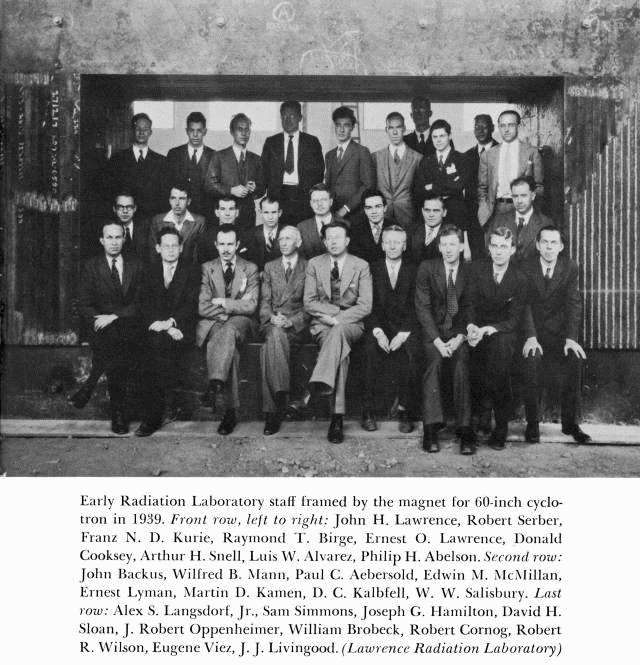
Early Radiation Laboratory staff framed by the magnet for 60-inch cyclotron in 1939. Front row, left to right: John H. Lawrence, Donald Cooksey, Arthur H. Snell, Luis W. Alvarez, Philip H. Abelson. Second row: John Backus, Wilfred B. Mann, Paul C. Aebersold, Edwin M. McMillan, Ernest Lyman, Martin D. Kamen, D.C. Kalbfell, W.W. Salisbury. Last Row: Alex S. Langsdorf, Jr., Sam Simmons, Joseph G. Hamilton, David H. Sloan, J. Robert Oppenheimer, William Brobeck, Robert Cornog, Robert R. Wilson, Eugene Viez, J.J. Livingood. (Lawrence Radiation Laboratory |
||||||||||||||||||||||||||||||||||||||||||||||||||||||||||||||||||||||||||||||||
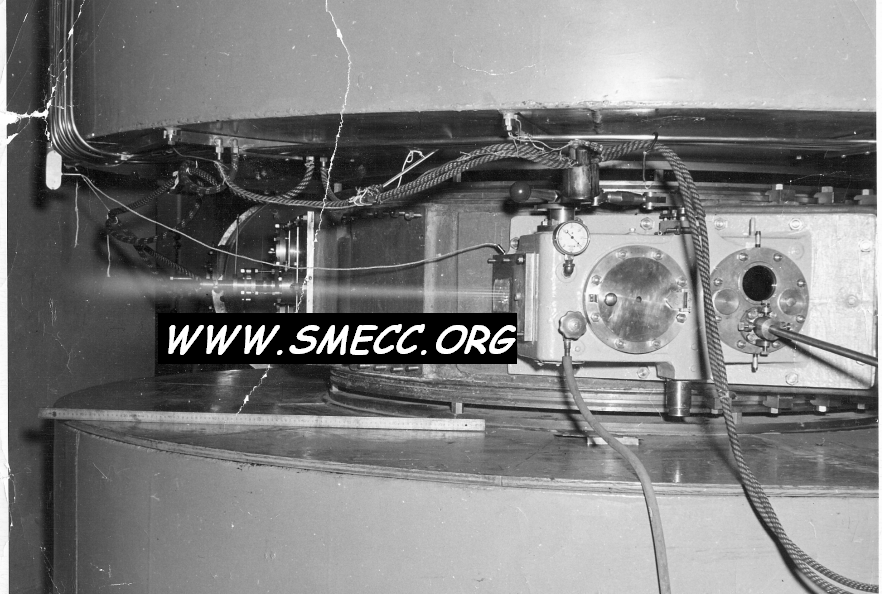
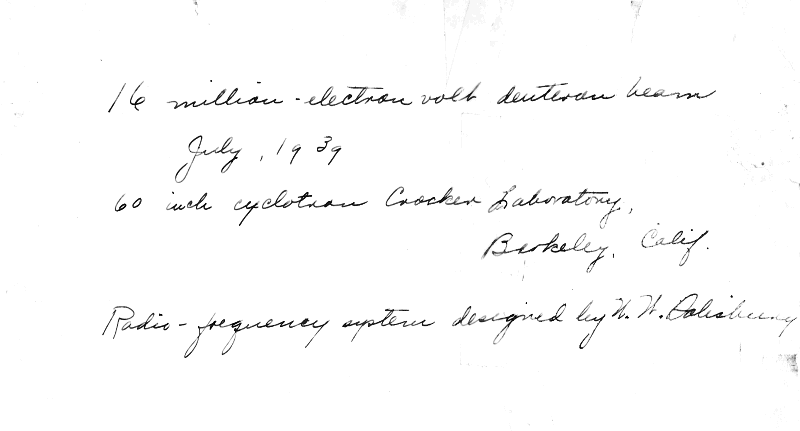
Lawrence, E. O., Alvarez L. W., Brobeck, W. M., Cooksey, D., Corson, D. R., McMillan, E. M., Salisbury, W. W., Thorton, R. L.: Initial performance of the 60" cyclotron of the William H. Crocker Radiation Laboratory, University of California. Physical Review, 56, 124, July 1, 1939.
|
||||||||||||||||||||||||||||||||||||||||||||||||||||||||||||||||||||||||||||||||
|
||||||||||||||||||||||||||||||||||||||||||||||||||||||||||||||||||||||||||||||||
|
― 496 ―
|
||||||||||||||||||||||||||||||||||||||||||||||||||||||||||||||||||||||||||||||||
|
Lawrence,
E. O., Alvarez L. W., Brobeck, W. M., Cooksey, D., Corson, D. R.,
McMillan, E. M., Salisbury, W. W., Thorton, R. L.: Initial
performance of the 60" cyclotron of the William H. Crocker
Radiation Laboratory, University of California.
Physical Review, 56, 124, July 1, 1939.
Ernest O. Lawrence Phys. Rev. 56, 124 1939
Initial Performance of the 60-Inch Cyclotron of
the William H. Crocker Radiation Laboratory,
University of California
William H. Crocker Radiation Laboratory,
University of California, Berkeley, California,
June 12, 1939.
During the past few weeks, we have been engaged in the adjustments of the 60-inch cyclotron of the William H. Crocker Radiation Laboratory, and at this time we wish to report its initial performance. As is always fruitful in first turning on a cyclotron, we looked for resonance in the first instance by placing a Geiger counter nearby. With hydrogen, proton resonance was found close to the expected value of magnet current, and we proceeded to build up the intensity of the resonance effect by adjusting the magnetic field with shims. Following this adjustment, the beam to the target was observed and further shimming yielded 25 microamperes at eight-million volt protons. Probe measurements indicated about 100 microamperes circulating within the dees. Next the hydrogen was replaced with deuterium at a pressure about one-tenth that normally used in our 37-inch cyclotron, and the procedure of adjustment was repeated. Again resonance of deuterons was first observed with a Geiger counter and shims were used to build up the effect. Indeed, the radiation intensity almost immediately obtained in this way, even with but one-tenth of the normal deuterium pressure, exceeded that ever obtained from the 37-inch cyclotron. At this juncture the high energy deuteron beam was looked for by detecting ionization in the air outside an aluminum target window. The beam was immediately found, and adjustments proceeded until ten microamperes to the target itself was obtained. The deuterons were observed to emerge from the target window and to penetrate the air for a distance of more than 1 1/2 meters, indicating the energy to be in the neighborhood of 16 million volts, a value consistent with the frequency and. the geometry. Under the circumstances, as is well known, replacing the 1 deuterium with helium would result in a beam of 38 million volt alpha particles. Dependence of the deuteron beam on the adjustments shows that very large currents are obtainable, perhaps as large as can conveniently be used. It is perhaps noteworthy also that this very high energy deuteron beam is obtained with an oscillator input of only 60 kilowatts. We therefore see no difficulties in the way of producing with the present equipment 25 million volt deuterons and 50 million volt alpha-particles, and moreover we are convinced that much higher energies could be obtained from a cyclotron of larger dimensions. We wish to take this opportunity to express our profound gratitude to many individuals and organizations who have made these developments possible. In the first place we are indebted to the late Mr. Francis P. Garvan and to Mr. William H, Buffum of the Chemical Foundation, who provided the initial funds for the cyclotron construction, and to the late Mr. William H. Crocker, who provided for the laboratory building. We are equally indebted to the Rockefeller Foundation and the National Advisory Cancer Council for continued support which has made possible the rapid development of the work. We also are deeply appreciative of the important part our laboratory colleagues are having in this work; for all of our associates have been actively interested and have contributed In large measure to the development of the 60-inch cyclotron; and we are likewise appreciative of the invaluable help of the staff of the shop. Ernest 0. Lawrence Luis W. Alvarez William M. Brobeck Donald Cooksey Dale R. Corson Edwin M. McMillan W. W. Salisbury Robert L. Thornton 2
|
||||||||||||||||||||||||||||||||||||||||||||||||||||||||||||||||||||||||||||||||