|
CONAR
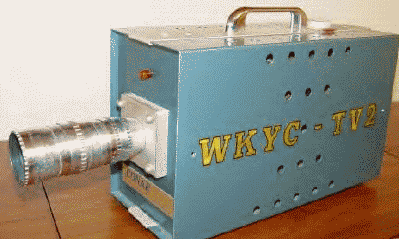
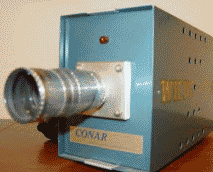
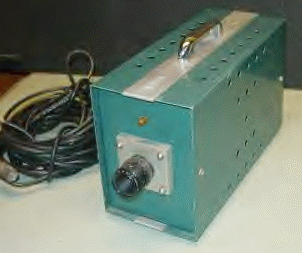
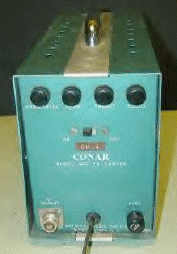
We are looking for aditional items for this page - including YOUR memories and experiences with this vidicon CONAR MODEL 800 TV CAMERA kit! And.... Another one! This camera is on display at SMECC
WKYC WAS IN CLEVELAND...
And yes.... yet one more of them!
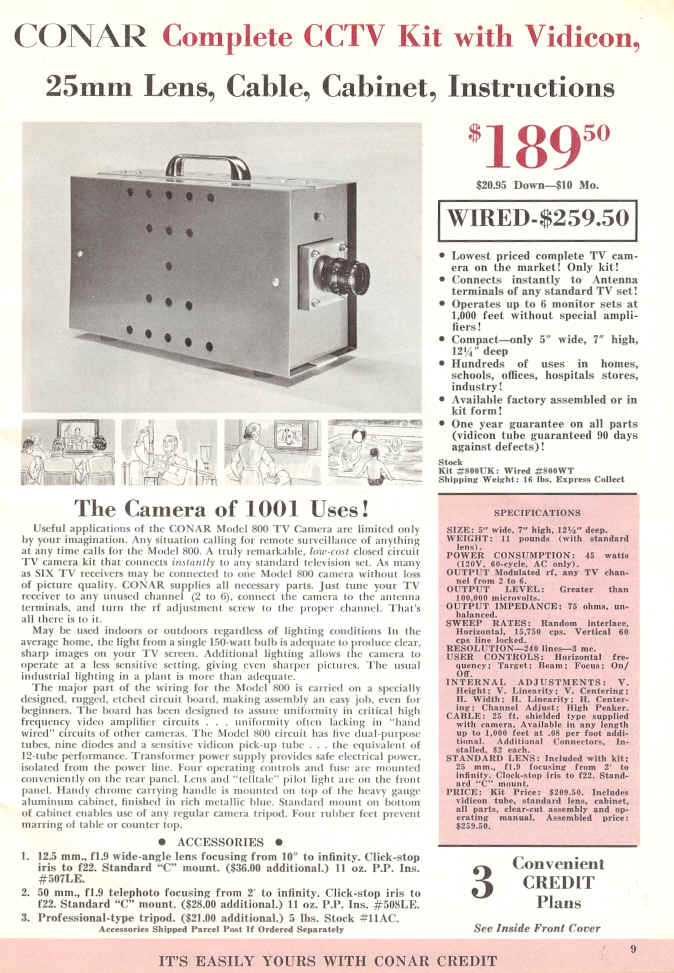
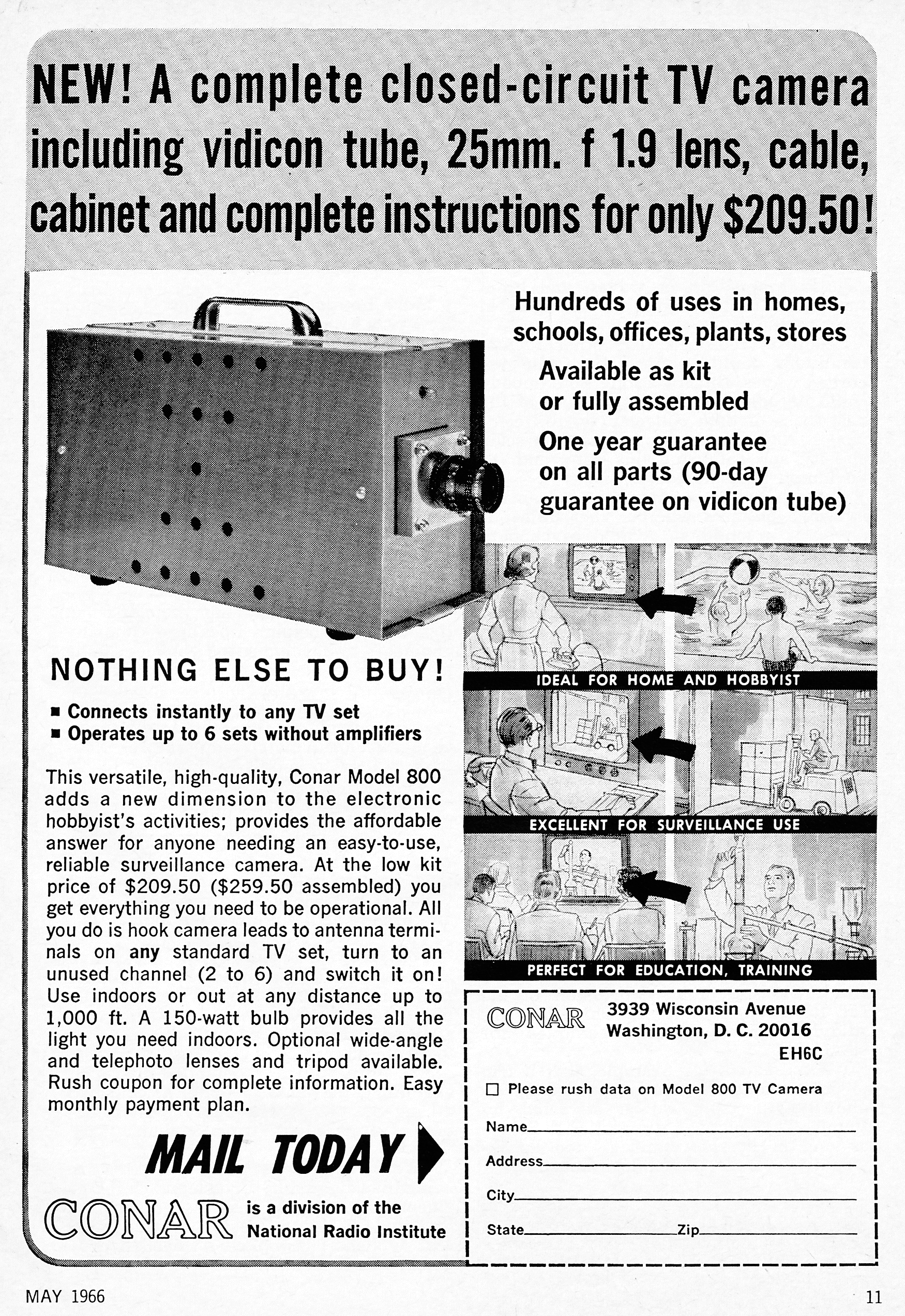 Vintage ad from a
May 1966 Popular Mechanics Magazine. This ad
is from Conar Division of National Radio Institute. This ad features
the Conar Model 800 closed circuit TV Camera. This includes vidicon
tube, 25 mm f1.9 lens, cable, cabinet, and instructions for $209.50 Vintage ad from a
May 1966 Popular Mechanics Magazine. This ad
is from Conar Division of National Radio Institute. This ad features
the Conar Model 800 closed circuit TV Camera. This includes vidicon
tube, 25 mm f1.9 lens, cable, cabinet, and instructions for $209.50
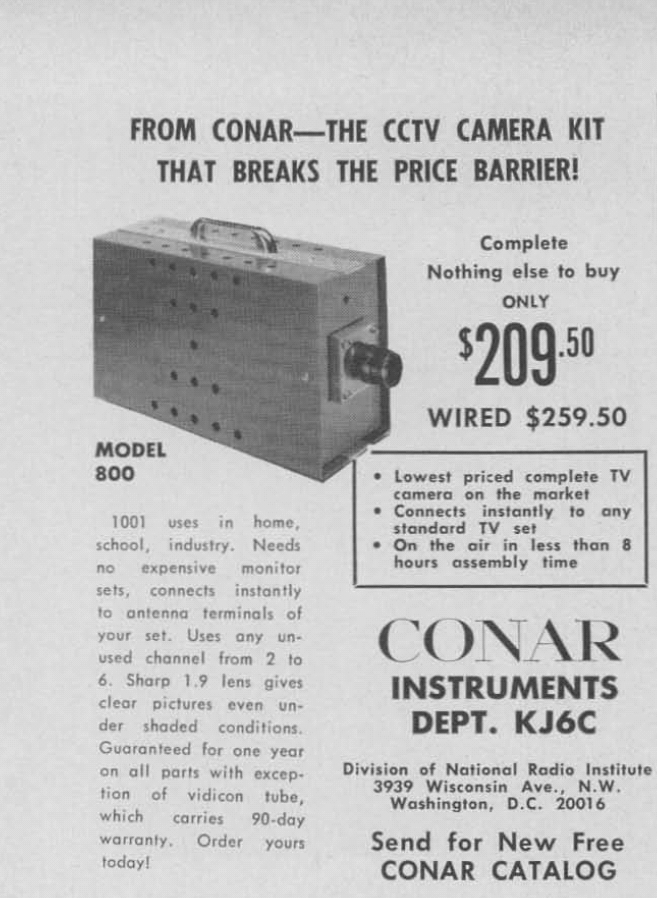
Hundreds of uses in homes, schools, offices, plants, stores Available as kit or fully assembled - One year guarantee on all parts (90-day guarantee on vidicon tube) - NOTHING ELSE TO BUY! - Connects instantly to any TV set - Operates up to 6 sets without amplifiers - This versatile, high-quality, Conar Model 800 adds a new dimension to the electronic hobbyist's activities; provides the affordable answer for anyone needing an easy-to-use, reliable surveillance camera. At the low kit price of $209.50 ($259.50 assembled) you get everything you need to be operational. All you do is hook camera leads to antenna terminals on any standard TV set, turn to an unused channel (2 to 6) and switch it on! Use indoors or out at any distance up to 1,000 ft. A 150-watt bulb provides all the light you need indoors. Optional wide-angle and telephoto lenses and tripod available. Rush coupon for complete information. Easy monthly payment plan. PLEASE! WE NEED THE MANUAL FOR THE KIT! 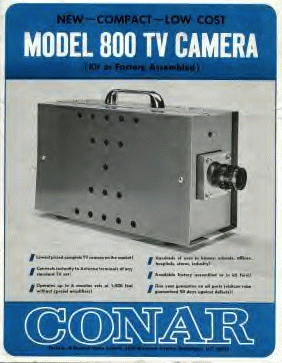 "The Conar Instruments Company of
Washington, D.C. is a comparative latecomer to the kit business, since it
first offered kits in 1962; yet it is not new in the electronics field.
You see, Conar is an expansion of the National Radio Institute's student
supply division that functioned primarily to supply test equipment to NRI
students and graduates. In fact, the name 'Conar' is rather tortuously
derived from the first letters of 'COmpany, NAtional Radio.' Conar was
thus able to enter the market with a complete series of radio-TV
test-equipment kits of proven design developed by NRI's technical staff.
Presently, Conar offers about twenty different kits with more in the
developmental stage Some are rather unusual and exotic, such as their
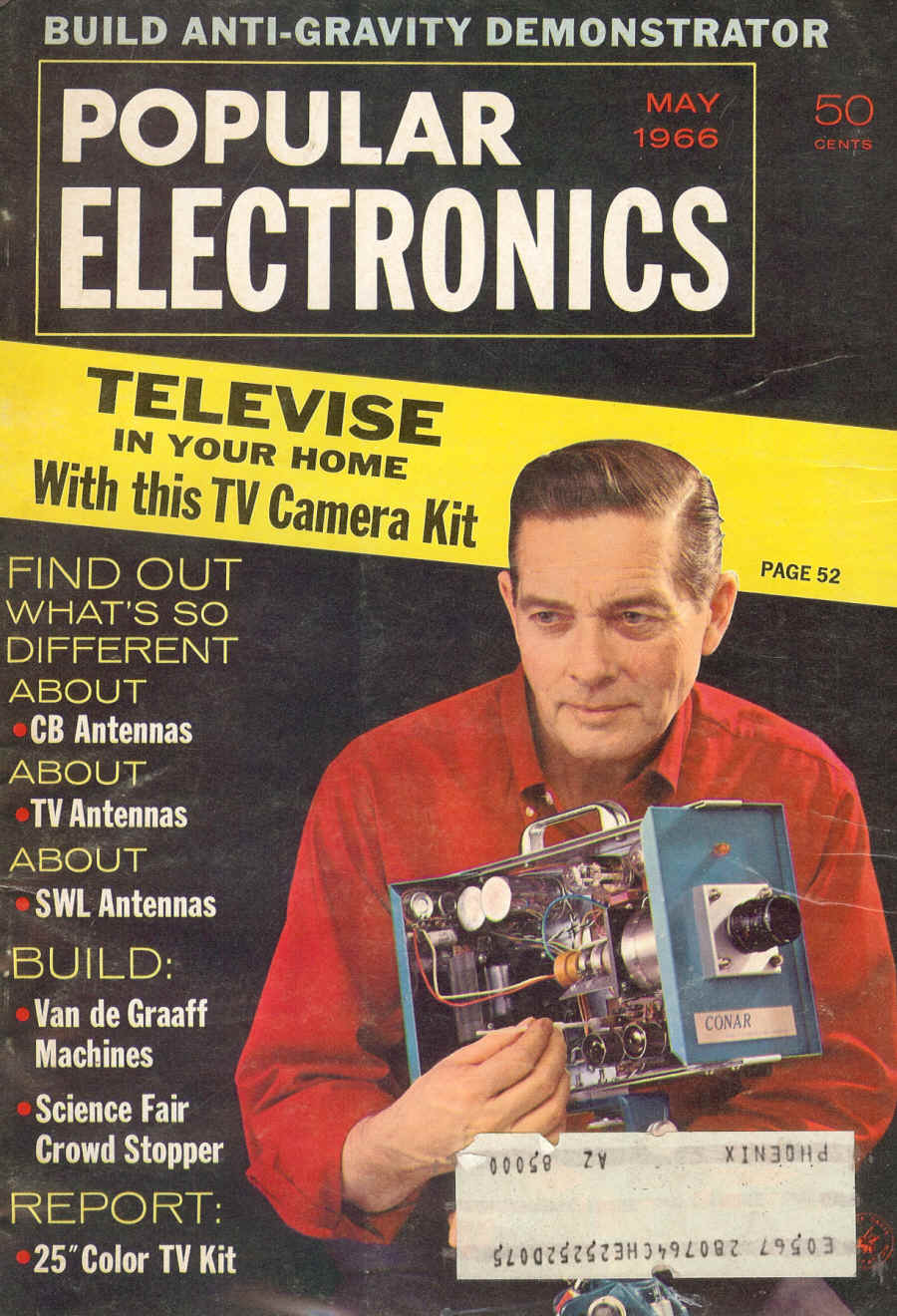
Model 800 closed-circuit TV camera kit that can be used with any TV set as
a monitor and their metal locator kit that should go big with treasure
hunters." "The Conar Instruments Company of
Washington, D.C. is a comparative latecomer to the kit business, since it
first offered kits in 1962; yet it is not new in the electronics field.
You see, Conar is an expansion of the National Radio Institute's student
supply division that functioned primarily to supply test equipment to NRI
students and graduates. In fact, the name 'Conar' is rather tortuously
derived from the first letters of 'COmpany, NAtional Radio.' Conar was
thus able to enter the market with a complete series of radio-TV
test-equipment kits of proven design developed by NRI's technical staff.
Presently, Conar offers about twenty different kits with more in the
developmental stage Some are rather unusual and exotic, such as their
Model 800 closed-circuit TV camera kit that can be used with any TV set as
a monitor and their metal locator kit that should go big with treasure
hunters."
From: Bjorn Heyning's HEATH
STORIES Supplement #1 HEATH STORIES #19 MEMOIRS AND ANTECEDENT ANTICS The
Customer is Always Right - - Kit Sales Incidents Bill Wilkinson - KC0SVZ
site http://www_heco.home.mindspring.com/wwheco2/hs_sup1.txt
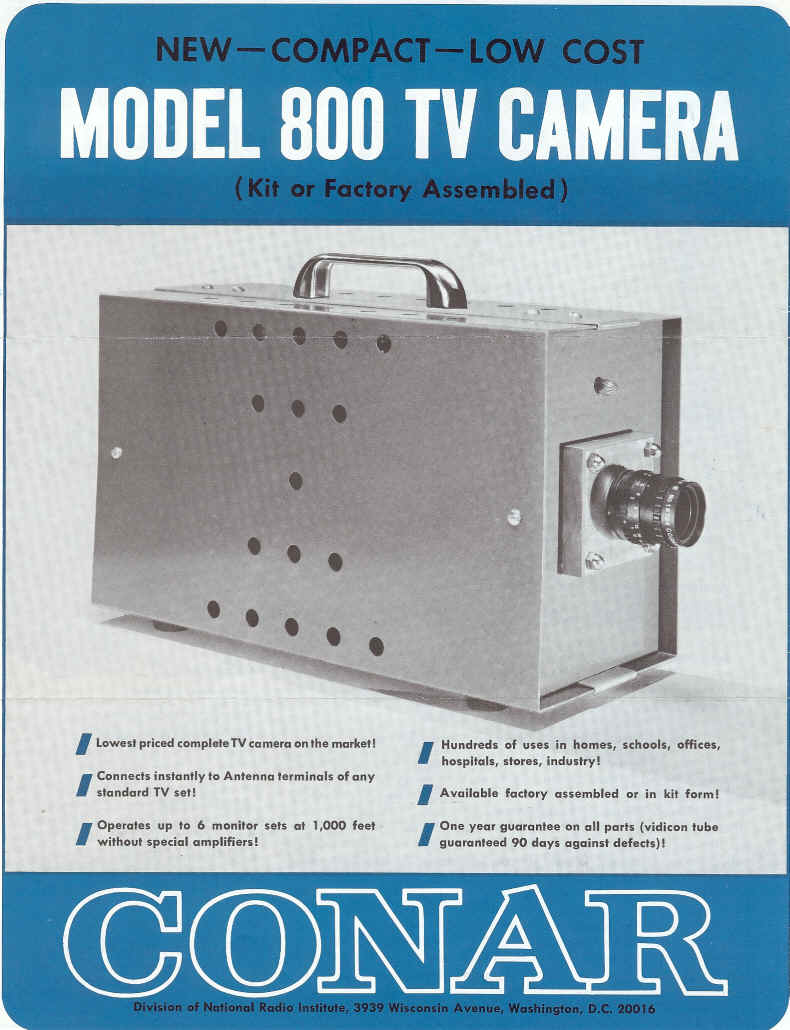
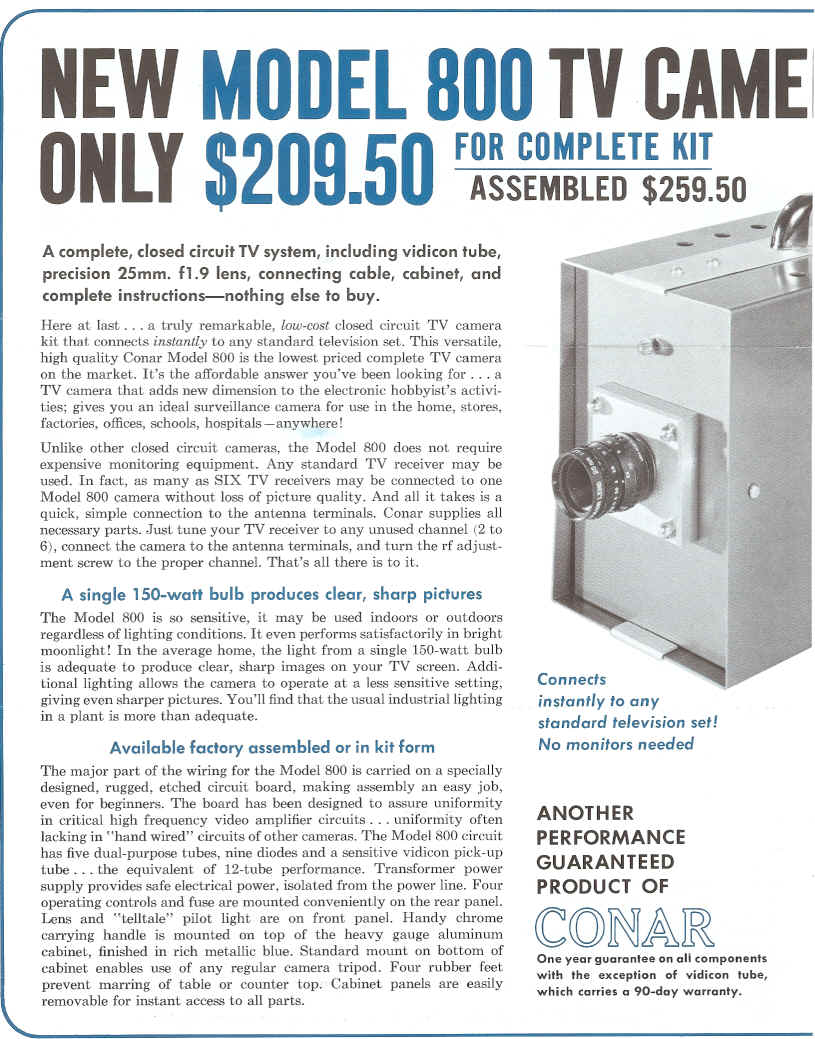
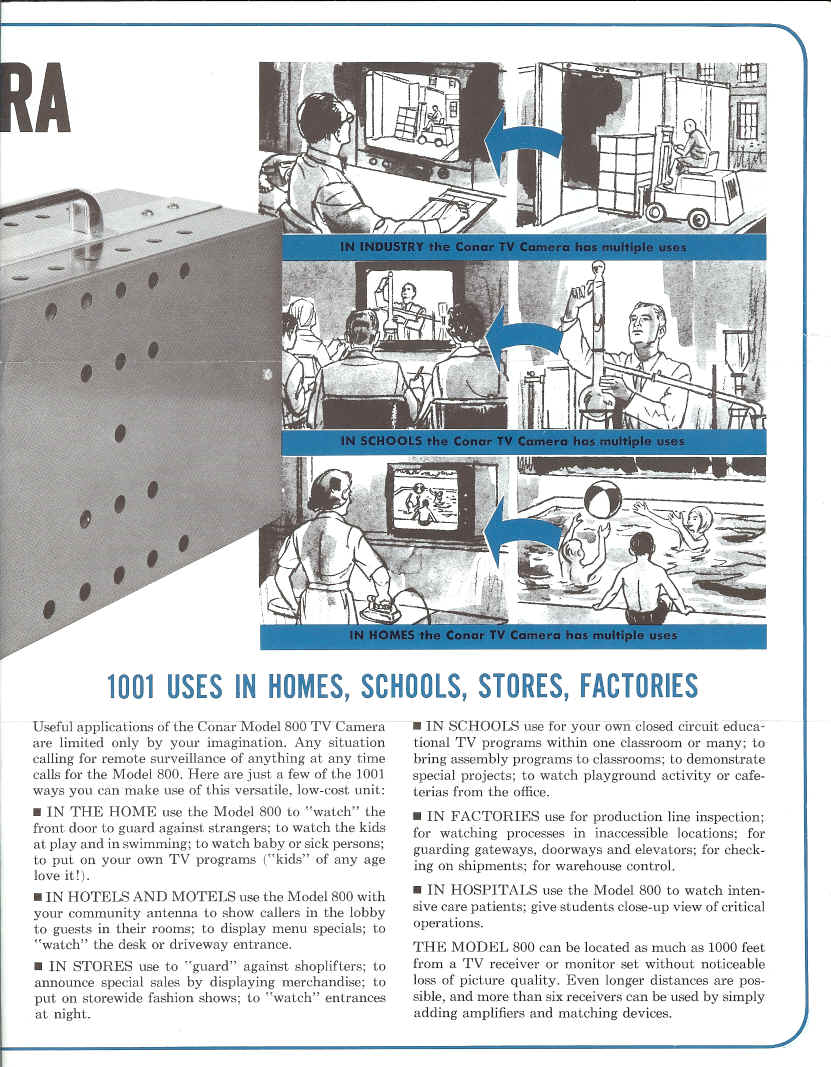
NEW ONLY TV CAME FOR COMPLETE KIT ASSEMBLED $259.50 A complete, closed circuit TV system, including vidicon tube, precision 25mm. fl.9 lens, connecting cable, cabinet, and complete instructions-nothing else to buy. Here at last. . . a truly remarkable, low-cost closed circuit TV camera kit that connects instantly to any standard television set. This versatile, high quality Conar Model 800 is the lowest priced complete TV camera on the market. It's the affordable answer you've been looking for. . . a TV camera that adds new dimension to the electronic hobbyist's activities; gives you an ideal surveillance camera for use in the home, stores, factories, offices, schools, hospitals -anywhere! Unlike other closed circuit cameras, the Model 800 does not require expensive monitoring equipment. Any standard TV receiver may be used. In fact, as many as SIX TV receivers may be connected to one Model 800 camera without loss of picture quality. And all it takes is a quick, simple connection to the antenna terminals. Conar supplies all necessary parts. Just tune your TV receiver to any unused channel (2 to 6), connect the camera to the antenna terminals, and turn the rf adjustment screw to the proper channel. That's all there is to it.A single 150-watt bulb produces clear, sharp pictures The Model 800 is so sensitive, it may be used indoors or outdoors regardless of lighting conditions. It even performs satisfactorily in bright moonlight! In the average home, the light from a single 150-watt bulb is adequate to produce clear, sharp images on your TV screen. Additional lighting allows the camera to operate at a less sensitive setting, giving even sharper pictures. You'll find that the usual industrial lighting in a plant is more than adequate. Available factory assembled or in kit form The major part of the wiring for the Model 800 is carried on a specially designed, rugged, etched circuit board, making assembly an easy job, even for beginners. The board has been designed to assure uniformity in critical high frequency video amplifier circuits. . . uniformity often lacking in "hand wired" circuits of other cameras. The Model 800 circuit has five dual-purpose tubes, nine diodes and a sensitive vidicon pick-up tube. . . the equivalent of 12-tube performance. Transformer power supply provides safe electrical power, isolated from the power line. Four operating controls and fuse are mounted conveniently on the rear panel. Lens and "telltale" pilot light are on front panel. Handy chrome carrying handle is mounted on top of the heavy gauge aluminum cabinet, finished in rich metallic blue. Standard mount on bottom of cabinet enables use of any regular camera tripod. Four rubber feet prevent marring of table or counter top. Cabinet panels are easily removable for instant access to all parts. Connects instantly to any standard television set! No monitors needed!ANOTHER PERFORMANCE One year guarantee on all components 1001 USES IN HOME, SCHOOLS, STORES, FACTORIES Useful applications of the Conar Model 800 TV Camera are limited only by your imagination. Any situation calling for remote surveillance of anything at any time calls for the Model 80o. Here are just a few of the 1001 ways you can make use of this versatile, low-cost unit: - IN THE HOME use the Model 800 to "watch" the front door to guard against strangers; to watch the kids at play and in swimming; to watch baby or sick persons; to put on your own TV programs ("kids" of any age love it!). - IN HOTELS AND MOTELS use the Model800 with your community antenna to show callers in the lobby to guests in their rooms; to display menu specials; to "watch" the desk or driveway entrance. - IN STORES use to "guard" against shoplifters; to announce special sales by displaying merchandise; to put on storewide fashion shows; to "watch" entrances at night. - IN SCHOOLS use for your own closed circuit educational TV programs within one classroom or many; to bring assembly programs to classrooms; to demonstrate special projects; to watch playground activity or cafeterias from the office. - IN FACTORIES use for production line inspection; for watching processes in inaccessible locations; for guarding gateways, doorways and elevators; for checking on shipments; for warehouse control. - IN HOSPITALS use the Model 800 to watch intensive care patients; give students close-up view of critical operations. THE MODEL 800 can be located as much as 1000 feet from a TV receiver or monitor set without noticeable loss of picture quality. Even longer distances are possible, and more than six receivers can be used by simply adding amplifiers and matching devices. SPECIFICATIONS
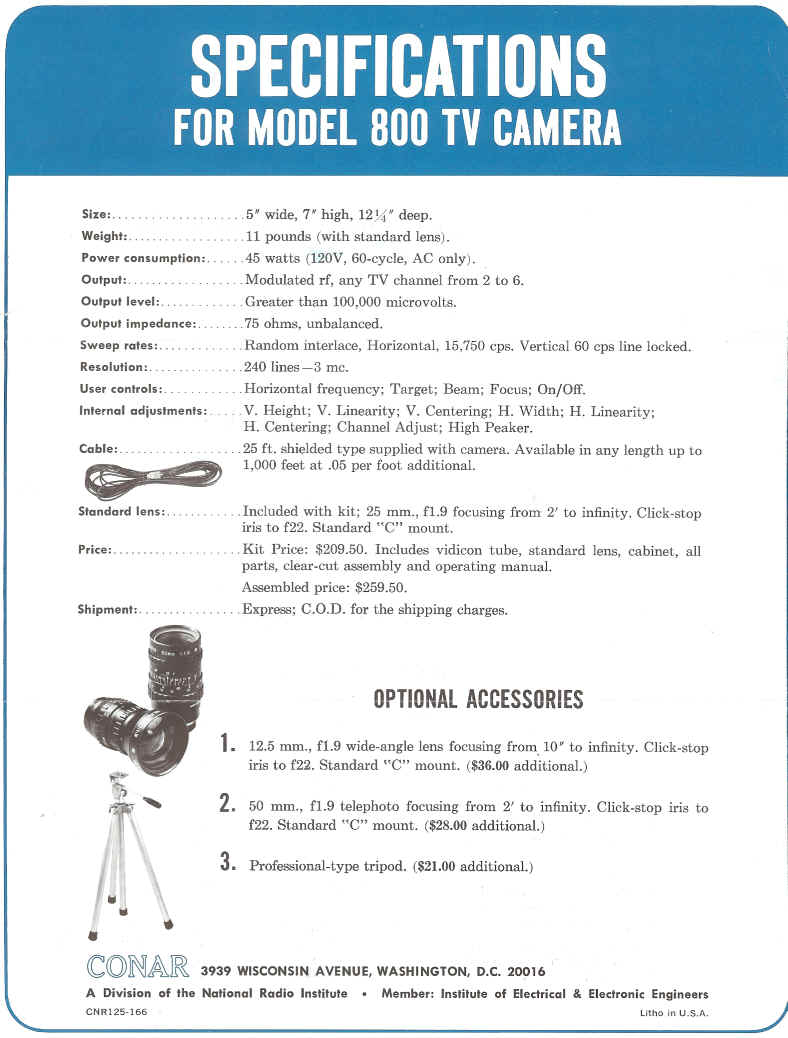
Size:... . . . . . . . . . . . . . . . . .5" wide, 7" high, 12 1/4" deep. Weight:11 pounds (with standard lens). Power consumption:. . . . . .45 watts (120V, 60-cycle, AC only). Output:. . . . . . . . . . . . . . . Modulated rf, any TV channel from 2 to 6. Output level:. . . . . . . . . . . . . Greater than 100,000 microvolts. Output impedance:. . . . . . . .75 ohms, unbalanced. Sweep rates:. . . . . . .. Random interlace, Horizontal, 15,750 cps. Vertical 60 cps line locked. Resolution:.......... 240 lines-3 mc. User controls:.......... Horizontal frequency; Target; Beam; Focus; On/Off. Internal adjustments:. ... V. Height; V. Linearity; V. Centering; H. Width; H. Linearity; H. Centering; Channel Adjust; High Peaker.Cable:. . . . . . .. . . .25 ft. shielded type supplied with camera. Available in any length up to 1,000 feet at .05 per foot additional. Standard lens:.. . . .. . Included with kit; 25 mm., f1.9 focusing from 2' to infinity. Click-stop iris to f22. Standard "C" mount. Price:. . . . . . . . ... Kit Price: $209.50. Includes vidicon tube,
standard lens, cabinet, all parts, clear-cut assembly and operating
manual. Shipment:. . . . . . . . . . . . . . . . Express; C.O.D. for the shipping charges.
OPTIONAL ACCESSORIES 1. 12.5 mm., fl.9 wide-angle lens focusing from, 10" to infinity. Click-stop iris to f22. Standard "C" mount. ($36.00 additional.) 2. 50 mm., fl.9 telephoto focusing from 2' to infinity. Click-stop iris to f22. Standard "C" mount. ($28.00 additional.) 3. Professional-type tripod. ($21.00 additional.
CONAR 3939 WISCONSIN
AVENUE, WASHINGTON, D.C. 20016 CNR125-166 Litho in U.S.A. Did You Build One Of
These?
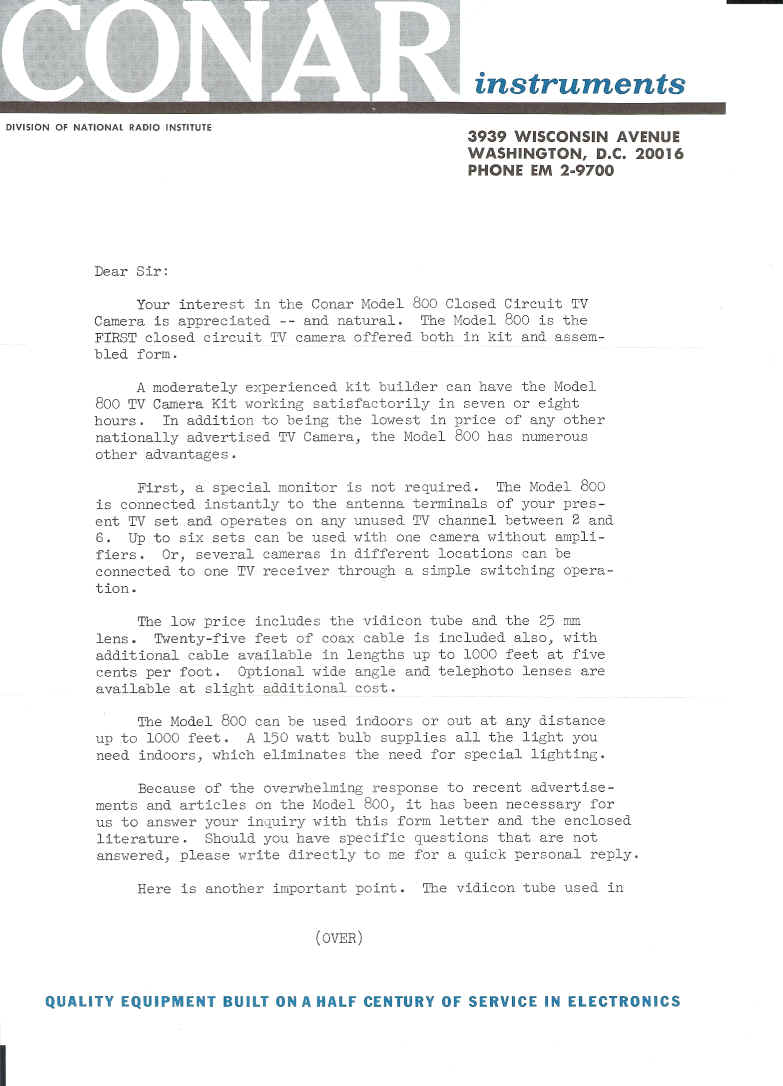
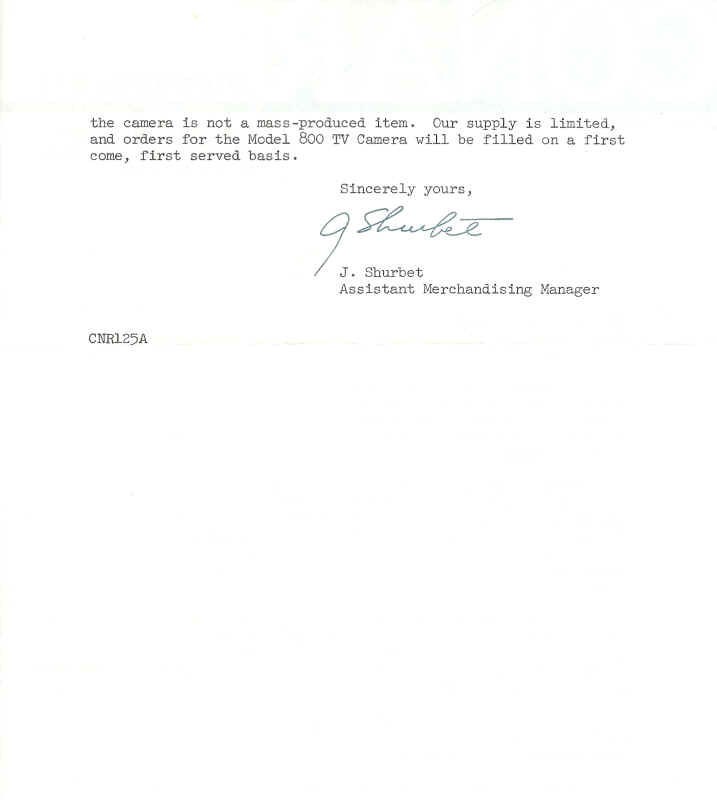
CONAR Instruments 3939 WISCONSIN AVENUE WASHINGTON, D.C. 20016 PHONE EM 2-9700 Dear Sir: Your interest in the Conar Model 800 Closed Circuit TV Camera is appreciated -- and natural. The Model 800 is the FIRST closed circuit TV camera offered both in kit and assembled form. A moderately experienced kit builder can have the Model 800 TV Camera Kit working satisfactorily in seven or eight hours. In addition to being the lowest in price of any other nationally advertised TV Camera, the Model 800 has numerous other advantages. First, a special monitor is not required. The Model 800 is connected instantly to the antenna terminals of your present TV set and operates on any unused TV channel between 2 and 6. Up to six sets can be used with one camera without amplifiers. Or, several cameras in different locations can be connected to one TV receiver through a simple switching operation. The low price includes the vidicon tube and the 25 mm lens. Twenty-five feet of coax cable is included also, with additional cable available in lengths up to 1000 feet at five cents per foot. Optional wide angle and telephoto lenses are available at slight additional cost. The Model 800 can be used indoors or out at any distance up to 1000 feet. A 150 watt bulb supplies all the light you need indoors, which eliminates the need for special lighting. Because of the overwhelming response to recent advertisements and articles on the Model 800) it has been necessary for us to answer your inquiry with this form letter and the enclosed literature. Should you have specific questions that are not answered, please write directly to me for a quick personal reply. Here is another important point. The vidicon tube used in (OVER)
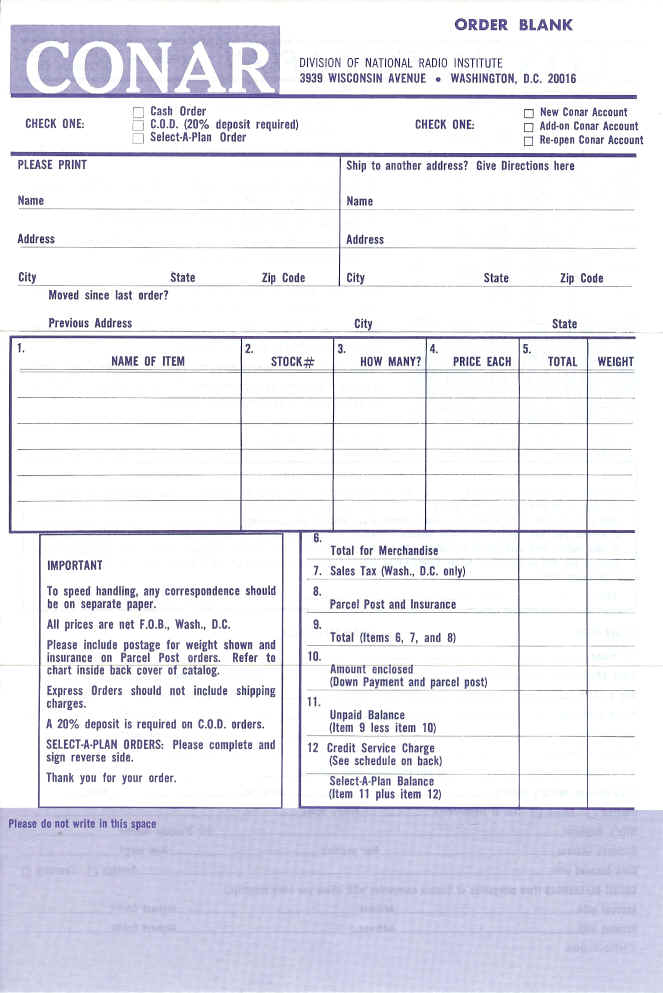
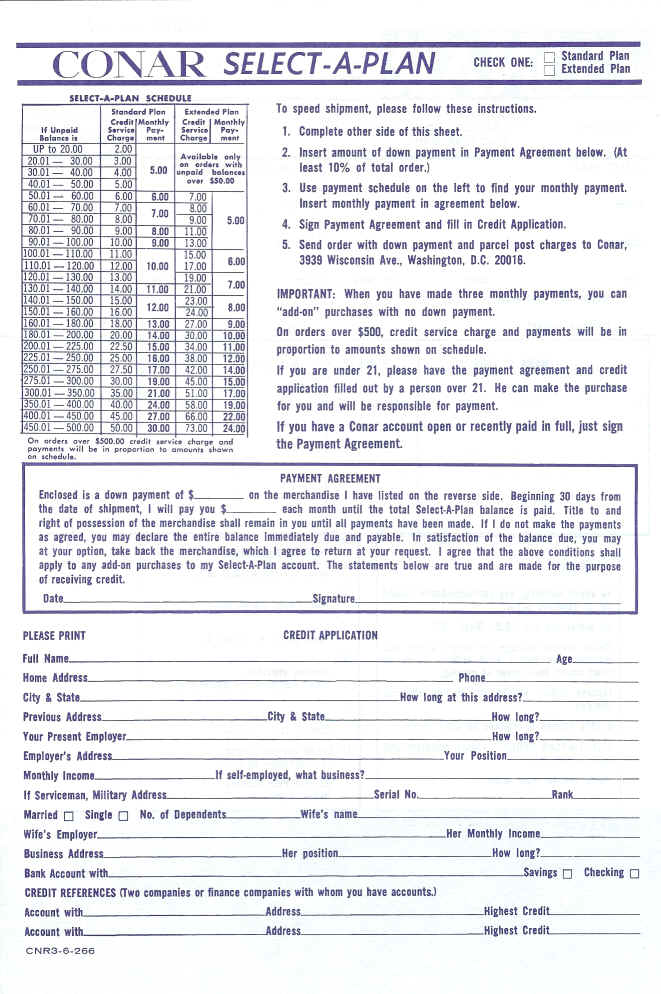
And look! - Easy Terms!
WRITE info@smecc.org with any information, parts, memories, books, photos - of the CONAR Model 800 TV Camera.
Company Information
NRI JOURNAL
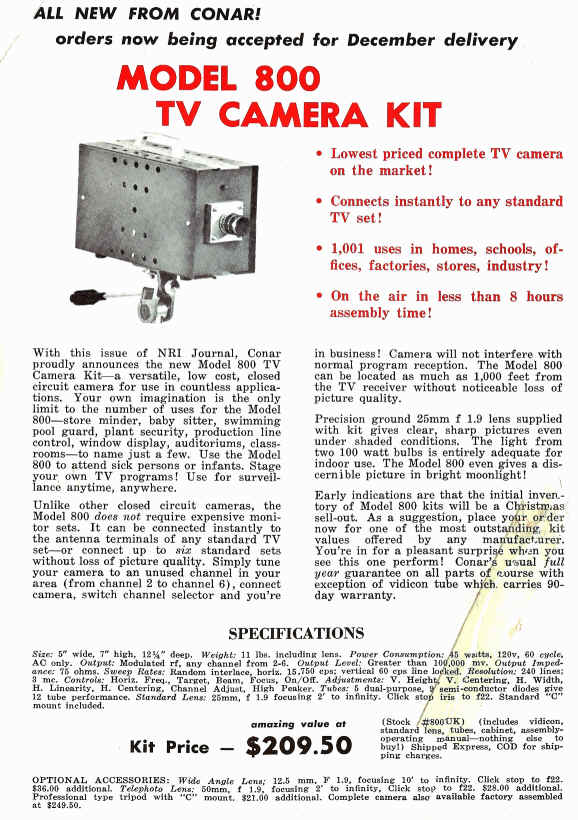
ALL NEW FROM CONAR!
orders now being accepted for December delivery With this issue of NRI Journal, Conar proudly announces the new Model 800 TV
Camera Kit-a versatile, low cost, closed circuit camera for use in countless
applications. Your own imagination is the only limit to the number of uses for
the Model 800-store minder, baby sitter, swimming pool guard, plant security,
production line control, window display, auditoriums, classrooms-to name just a
few. Use the Model 800 to attend sick persons or infants. Stage your own TV
programs! Use for surveillance anytime, anywhere. Unlike other closed circuit cameras, the Model 800 does not require expensive
monitor sets. It can be connected instantly to the antenna terminals of any
standard TV set-or connect up to six standard sets without loss of picture
quality. Simply tune your camera to an unused channel in your area (from channel
2 to channel 6), connect camera, switch channel selector and you're in business!
Camera will not interfere with normal program reception. The Model 800 can be
located as much as 1,000 feet from the TV receiver without noticeable loss of
picture quality. Precision ground 25mm f 1.9 lens supplied with kit gives clear, sharp
pictures even under shaded conditions. The light from two 100 watt bulbs is
entirely adequate for indoor use. The Model 800 even gives a discernible picture
in bright moonlight! Early indications are that the initial inveI1tory of Model 800 kits will be a
Christmas sell-out. As a suggestion, place your order now for one of the most
outstanding, kit values offered by any manufacturer. You're in for a pleasant
surprise which you see this one perform! Conar's usual full year guarantee on
all parts of course with exception of vidicon tube which. carries 90day
warranty. SPECIFICATIONS Size: 5" wide, 7" high, 12 1/4" deep. Weight: 11 lbs.
including lens. Power Consumption: 45 watts, 120v, 60 cycle, AC only. Output:
Modulated rf, any channel from 2-6. Output Level: Greater than 100,000 mv.
Output Impedance: 75 ohms. Sweep Rates: Random interlace, Horiz. 15,750 cps;
vertical 60 cps line locked. Resolution: 240 lines; 3 mc. Controls: Horiz.
Freq., Target, Beam, Focus, On/Off. Adjustments: V. Height, V. Centering, H.
Width, H. Linearity. H. Centering, Channel Adjust, High Peaker. Tubes: 5
dual-purpose, 9 semi -conductor diodes give 12 tube performance. Standard Lens:
25mm, f 1.9 focusing 2' to infinity. Click stop iris to f22. Standard
"0" mount included. (Stock #800UK) (includes vidicon, standard lens, tubes, cabinet, assembly
operating manual---nothing else to buy!) Shipped Express, COD for shipping
charges. amazing value at Kit Price $209.50
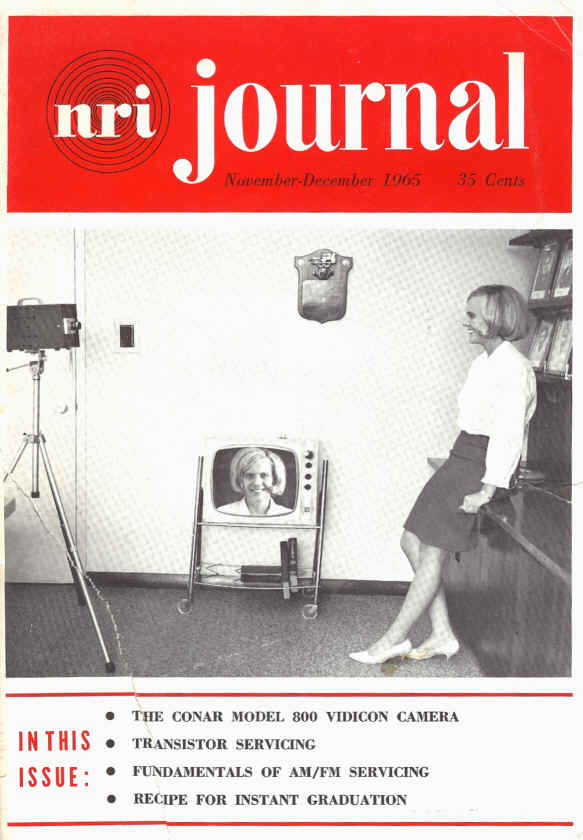
OPTIONAL ACCESSORIES: Wide Angle Lens; 12.5 mm, F 1.9, focusing 10' to infinity. Click stop to f22. $36.00 additional. Telephoto Lens: 50mm, f 1.9, focusing 2' to infinity, Click stop to f22. $28.00 additional. Professional type tripod with "C" mount. $21.00 additional. Complete camera also available factory assembled at $249.50. NOVEMBER/DECEMBER Published every other month by the National Radio Institute, 3939 Wisconsin Ave., N.W., Washington, D.C. 20016. Subscription $2.00 a year. Printed in U.S.A. Second class postage paid at Washington, D.C. Copyright 1965 by National Radio Institute. All rights reserved. 2. CONAR MODEL 800 CCTV CAMERA WILLIAM F. DUNN Editor and Publisher ALLENE MAGANN Managing Editor J.B. STRAUGHN Technical Editor T.E. ROSE Alumni News Editor Alice Buckingham of NRI's Student Service Department gets a preview of CONAR's new Model 800 Vidicon TV Camera (discussed in an article beginning on Page 3). She thought the idea was great, but that's not the only reason for the happy smile on her face: She had gotten her ring just before the picture was taken, and "I've been grinning all over all day!"
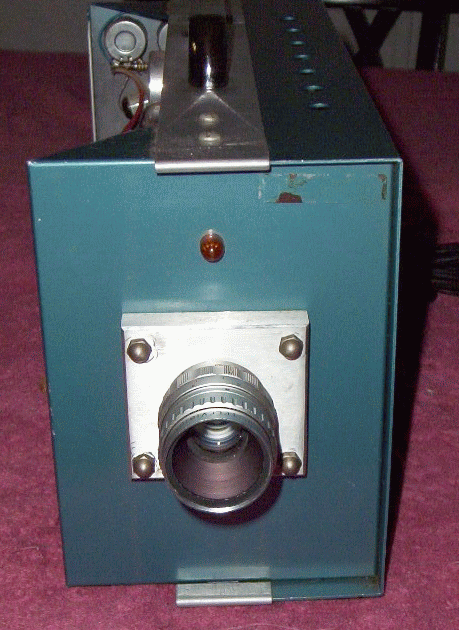
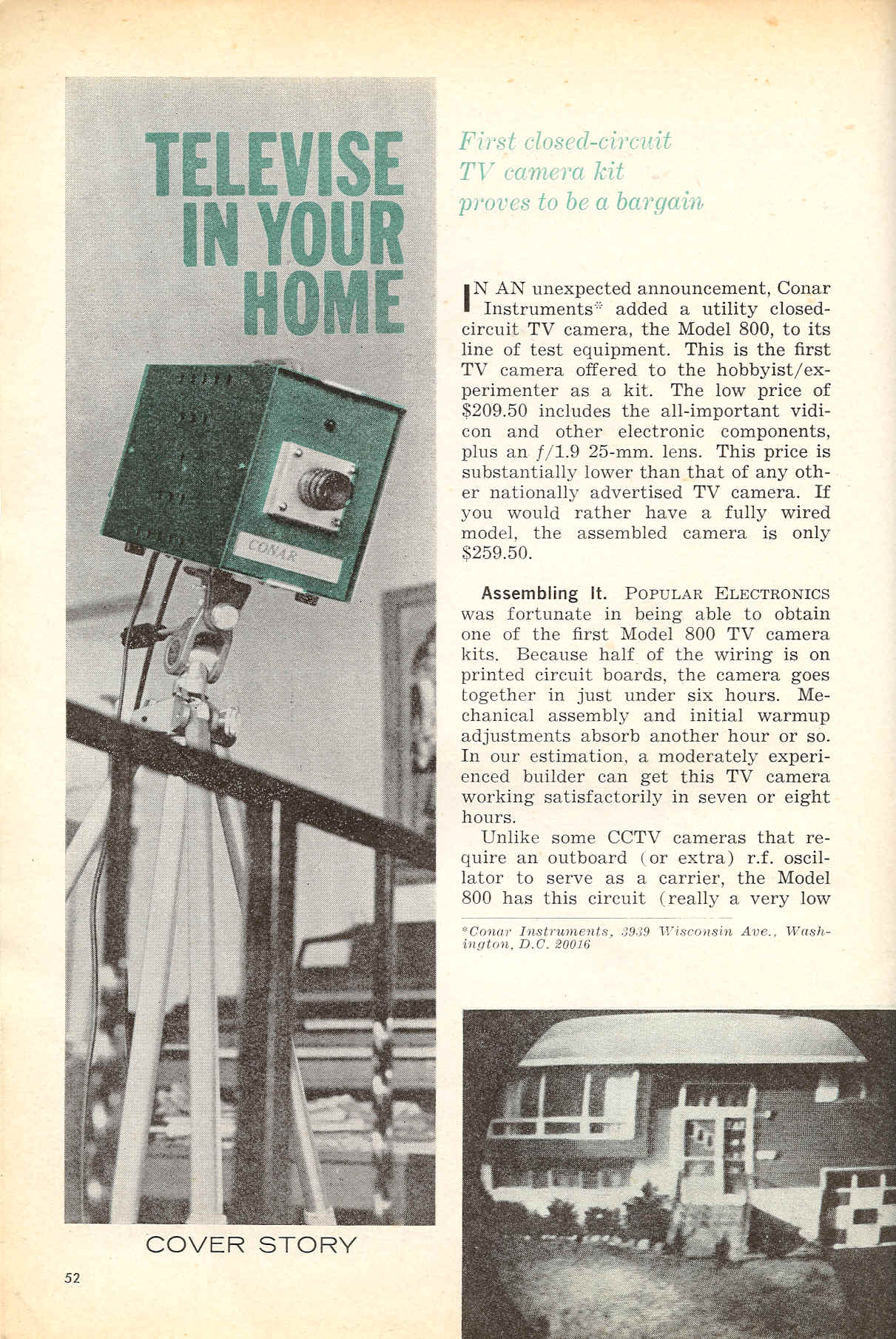
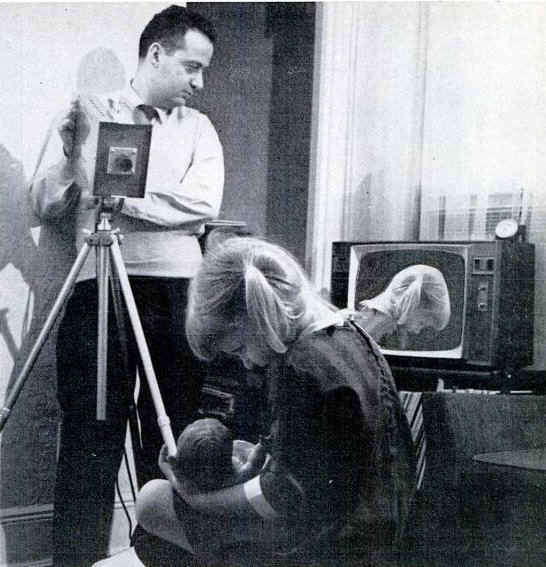
NEW CONAR MODEL 800 By ROBERT L. CARLSON Everybody knows what television is, of course, but what is closed-circuit television? Is it anything like "regular" TV? What is it used for? Is it expensive? Is it complicated? Before we specifically answer these questions by discussing the new CONAR Model 800 closed-circuit TV camera, let's answer the questions first in general terms. As you know, the TV signal you receive at home originates at a distance at the television station. The station broadcasts its programs to TV receivers in the area by means of radio waves. Closed-circuit TV, on the other hand, is sent directly from the camera to the receiver or receivers by a direct wire connection (usually a coaxial cable). There may be more than one receiver connected to the cable; however, the important thing here is that the camera signal is NOT broadcast--there is a closed (wire) circuit between the camera and receiver, hence the name closed-circuit TV. Closed-circuit TV (or CCTV for short) is very similar in many respects to "regular" TV. A visual image is scanned and transformed in a camera into an electrical signal and sent to a receiver where it is transformed back into a visual image. To do this, the CCTV signal must have sync and blanking signals like regular TV, and if standard TV receivers are to be used as receivers, or monitors, for CCTV, then the scanning rates must be the same for CCTV as for regular TV. The CCTV system, then, is a regular TV system in miniature, having a camera and a sync generator and the necessary amplifiers and mixers to produce a composite video signal. Some CCTV systems also include rf generators and a modulator, so the signal from the camera may be processed by a standard TV receiver merely by connecting a cable to the antenna terminals of the receiver. Other systems do not provide an rf signal and so must use either a special monitor receiver or special video connections to a standard receiver. CCTV was first used in industrial applications for observing various manufacturing operations and for security surveillance purposes. 2Gradually, other uses were found for CCTV. Banks use it for protection and signature verification, hospitals show patients their children on CCTV, drama schools use it to advantage for studying technique, hotels and apartments use CCTV in many ways for guest convenience, small businesses use it for shop protection and display purposes, and many other people use it in any number of ways for various surveillance jobs. At home, for example, CCTV makes an excellent baby sitter, door protector, or swimming pool guard. Portrait photographers use CCTV for "instant proofs "--even faster than Polaroid, and larger pictures, too. Until CONAR announced their Model 800 CCTV camera, CCTV systems would have to be classed as "rather expensive". Not the sort of thing one would REALLY use around the house or small shop. Prices, even for the SIMPLEST system, started at around the $400 level and went up--and up! A good quality industrial CCTV system could easily cost $10,000 or more, depending upon the number of cameras and receivers and the length of cable required. Today, the CONARModel800 CCTV camera at $249.50 assembled or $209.50 as a kit, represents the lowest priced Fig. 1. The CONAR Model 800 Vidicon TV Camera.
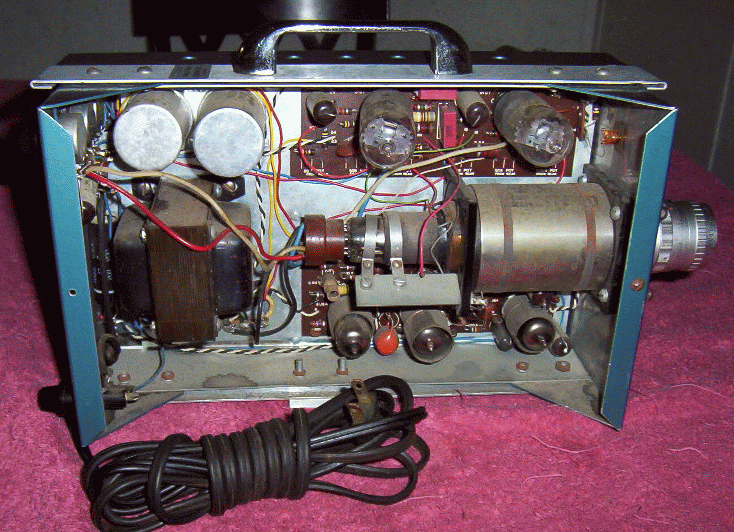
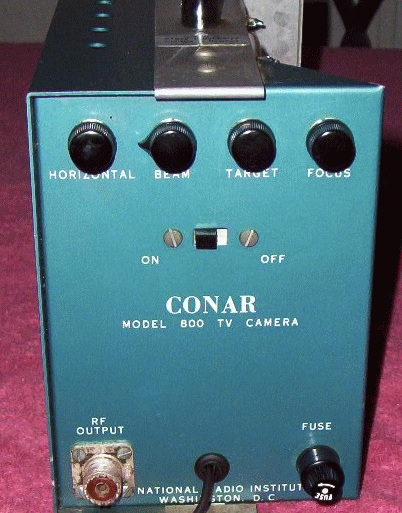
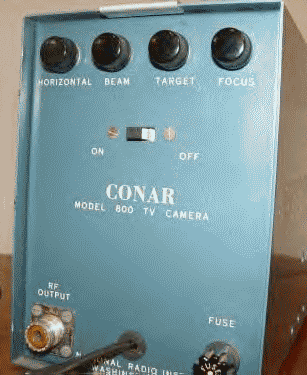
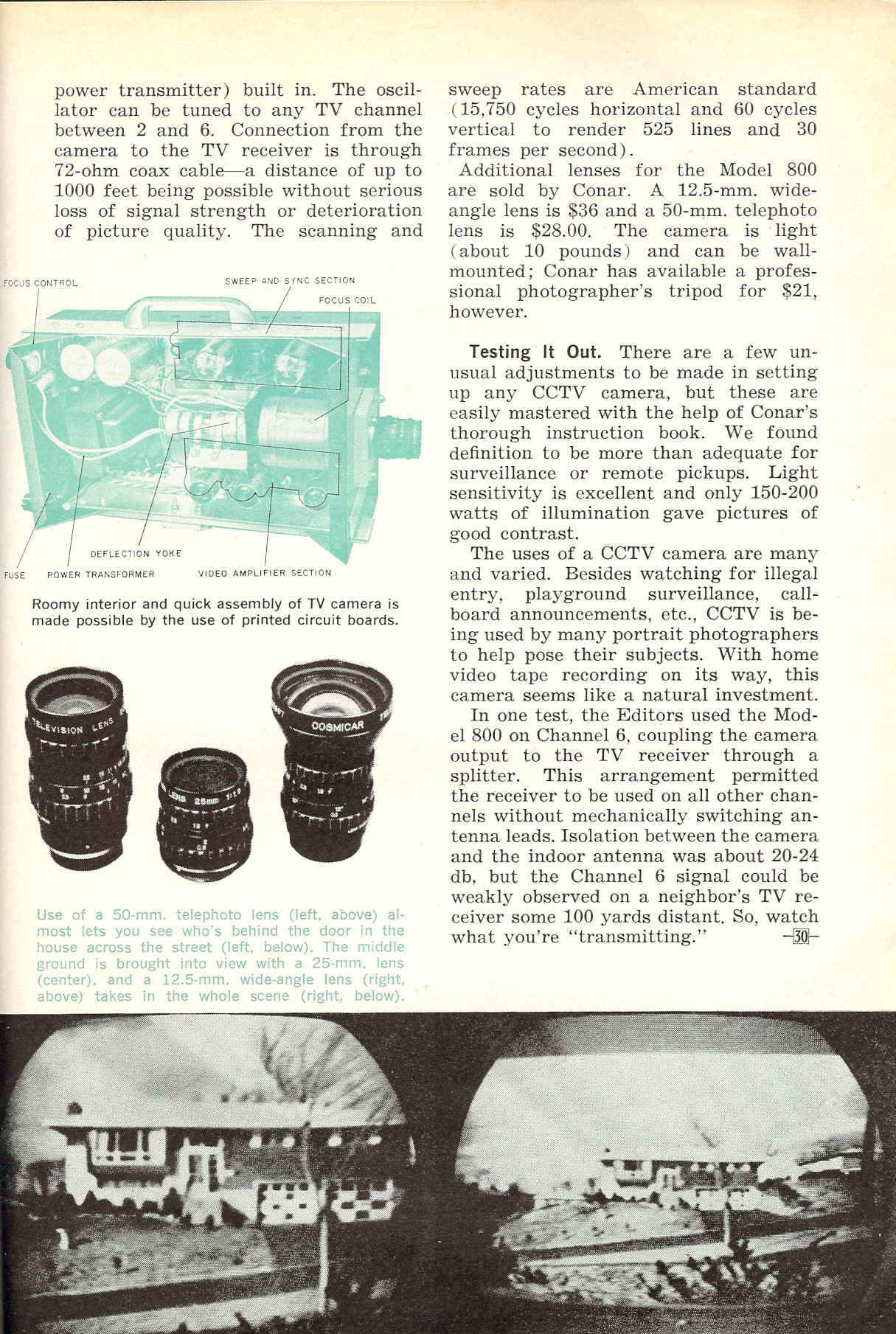
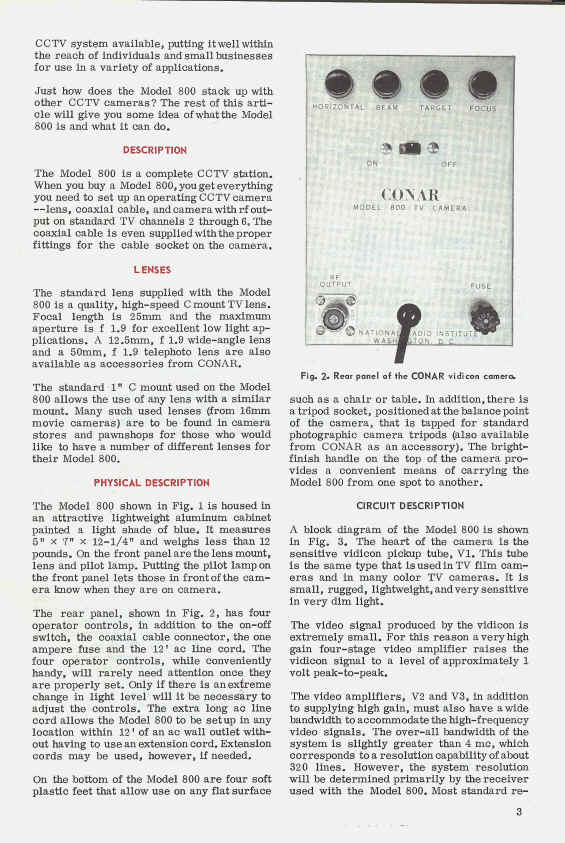
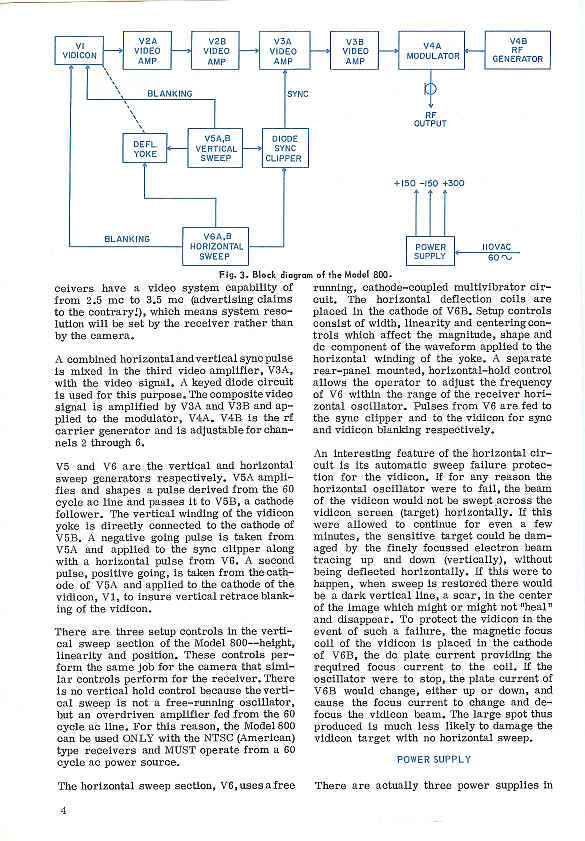
CCTV system available, putting it well within the reach of individuals and small businesses for use in a variety of applications. Just how does the Model 800 stack up with other CCTV cameras? The rest of this article will give you some idea of what the Model 800 is and what it can do. The Model 800 is a complete CCTV station. When you buy a Model 800, you get every thing you need to set up an operating CC TV camera --lens, coaxial cable, and camera with rf output on standard TV channels 2 through 6. The coaxial cable is even supplied with the proper fittings for the cable socket on the camera. The standard lens supplied with the Model 800 is a quality, high-speed C mount TV lens. Focal length is 25mm and the maximum aperture is f 1.9 for excellent low light applications. A 12.5mm, f 1.9 wide-angle lens and a 50mm, f 1.9 telephoto lens are also available as accessories from CONAR. The standard 1" C mount used on the Model 800 allows the use of any lens with a similar mount. Many such used lenses (from 16mm movie cameras) are to be found in camera stores and pawnshops for those who would like to have a number of different lenses for their Model 800. The Model 800 shown in Fig. 1 is housed in an attractive lightweight aluminum cabinet painted a light shade of blue. It measures 5" x '7" x 12-1/4" and weighs less than 12 pounds. On the front panel are the lens mount, lens and pilot lamp. Putting the pilot lamp on the front panel lets those in front of the camera know when they are on camera. The rear panel, shown in Fig. 2, has four operator controls, in addition to the on-off switch, the coaxial cable connector, the one ampere fuse and the 12 I ac line cord. The four operator controls, while conveniently handy, will rarely need attention once they are properly set. Only if there is an extreme change in light level will it be necessary to adjust the controls. The extra long ac line cord allows the Model 800 to be set up in any location within 12 I of an ac wall outlet without having to use an extension cord. Extension cords may be used, however, if needed. On the bottom of the Model 800 are four soft plastic feet that allow use on any flat surface Fig. 2. Rear panel of the CONAR vidicon camera. such as a chair or table. In addition, there is a tripod socket, positioned at the balance point of the camera, that is tapped for standard photographic camera tripods (also available from CONAR as an accessory). The bright finish handle on the top of the camera provides a convenient means of carrying the Model 800 from one spot to another. CIRCUIT DESCRIPTION A block diagram of the Model 800 is shown in Fig. 3. The heart of the camera is the sensitive vidicon pickup tube, V1. This tube is the same type that is used in TV film cameras and in many color TV cameras. It is small, rugged, lightweight, and very sensitive in very dim light. The video signal produced by the vidicon is extremely small. For this reason a very high gain four-stage video amplifier raises the vidicon signal to a level of approximately 1 volt peak-to-peak. The video amplifiers, V2 and V3, in addition to supplying high gain, must also have a wide bandwidth to accommodate the high-frequency video signals. The over-all bandwidth of the system is slightly greater than 4 mc, which corresponds to a resolution capability of about 320 lines. However, the system resolution will be determined primarily by the receiver used with the Model 800. Most standard re 3 Fig. 3. Block diagram of the Model 800. ceivers have a video system capability of from 2.5 mc to 3.5 mc (advertising
claims to the contrary!), which means system resolution will be set by the
receiver rather than by the camera. A combined horizontal and vertical sync pulse is mixed in the third video
amplifier, V3A, with the video signal. A keyed diode circuit is used for this
purpose. The composite video signal is amplified by V3A and V3B and applied to
the modulator, V4A. V4B is the rf carrier generator and is adjustable for
channels 2 through 6. V5 and V6 are the vertical and horizontal sweep generators respectively. V5A
amplifies and shapes a pulse derived from the 60 cycle ac line and passes it to
V5B, a cathode follower. The vertical winding of the vidicon yoke is directly
connected to the cathode of V5B. A negative going pulse is taken from V5A and
applied to the sync clipper along with a horizontal pulse from V6. A second
pulse, positive going, is taken from the cathode of V5A and applied to the
cathode of the vidicon, VI, to insure vertical retrace blanking of the vidicon. There are three setup controls in the vertical sweep section of the Model
800--height, linearity and position. These controls perform the same job for the
camera that similar controls perform for the receiver. There is no vertical hold
control because the vertical sweep is not a free-running oscillator, but an
overdriven amplifier fed from the 60 cycle ac line. For this reason, the
Model800 can be used ONLY with the NTSC (American) type receivers and MUST
operate from a 60 cycle ac power source. The horizontal sweep section, V6, uses a free running, cathode-coupled
multivibrator circuit. The horizontal deflection coils are placed in the cathode
of V6B. Setup controls consist of width, linearity and centering controls which
affect the magnitude, shape and dc component of the waveform applied to the
horizontal winding of the yoke. A separate rear-panel mounted, horizontal-hold
control allows the operator to adjust the frequency of V6 within the range of
the receiver horizontal oscillator. Pulses from V6 are fed to the sync clipper
and to the vidicon for sync and vidicon blanking respectively. An interesting feature of the horizontal circuit is its automatic sweep
failure protection for the vidicon. If for any reason the horizontal oscillator
were to fail, the beam of the vidicon would not be swept across the vidicon
screen (target) horizontally. If this were allowed to continue for even a few
minutes, the sensitive target could be damaged by the finely focussed electron
beam tracing up and down (vertically), without being deflected horizontally. If
this were to happen, when sweep is restored there would be a dark vertical line,
a scar, in the center of the image which might or might not "heal" and
disappear. To protect the vidicon in the event of such a failure, the magnetic
focus coil of the vidicon is placed in the cathode of V6B, the dc plate current
providing the required focus current to the coil. If the oscillator were to
stop, the plate current of V6B would change, either up or down, and cause the
focus current to change and defocus the vidicon beam. The large spot thus
produced is much less likely to damage the vidicon target with no horizontal
sweep. POWER SUPPLY There are actually three power supplies in 4
the Model 800 camera: +150v, +300v, and -15Ov. The +150v supply is the
workhorse supply and is used for the video amplifiers, rf generator and
modulator, and the horizontal oscillator. The +300v supply is used for the vertical sweep circuit and for the gun supply for the vidicon. The
-150v supply provides bias for the grid of the vidicon. All three supplies are
derived from a single untapped secondary winding on the power transformer. The
+150v supply is a husky halfwave rectifier circuit. The +300v supply is a
half-wave doubler in conjunction with the +150V supply, while the -150v supply
is yet another half-wave circuit. All three power supplies use silicon
rectifiers for improved efficiency and cooler operation of the camera. A
separate center-tapped 6.3v ac winding on the power transformer supplies
balanced ac for the filaments of all tubes. Operating the Model 800 is very simple; a few minutes' practice will make
anyone an expert. After the initial sweep adjustments and channel selection
(preset at the factory on assembled units) have been made, there are only four
operator controls to be concerned with. Actually, once these have been set for
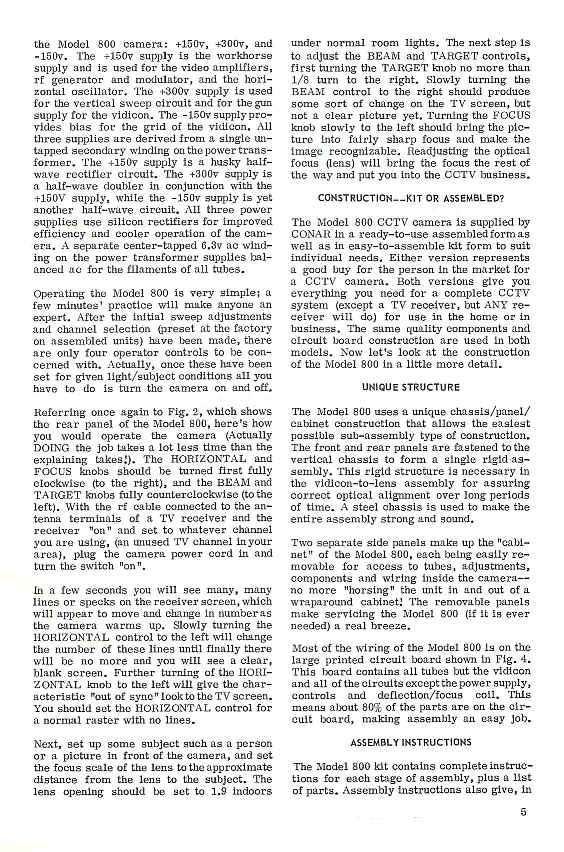
given light/subject conditions all you have to do is turn the camera on and off. Referring once again to Fig. 2, which shows the rear panel of the Model 800,
here's how you would operate the camera (Actually DOING the job takes a lot less
time than the explaining takes!). The HORIZONTAL and FOCUS knobs should be turned first fully clockwise (to the right), and the
BEAM and TARGET knobs fully counterclockwise (to the left). With the rf cable
connected to the antenna terminals of a TV receiver and the receiver
"on" and set to whatever channel you are using, (an unused TV channel
in your area), plug the camera power cord in and turn the switch "on
". In a few seconds you will see many, many lines or specks on the receiver
screen, which will appear to move and change in number as the camera warms up.
Slowly turning the HORIZONTAL control to the left will change the number of
these lines until finally there will be no more and you will see a clear, blank
screen. Further turning of the HORIZONTAL knob to the left will give the
characteristic "out of sync "look to the TV screen. You should set the
HORIZONTAL control for a normal raster with no lines. Next, set up some subject such as a person or a picture in front of the
camera, and set the focus scale of the lens to the approximate distance from the
lens to the subject. The lens opening should be set to 1.9 indoors under normal room lights. The next step is to adjust the BEAM and TARGET
controls, first turning the TARGET knob no more than 1/8 turn to the right.
Slowly turning the BEAM control to the right should produce some sort of change
on the TV screen, but not a clear picture yet. Turning the FOCUS knob slowly to
the left should bring the picture into fairly sharp focus and make the image
recognizable. Readjusting the optical focus (lens) will bring the focus the rest
of the way and put you into the CCTV business. CONSTRUCTION KIT OR ASSEMBLED? The Model 800 CCTV camera is supplied by CONAR in a ready-to-use assembled
form as well as in easy-to-assemble kit form to suit individual needs. Either version
represents a good buy for the person in the market for a CCTV camera. Both
versions give you everything you need for a complete CCTV system (except a TV
receiver, but ANY receiver will do) for use in the home or in business. The same
quality components and circuit board construction are used in both models. Now
let's look at the construction of the Model 800 in a little more detail. UNIQUE STRUCTURE The Model 800 uses a unique chassis/panel/ cabinet construction that allows
the easiest possible sub-assembly type of construction. The front and rear
panels are fastened to the vertical chassis to form a single rigid assembly.
This rigid structure is necessary in the vidicon-to-lens assembly for assuring
correct optical alignment over long periods of time. A steel chassis is used to
make the entire assembly strong and sound. Two separate side panels make up the "cabinet" of the Model 800,
each being easily removable for access to tubes, adjustments, components and
wiring inside the camera-no more "horsing" the unit in and out of a
wraparound cabinet! The removable panels make servicing the Model 800 (if it is
ever needed) a real breeze. Most of the wiring of the Model 800 is on the large printed circuit board
shown in Fig. 4. This board contains all tubes but the vidicon and all of the
circuits except the power supply, controls and deflection/focus coil. This means
about 80% of the parts are on the circuit board, making assembly an easy job. ASSEMBLY INSTRUCTIONS The Model 800 kit contains complete instructions for each stage of assembly,
plus a list of parts. Assembly instructions also give, in 5 detail procedures for making initial tests and adjustments of the various circuits. Detailed operating instructions are
given in a separate manual which is also supplied with the Fig. 4. Circuit board for the Model 800. factory-wired Model 800 camera. The table below lists some of the specifications of the CONAR Model 800 CCTV
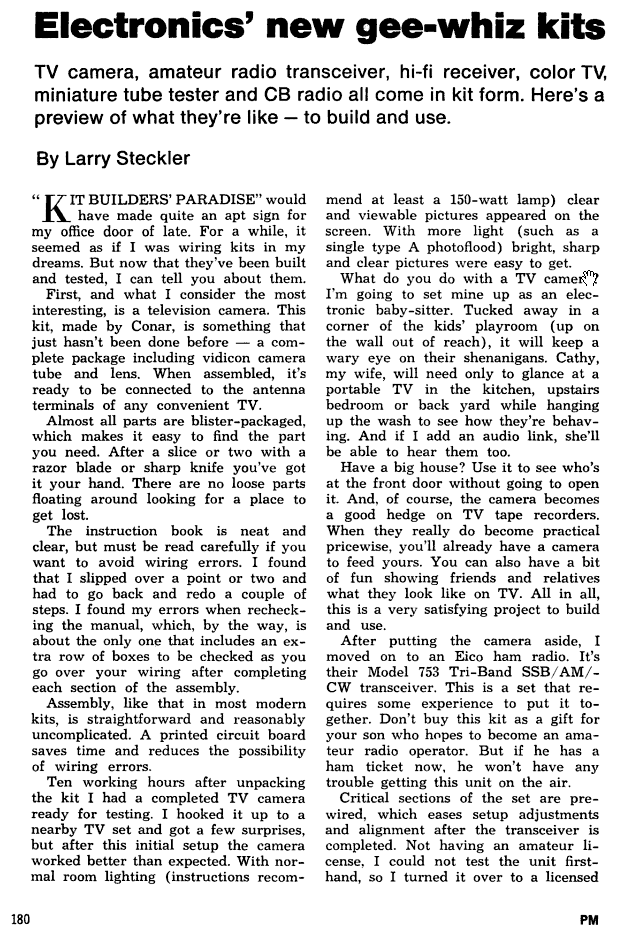
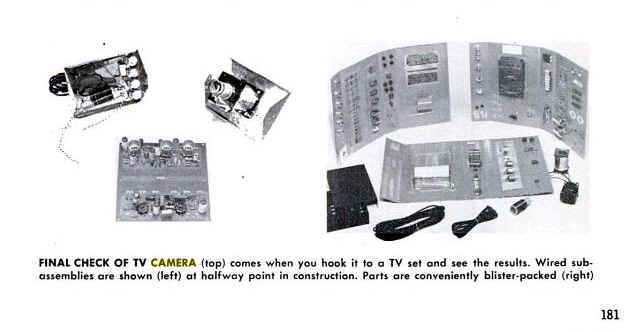
Camera: Popular Mechanics May 1966
|
||||||||||||||||||
|
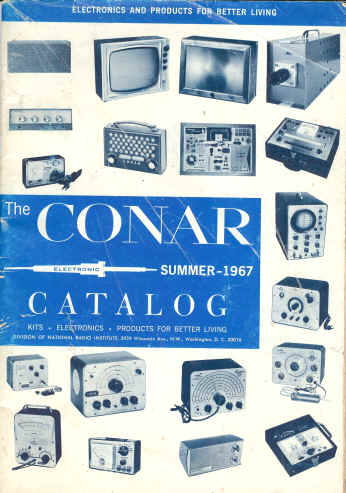
NRI CONAR SUMMER 1967 CATALOG |
|
|||||||||||||||||
|
CONAR |
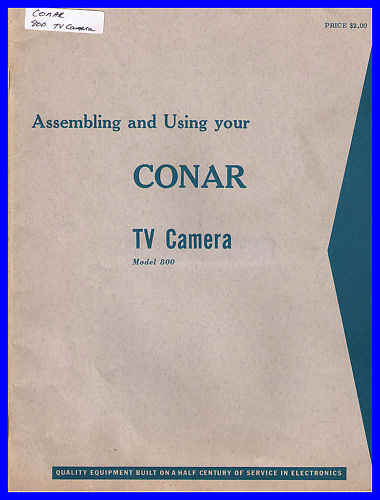
We have found a manual! It is on a separate page... HERE! |
|||||||||||||||||
| Need
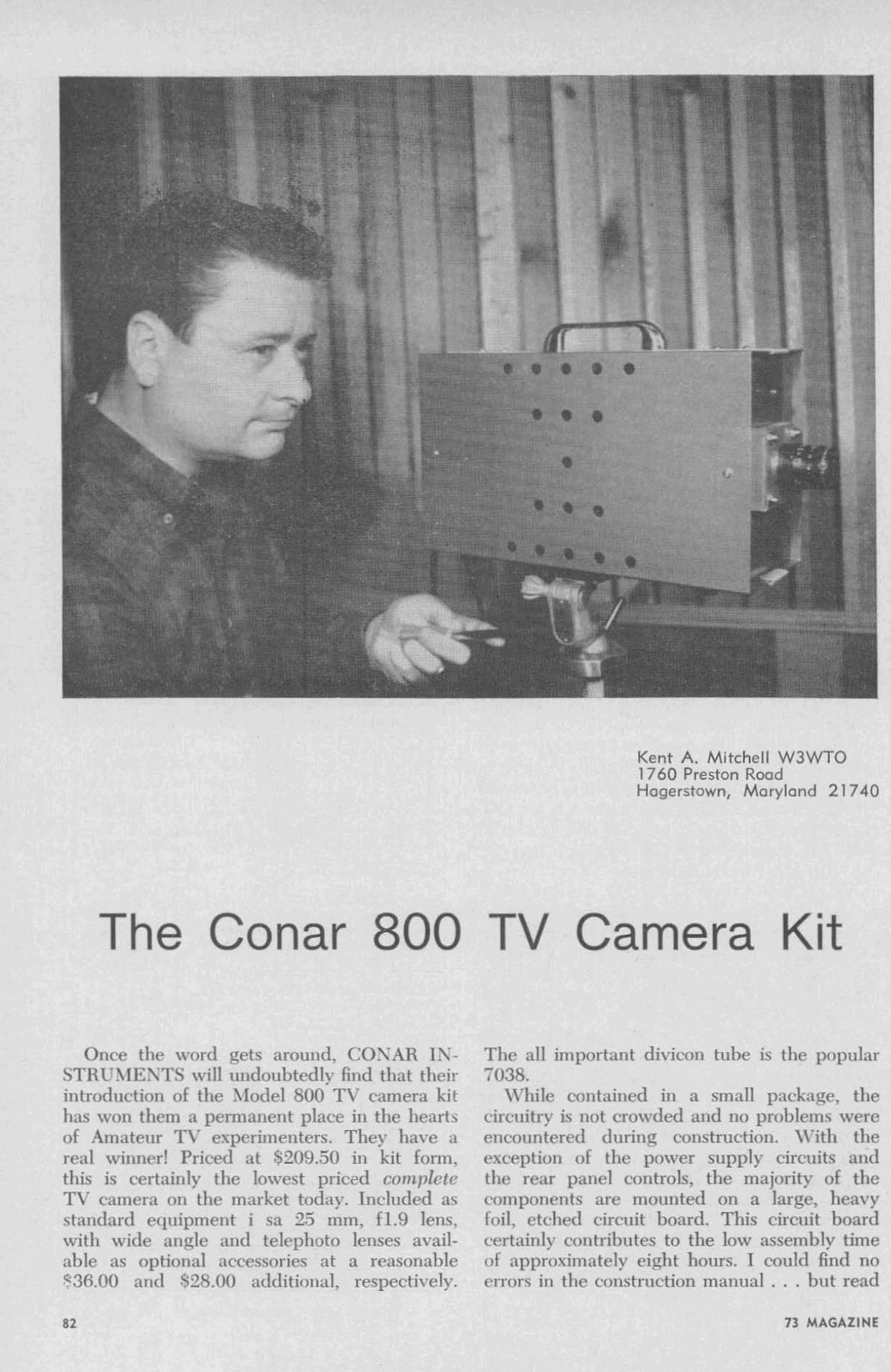
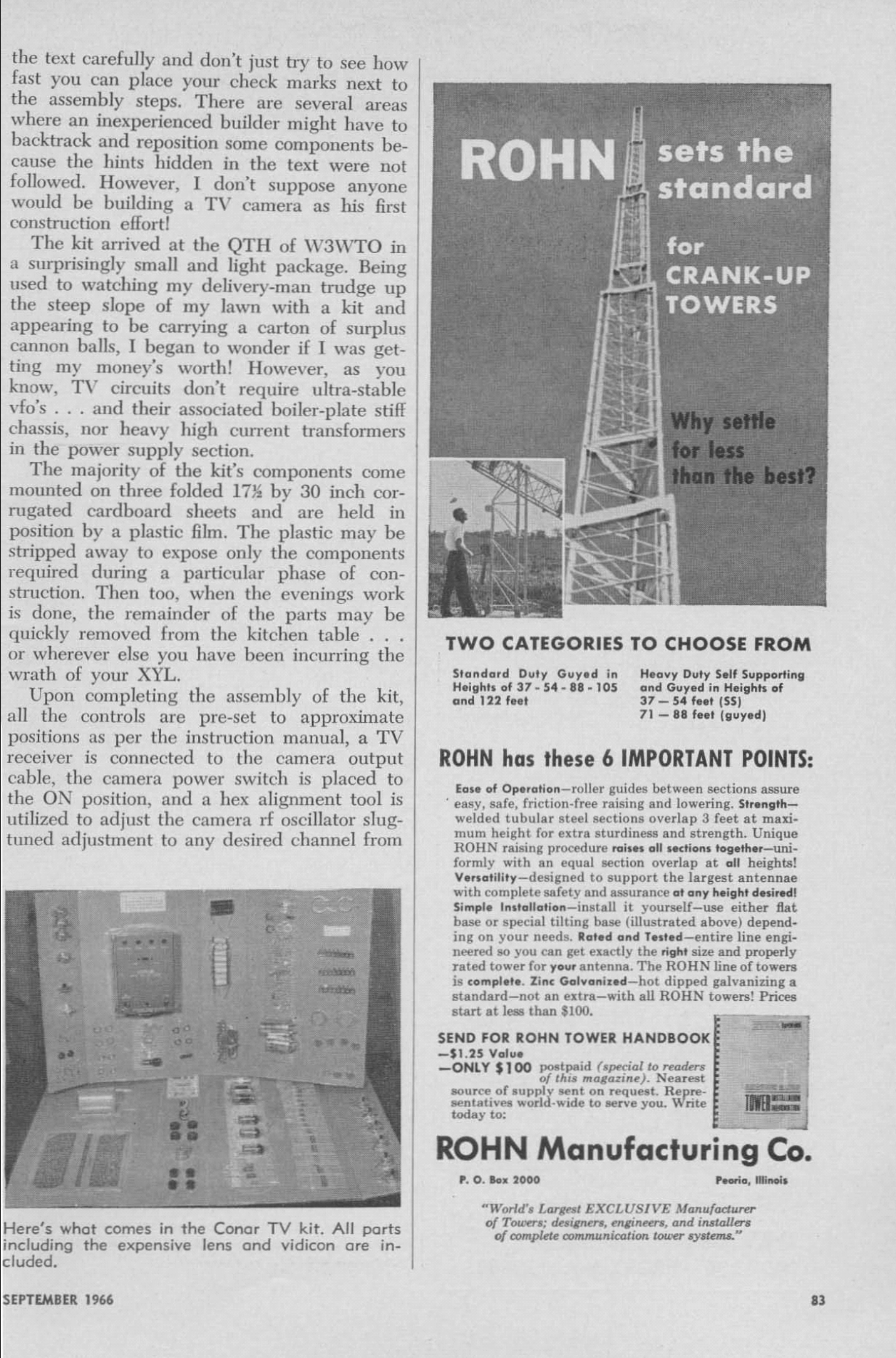
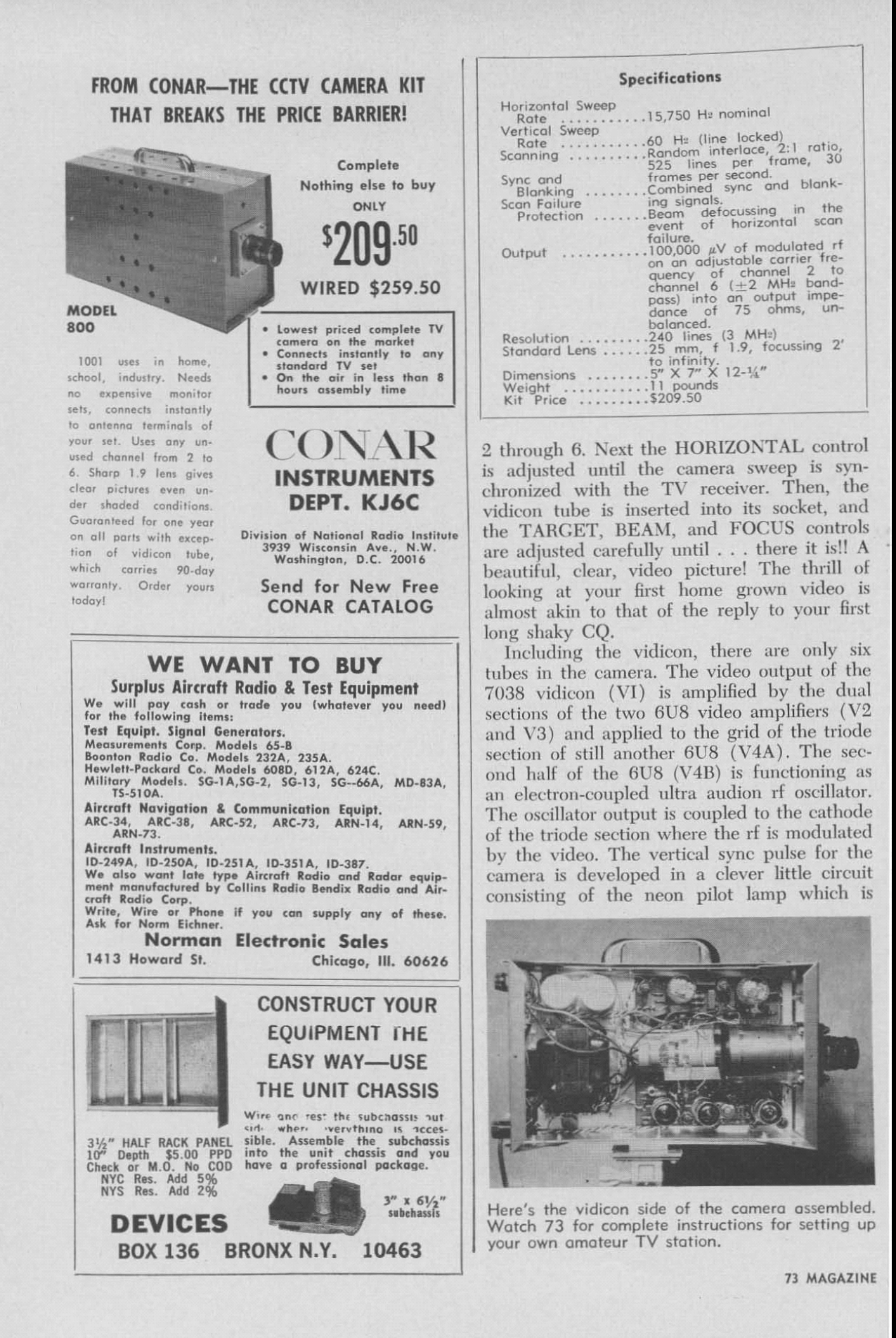
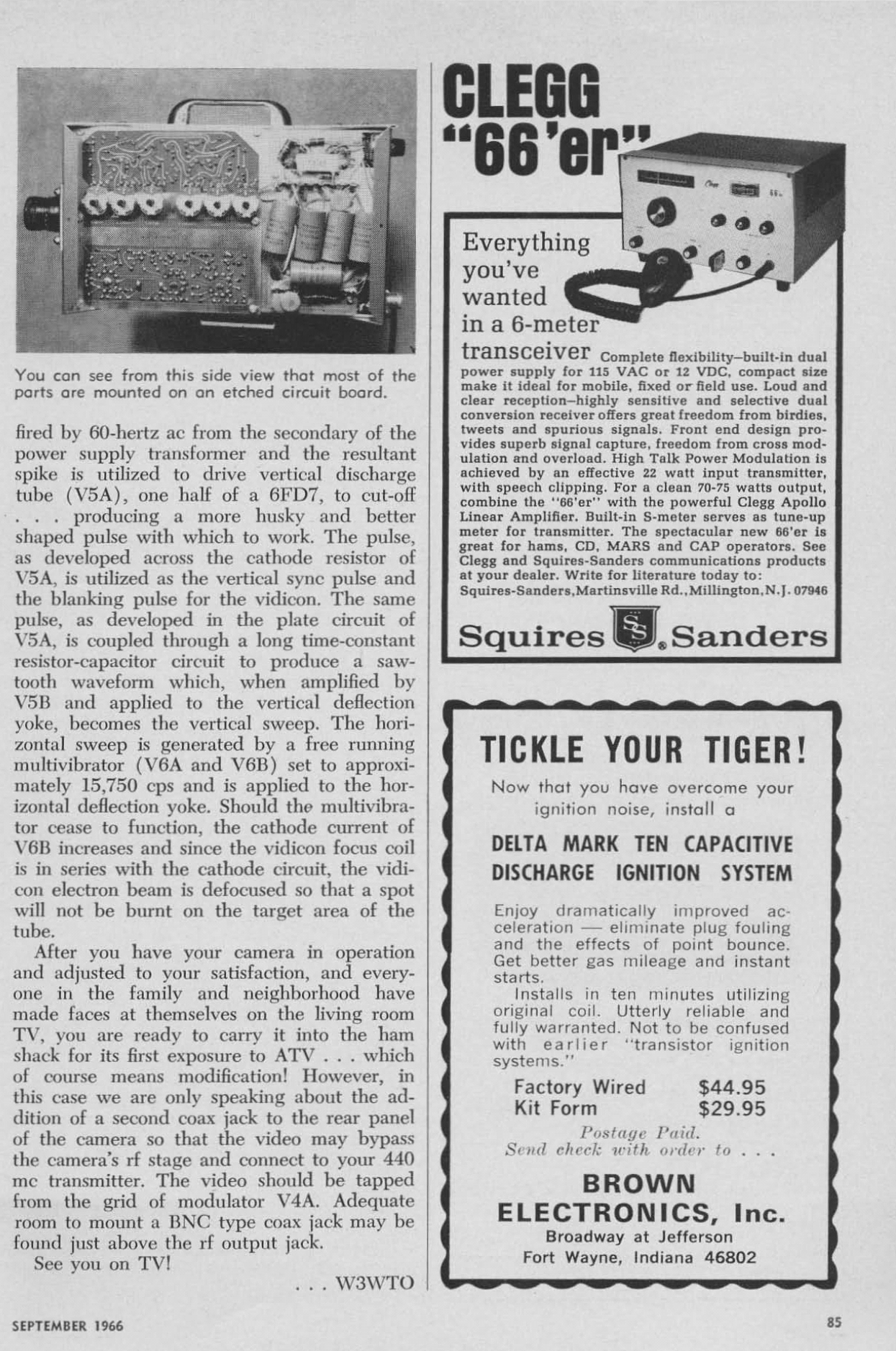
Sep 1966 73 Magazine CONAR TV CAMERA ARTICLE |
|
|||||||||||||||||
|
OTHER
|
Beukit Closed Circuit
But... Before the Conar 800 offering in 1966, Oct. 1965, Popular Science had the Beukit Closed Circuit TV Camera. See more HERE
|
|||||||||||||||||
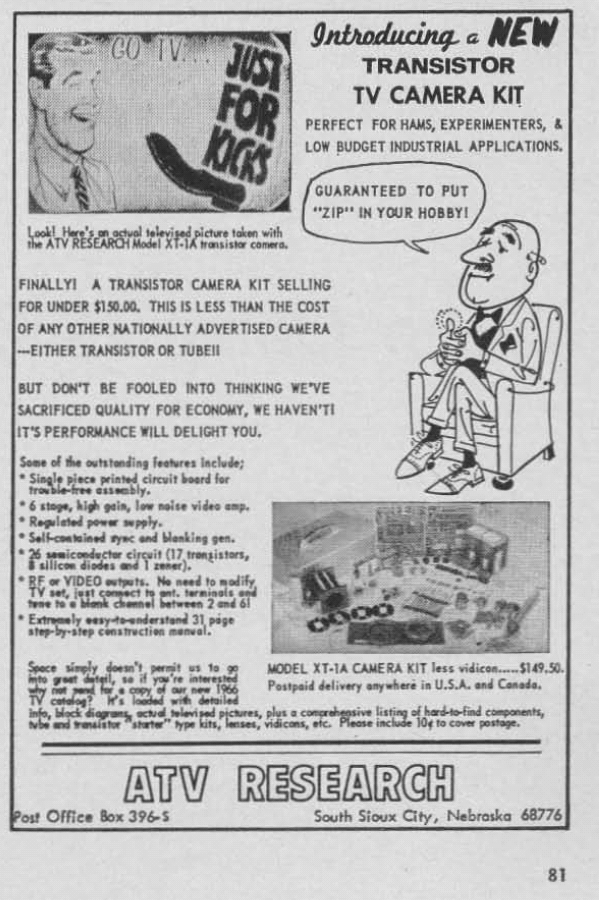
| ATV Research
1964-current |
ATV Research - 1964 ATV Research was originally founded in 1964 by Mel Shadbolt and Richard Wright, both of whom were engineers for a local NBC affiliated TV station, KTIV-TV Ch. 4. It later became incorporated in the early '80s.
Business, some 46 years later, still carries our same major
goals...GOOD, FRIENDLY, HONEST, FAST SERVICE...at discount
prices...that's our goal - ALWAYS! Welcome to the ATV
Research "Family" ...we look forward to serving you for
years to come.
Mel Shadbolt, Pres.,
Opal Shadbolt, Vice-Pres.
Scott Shadbolt, Vice-Pres.
© ATV Research Inc. 1996-2010 All Rights Reserved.
From - http://www.atvresearch.com/about-us.aspx
This add is from 73- 1966 sept. |
|||||||||||||||||